|
|
|
.So, we made very good time even though the wind was blowing upstream the first day. We camped in the same spot as we had on the previous trip. We could tell that it had had a lot of visitors since we had last been there. Some of the vegetation was trampled and new trails up from the beach had emerged. Anyone who thinks that rafting, hiking, biking, etc. doesn't have an impact on the river corridor is fooling themselves. We do impact these places. We need to be as careful as we can be so that the next boating party down the river has the illusion that they are discovering the river for the first time.
On
the third day, the sun came out and we were on the river again. We
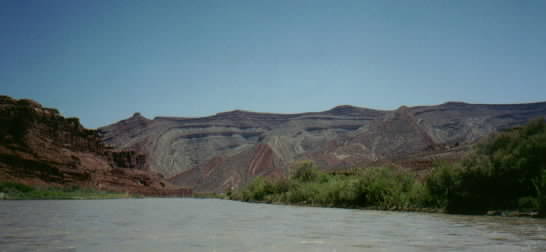
headed down toward Mexican Hat and the Raplee Anticline. A
beautiful thing about the west is that the erosional and geological
processes are not obscured by vegetation. The Raplee Anticline is
really a big bulge in the earth. What you see in the picture below
is the erosion of one side of the bulge. It's really very
spectacular and gives you a real sense of the earth bending. You
know that the bend means some of those layers you see off in the
distance are below you right now, which means that all the earth in
between you and those layers has already eroded off the anticline in
front of you.
A little further on, you come to the goosenecks of the San Juan River. Basically, the story is that the San Juan river used to roll back and forth across a shallow plain, much like the Mississippi River does today. As the earth lifted due to tectonic forces, the river kept its same course, but it dug in a bit, then a bit more and finally you have firmly entrenched meanders. |
||