|
 |
|
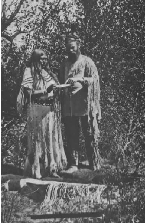 John
Wesley Powell was a Civil War Veteran. He lost his arm during
the war. He was very interested in Geology. So he comes out
west. He recruits a bunch of guys and proceeds to run down the
Colorado River from Green River, Wyoming through the Grand Canyon. John
Wesley Powell was a Civil War Veteran. He lost his arm during
the war. He was very interested in Geology. So he comes out
west. He recruits a bunch of guys and proceeds to run down the
Colorado River from Green River, Wyoming through the Grand Canyon.
This is back before rafts were even a dream. The lifejackets used cork as floatation. They carried food with them, but it's not in the convenient plastic preservative wrapping we have today. The flour goes moldy, the bacon gets rancid. They are using a rowboat and rowing downstream with their backs to what's coming. It isn't until later that a gentleman named Nathaniel Galloway starts to run rivers that the row boat is turned around with the stern facing downstream which gives the rower an actual view of what's coming and also allows him to row upstream to counter the downstream current. The boats they have, have a closed deck which helps. And ole J.W. bolts a chair to the top of the boat and commands his boat and the others with flags. Imagine, this one armed guy, sitting on top of a boat, running rapids. Well, they didn't run them all. Often they would portage - unpack everything, drag the boat down the shore past the rapid and then reload everything. This usually was a very, very slow and painful process. The other method they used was to line the boats. This meant one guy would walk down the river bank with a rope in his hand and they would give the boat a shove out into the current where it would rush down past the guy with the rope and he would swing it back into shore. That was the theory anyway. Well, J.W. falls in love with the west. The geology is exposed for everyone to see. It really is awesome and makes it interesting even if you don't like geology. You can fairly see the earth moving out west. He gets in pretty good with the Native Americans in the area and runs the Bureau of Indian Affairs (I think) for a while. He becomes a U.S. Senator and purposes that states in the west be set up along watersheds rather than by some arbitrary straight line. The reason for this is he knows that water is scarce and he figures that you can prevent a lot of arguing over water if it's all controlled within one state. So you'd have the Columbia River Basin, the Colorado, the Rio Grande and then a few coastal ones. But that idea doesn't happen and you have a lot of states fighting each other and mostly California for water. And then you have a whole bunch of dams on the river to hoard and redirect it. It's not a very natural way for the river to be and wouldn't be as necessary if the states were organized along watersheds. The other problem is that the government gave all this land to railroad companies who built railroads and then told everyone back east that there is plenty of rain and sunshine for farming. The people come out. Their farms don't do too well. They don't pay off their loans from local banks who had borrowed the money from banks back east who don't get paid back and whamo you have a depression on your hands. So... in order that people can farm and pay off their loans and not starve to death, the government starts putting up lots of dams to store the water. This leads to a western philosophy of water conservation that says all water must be used. Whereas back east, water conservation means keeping the water in a natural state. The western philosophy is only too glad to see big rivers like the Colorado never reach the sea. Well, that's why the Lake should be named after Dominy and not Powell; in my opinion. |
||