Not long
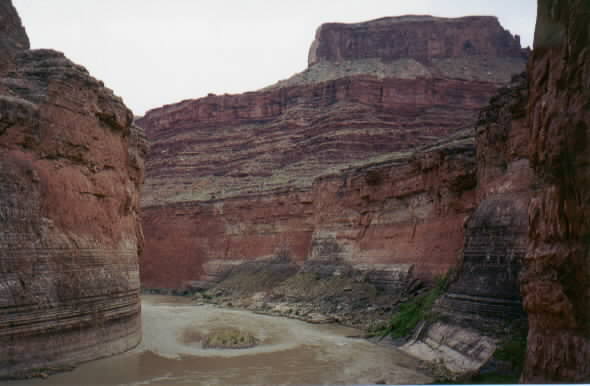
after you leave the put in, the river begins to grind down into the
canyon. You have lots of different layers of stone and within a
couple miles you are hundreds of feet deep in the canyon. The
thing is though, that you kind of forget that you are in the Grand
Canyon. All you have are the walls around you that you can
see. There are big but it's far more intimate than when you stand
at the top of the canyon and look the full 10 miles across it.
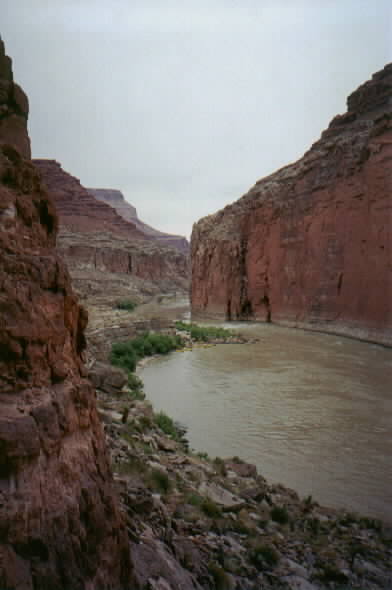
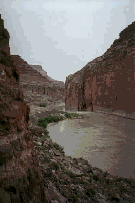 In
the picture to the left, the river is flowing toward you. It gets
pinched by the bit of land sticking out into the river (just about in
the center of the picture). When you get that kind of pinching,
you get rapids followed in this case by an eddy on river right.
River right means as you are looking downstream, the side of the river to
your right). That's where camp was set up. This picture is
looking up river from Stanton's Cave.
In
the picture to the left, the river is flowing toward you. It gets
pinched by the bit of land sticking out into the river (just about in
the center of the picture). When you get that kind of pinching,
you get rapids followed in this case by an eddy on river right.
River right means as you are looking downstream, the side of the river to
your right). That's where camp was set up. This picture is
looking up river from Stanton's Cave.
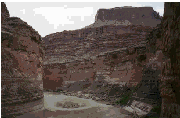 Angie,
Greg (Basel), Tom (Basel) and I used to go exploring pretty much any
chance we got. I guess to us it seemed like such a special place
and such a rare opportunity that we wanted to see as much as we possibly
could while our bodies held out. By this time, Angie and I had
been rafting quite a bit and were in pretty good shape, but there were
definitely days when we took it easy. But we got pretty antsy
about taking it easy. A scramble up some rocks got us to Stanton's
Cave. The cave mouth is sealed off with bars to protect Mexican
Free-tailed bats which are endangered. Regardless of the species,
bats are easily disturbed by humans and each time they are disturbed,
they lose a bit of energy. If you can go down to the store and
grab a Snicker's bar, this isn't a problem, but bats feed all night and
conserve energy all day so disruptions can tax them very hard.
Bats are good animals, especially if you like to be outside as they
devour tons of mosquitoes.
Angie,
Greg (Basel), Tom (Basel) and I used to go exploring pretty much any
chance we got. I guess to us it seemed like such a special place
and such a rare opportunity that we wanted to see as much as we possibly
could while our bodies held out. By this time, Angie and I had
been rafting quite a bit and were in pretty good shape, but there were
definitely days when we took it easy. But we got pretty antsy
about taking it easy. A scramble up some rocks got us to Stanton's
Cave. The cave mouth is sealed off with bars to protect Mexican
Free-tailed bats which are endangered. Regardless of the species,
bats are easily disturbed by humans and each time they are disturbed,
they lose a bit of energy. If you can go down to the store and
grab a Snicker's bar, this isn't a problem, but bats feed all night and
conserve energy all day so disruptions can tax them very hard.
Bats are good animals, especially if you like to be outside as they
devour tons of mosquitoes.
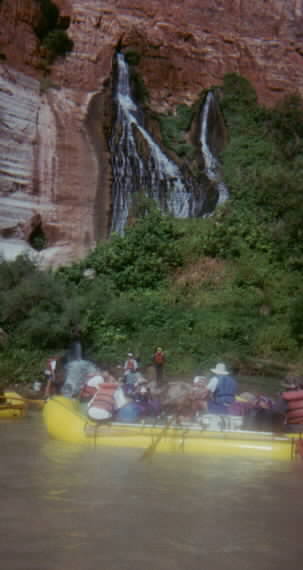
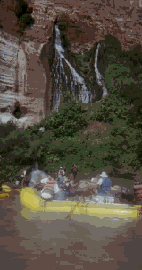 Just downstream from our camp by Stanton's Cave is a place called
Vasey's Paradise. George Vasey was a botanist who was on previous(non-river)
expeditions with Powell. What happens in the Grand Canyon as a
whole is that the land is sloped gently from north to south. The
north rim is higher than the south rim by a thousand feet or so.
What the sloping does then is allow under ground pockets of water to
drain from the north to the south and so those pockets on the north side
of the river flow to the walls north of the river and emerge from the rock as
springs. Vasey's is one of the first big ones you come to.
The water flows right out of the wall. And this water makes an
oasis of maiden hair ferns. Stanton's Cave was in the past also a
spring like this but the spring moved and now Stanton's is just a cave.
Just downstream from our camp by Stanton's Cave is a place called
Vasey's Paradise. George Vasey was a botanist who was on previous(non-river)
expeditions with Powell. What happens in the Grand Canyon as a
whole is that the land is sloped gently from north to south. The
north rim is higher than the south rim by a thousand feet or so.
What the sloping does then is allow under ground pockets of water to
drain from the north to the south and so those pockets on the north side
of the river flow to the walls north of the river and emerge from the rock as
springs. Vasey's is one of the first big ones you come to.
The water flows right out of the wall. And this water makes an
oasis of maiden hair ferns. Stanton's Cave was in the past also a
spring like this but the spring moved and now Stanton's is just a cave.