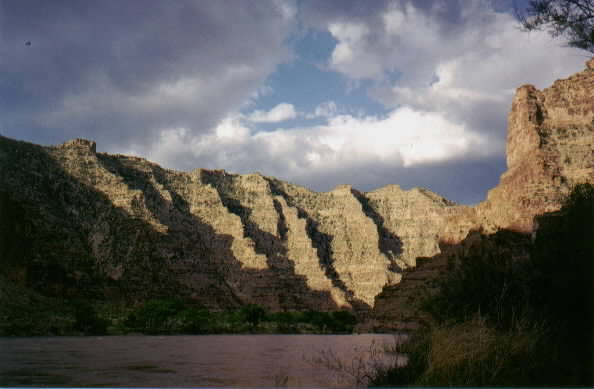
 So
the old pattern of river travel sets in quickly. Wake up, make
breakfast, put everything away, load the boat, shove off, and paddle,
stop for lunch or side canyon hikes, shove off and paddle some more,
stop for the day, unload the boats, set up the groover, tents and
kitchen. Not a bad life if you ask me.
So
the old pattern of river travel sets in quickly. Wake up, make
breakfast, put everything away, load the boat, shove off, and paddle,
stop for lunch or side canyon hikes, shove off and paddle some more,
stop for the day, unload the boats, set up the groover, tents and
kitchen. Not a bad life if you ask me.
We hike up Rock Creek Canyon where there
are some more petroglyphs. It's a nice hike up and along the way
you can see a section of vegetation that had been burned about a month
ago. On the way backto the boat, we stopped and soaked our feet
and heads in the cool water of Rock Creek. Cold, clear water is
something you really enjoy on a hot day!
So the river is working its magic
again. We are all happy to be paddling, eating, and sleeping.
 Around
this time, I got onboard Don's boat to see what the trouble was.
In the first two strokes, I knew what the problem was. Oars on a
boat can be either freely rotating or they can have what are called oar
rights. Oar rights keep the oars at a certain angle to the oar
locks. Don's boat had oar rights. Basically, when you mount
the oars in the oar rights, you want the paddle to be perpendicular to
the water. This puts the most power from the oars into the
water. If you have the oar rotated either way from perpendicular,
it pusshes water up or down but not back and forth. So it's like
shoveling snow all day and you don't get aanywhere. This was the
problem. The next morning, we backed out the screws holding the
oar rights in place and set the oars to the right angle. We were
getting into the first rapids and I felt it would be a good idea to
coach Don a bit. This meant that Angie had to captain the
raft. She was nervous at first but she warmed to the job and was
reluctant to give up command afterward.
Around
this time, I got onboard Don's boat to see what the trouble was.
In the first two strokes, I knew what the problem was. Oars on a
boat can be either freely rotating or they can have what are called oar
rights. Oar rights keep the oars at a certain angle to the oar
locks. Don's boat had oar rights. Basically, when you mount
the oars in the oar rights, you want the paddle to be perpendicular to
the water. This puts the most power from the oars into the
water. If you have the oar rotated either way from perpendicular,
it pusshes water up or down but not back and forth. So it's like
shoveling snow all day and you don't get aanywhere. This was the
problem. The next morning, we backed out the screws holding the
oar rights in place and set the oars to the right angle. We were
getting into the first rapids and I felt it would be a good idea to
coach Don a bit. This meant that Angie had to captain the
raft. She was nervous at first but she warmed to the job and was
reluctant to give up command afterward.
So as Don and I went downriver, we talked
about dangers on the river - strainers (anything sticking in the river
which acts like a sieve allowing water to pass through but solides like
a body to stay trapped behind), holes (where water pours over rocks and
sets up a back wash of water that can keep you tumbling over and
over). We talked about the mechanics of the river, the several
causes of rapids, eddies, and how to handle the boat in each of these
situations. He made great progress, though one time, we were swept
over a rock and into the hole behind it. I can tell you now that a
cataraft is a very stable type of boat.
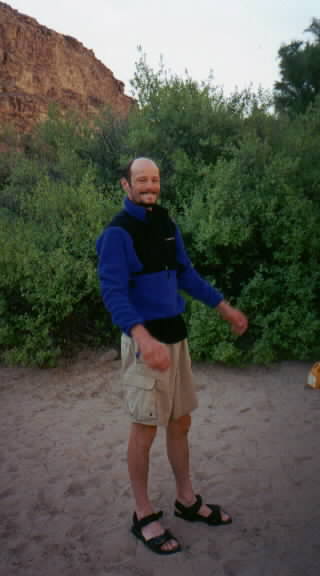
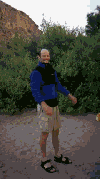 Alex
(seen to the left here) works for the National Park Service at
Florrisant Fossil Beds National Monument. He hales from Hoo Hoo
Holler in West Virginia. His southern drawl was a source of much
amusement and imitations. His great sense of humor and desire to
make things happen was a great asset to the trip. He took his
inflatable kayak through a lot of stuff that I thought might be too big,
but he took it all in stride and had no difficulties at all.
Alex's wife, Cheryl, was pretty impressive in her kayak and was an
extremely welcome addition on the raft when she was aboard it. She
said something about doing 200 sit-ups a day, which I have have no doubt
of.
Alex
(seen to the left here) works for the National Park Service at
Florrisant Fossil Beds National Monument. He hales from Hoo Hoo
Holler in West Virginia. His southern drawl was a source of much
amusement and imitations. His great sense of humor and desire to
make things happen was a great asset to the trip. He took his
inflatable kayak through a lot of stuff that I thought might be too big,
but he took it all in stride and had no difficulties at all.
Alex's wife, Cheryl, was pretty impressive in her kayak and was an
extremely welcome addition on the raft when she was aboard it. She
said something about doing 200 sit-ups a day, which I have have no doubt
of.
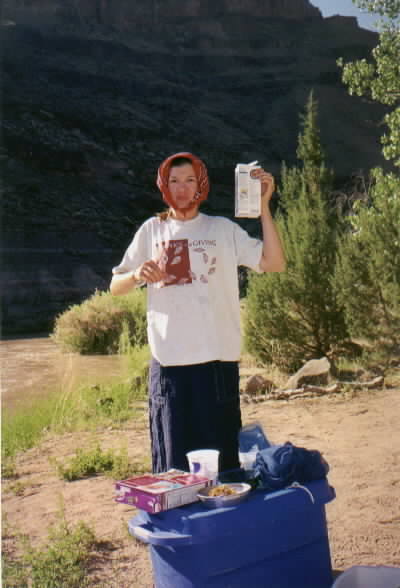 So
the old pattern of river travel sets in quickly. Wake up, make
breakfast, put everything away, load the boat, shove off, and paddle,
stop for lunch or side canyon hikes, shove off and paddle some more,
stop for the day, unload the boats, set up the groover, tents and
kitchen. Not a bad life if you ask me.
So
the old pattern of river travel sets in quickly. Wake up, make
breakfast, put everything away, load the boat, shove off, and paddle,
stop for lunch or side canyon hikes, shove off and paddle some more,
stop for the day, unload the boats, set up the groover, tents and
kitchen. Not a bad life if you ask me.