| Geography |
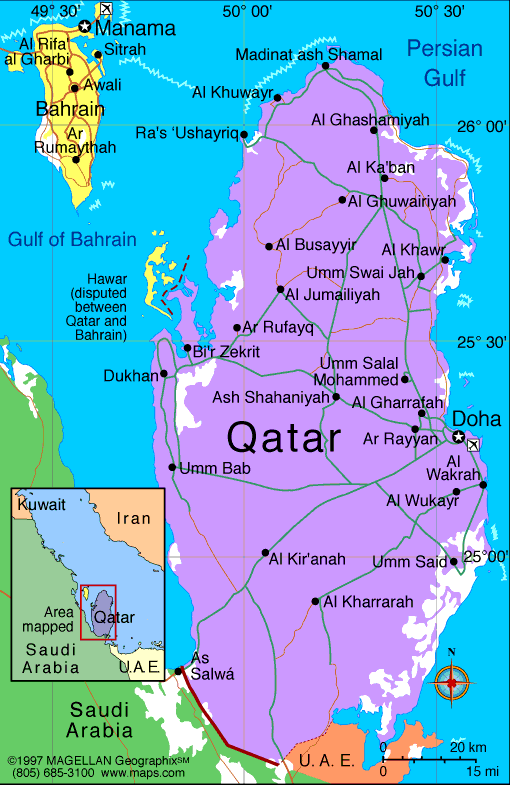
| Location: Middle East, peninsula bordering the Persian Gulf and Saudi Arabia |
| Geographic coordinates: 25 30 N, 51 15 E |
| Map references: Middle East |
| Area: total: 11,437 sq km land: 11,437 sq km water: 0 sq km |
| Area—comparative: slightly smaller than Connecticut |
| Land boundaries: total: 60 km border countries: Saudi Arabia 60 km |
| Coastline: 563 km |
| Maritime claims: contiguous zone: 24 nm exclusive economic zone: 200 nm territorial sea: 12 nm |
| Climate: desert; hot, dry; humid and sultry in summer |
| Terrain: mostly flat and barren desert covered with loose sand and gravel |
| Elevation extremes: lowest point: Persian Gulf 0 m highest point: Qurayn Abu al Bawl 103 m |
| Natural resources: petroleum, natural gas, fish |
| Land use: arable land: 1% permanent crops: NA% permanent pastures: 5% forests and woodland: NA% other: 94% (1993 est.) |
| Irrigated land: 80 sq km (1993 est.) |
| Natural hazards: haze, dust storms, sandstorms common |
| Environment—current issues: limited natural fresh water resources are increasing dependence on large-scale desalination facilities |
| Environment—international agreements: party to: Biodiversity, Climate Change, Hazardous Wastes, Ozone Layer Protection signed, but not ratified: Law of the Sea |
| Geography—note: strategic location in central Persian Gulf near major petroleum deposits |
| People |
| Population: 723,542 (July 1999 est.) |
| Age structure: 0-14 years: 27% (male 99,232; female 95,421) 15-64 years: 71% (male 367,213; female 145,925) 65 years and over: 2% (male 11,047; female 4,704) (1999 est.) |
| Population growth rate: 3.62% (1999 est.) |
| Birth rate: 16.75 births/1,000 population (1999 est.) |
| Death rate: 3.57 deaths/1,000 population (1999 est.) |
| Net migration rate: 23.03 migrant(s)/1,000 population (1999 est.) |
| Sex ratio: at birth: 1.05 male(s)/female under 15 years: 1.04 male(s)/female 15-64 years: 2.52 male(s)/female 65 years and over: 2.35 male(s)/female total population: 1.94 male(s)/female (1999 est.) |
| Infant mortality rate: 17.25 deaths/1,000 live births (1999 est.) |
| Life expectancy at birth: total population: 74.23 years male: 71.7 years female: 76.89 years (1999 est.) |
| Total fertility rate: 3.42 children born/woman (1999 est.) |
| Nationality: noun: Qatari(s) adjective: Qatari |
| Ethnic groups: Arab 40%, Pakistani 18%, Indian 18%, Iranian 10%, other 14% |
| Religions: Muslim 95% |
| Languages: Arabic (official), English commonly used as a second language |
| Literacy: definition: age 15 and over can read and write total population: 79.4% male: 79.2% female: 79.9% (1995 est.) |
| Government |
| Country name: conventional long form: State of Qatar conventional short form: Qatar local long form: Dawlat Qatar local short form: Qatar note: closest approximation of the native pronunciation falls between cutter and gutter, but not like guitar |
| Data code: QA |
| Government type: traditional monarchy |
| Capital: Doha |
| Administrative divisions: 9 municipalities (baladiyat, singular—baladiyah); Ad Dawhah, Al Ghuwayriyah, Al Jumayliyah, Al Khawr, Al Wakrah, Ar Rayyan, Jarayan al Batinah, Madinat ash Shamal, Umm Salal |
| Independence: 3 September 1971 (from UK) |
| National holiday: Independence Day, 3 September (1971) |
| Constitution: provisional constitution enacted 19 April 1972 |
| Legal system: discretionary system of law controlled by the amir, although civil codes are being implemented; Islamic law is significant in personal matters |
| Suffrage: none |
| Executive branch: chief of state: Amir HAMAD bin Khalifa Al Thani (since 27 June 1995 when, as crown prince, he ousted his father, Amir KHALIFA bin Hamad Al Thani, in a bloodless coup); Crown Prince JASSIM bin Hamad bin Khalifa Al Thani, third son of the monarch (selected crown prince by the monarch 22 October 1996); note—Amir HAMAD also holds the positions of minister of defense and commander-in-chief of the armed forces head of government: Prime Minister ABDALLAH bin Khalifa Al Thani, brother of the monarch (since 30 October 1996); Deputy Prime Minister MUHAMMAD bin Khalifa Al Thani, brother of the monarch (since 20 January 1998) cabinet: Council of Ministers appointed by the monarch elections: none; the monarch is hereditary |
| Legislative branch: unicameral Advisory Council or Majlis al-Shura (35 seats; members appointed by the monarch) note: the constitution calls for elections for part of this consultative body, but no elections have been held since 1970, when there were partial elections to the body; Council members have had their terms extended every four years since |
| Judicial branch: Court of Appeal |
| Political parties and leaders: none |
| International organization participation: ABEDA, AFESD, AL, AMF, CCC, ESCWA, FAO, G-77, GCC, IAEA, IBRD, ICAO, ICRM, IDB, IFAD, IFRCS, IHO (pending member), ILO, IMF, IMO, Inmarsat, Intelsat, Interpol, IOC, ISO (correspondent), ITU, NAM, OAPEC, OIC, OPCW, OPEC, UN, UNCTAD, UNESCO, UNIDO, UPU, WHO, WIPO, WMO, WTrO |
| Diplomatic representation in the US: chief of mission: Ambassador Saad Muhammad al-KUBAYSI chancery: Suite 200, 4200 Wisconsin Avenue NW, Washington, DC 20016 telephone: [1] (202) 274-1600 consulate(s) general: Houston |
| Diplomatic representation from the US: chief of mission: Ambassador Elizabeth MCKUNE embassy: 149 Ahmed Bin Ali St., Fariq Bin Omran (opposite the television station), Doha mailing address: P. O. Box 2399, Doha telephone: [974] 864701 through 864703 FAX: [974] 861669 note: work week is Saturday-Wednesday |
| Flag description: maroon with a broad white serrated band (nine white points) on the hoist side |
| Economy |
| Economy—overview: Oil is the backbone of the economy and accounts for more than 30% of GDP, roughly 70% of export earnings, and 66% of government revenues. Proved oil reserves of 3.7 billion barrels should ensure continued output at current levels for 23 years. Oil has given Qatar a per capita GDP comparable to the leading West European industrial countries. Qatar's proved reserves of natural gas exceed 7 trillion cubic meters, more than 5% of the world total, third largest in the world. Production and export of natural gas are becoming increasingly important. Long-term goals feature the development of off-shore petroleum and the diversification of the economy. Lower world oil prices brought GDP down in 1998. |
| GDP: purchasing power parity—$12 billion (1998 est.) |
| GDP—real growth rate: -3% (1998 est.) |
| GDP—per capita: purchasing power parity—$17,100 (1998 est.) |
| GDP—composition by sector: agriculture: 1% industry: 49% services: 50% (1996 est.) |
| Population below poverty line: NA% |
| Household income or consumption by percentage share: lowest 10%: NA% highest 10%: NA% |
| Inflation rate (consumer prices): 7.4% (1996) |
| Labor force: 233,000 (1993 est.) |
| Unemployment rate: NA% |
| Budget: revenues: $3.4 billion expenditures: $4.3 billion, including capital expenditures of $700 million (FY98/99 budget est.) |
| Industries: crude oil production and refining, fertilizers, petrochemicals, steel reinforcing bars, cement |
| Industrial production growth rate: -4% (1995) |
| Electricity—production: 5.2 billion kWh (1996) |
| Electricity—production by source: fossil fuel: 100% hydro: 0% nuclear: 0% other: 0% (1996) |
| Electricity—consumption: 5.2 billion kWh (1996) |
| Electricity—exports: 0 kWh (1996) |
| Electricity—imports: 0 kWh (1996) |
| Agriculture—products: fruits, vegetables; poultry, dairy products, beef; fish |
| Exports: $5.6 billion (f.o.b., 1997 est.) |
| Exports—commodities: petroleum products 80%, fertilizers, steel |
| Exports—partners: Japan 49%, Singapore 12%, South Korea 12%, Thailand 4%, US 3% (1997) |
| Imports: $4.4 billion (f.o.b., 1997 est.) |
| Imports—commodities: machinery and equipment, consumer goods, food, chemicals |
| Imports—partners: UK 25%, France 13%, Japan 10%, US 9%, Italy 6% (1997) |
| Debt—external: $11 billion (1997 est.) |
| Economic aid—recipient: $NA |
| Currency: 1 Qatari riyal (QR) = 100 dirhams |
| Exchange rates: Qatari riyals (QR) per US$1—3.6400 riyals (fixed rate) |
| Fiscal year: 1 April—31 March |
| Communications |
| Telephones: 160,717 (1992 est.) |
| Telephone system: modern system centered in Doha domestic: NA international: tropospheric scatter to Bahrain; microwave radio relay to Saudi Arabia and UAE; submarine cable to Bahrain and UAE; satellite earth stations—2 Intelsat (1 Atlantic Ocean and 1 Indian Ocean) and 1 Arabsat |
| Radio broadcast stations: AM 2, FM 3, shortwave 0 |
| Radios: 201,000 (1992 est.) |
| Television broadcast stations: 2 (in addition, there are three repeaters) (1997) |
| Televisions: 205,000 (1992 est.) |
| Transportation |
| Railways: 0 km |
| Highways: total: 1,230 km paved: 1,107 km unpaved: 123 km (1996 est.) |
| Pipelines: crude oil 235 km; natural gas 400 km |
| Ports and harbors: Doha, Halul Island, Umm Sa'id |
| Merchant marine: total: 22 ships (1,000 GRT or over) totaling 713,014 GRT/1,112,829 DWT ships by type: cargo 10, combination ore/oil 2, container 5, oil tanker 5 (1998 est.) |
| Airports: 4 (1998 est.) |
| Airports—with paved runways: total: 2 over 3,047 m: 2 (1998 est.) |
| Airports—with unpaved runways: total: 2 914 to 1,523 m: 1 under 914 m: 1 (1998 est.) |
| Heliports: 1 (1998 est.) |
| Military |
| Military branches: Army, Navy, Air Force, Public Security |
| Military manpower—military age: 18 years of age |
| Military manpower—availability: males age 15-49: 301,451 (1999 est.) note: includes non-nationals |
| Military manpower—fit for military service: males age 15-49: 158,114 (1999 est.) |
| Military manpower—reaching military age annually: males: 6,125 (1999 est.) |
| Military expenditures—dollar figure: $940 million (FY98/99) |
| Military expenditures—percent of GDP: 9.6% (FY98/99) |
| Transnational Issues |
| Disputes—international: territorial dispute with Bahrain over the Hawar Islands and maritime boundary dispute with Bahrain currently before the International Court of Justice (ICJ); in 1996, agreed with Saudi Arabia to demarcate border per 1992 accord; that process is ongoing Source: 1999 CIA World Factbook |
|
|
 |
 |