THE
STAGES OF
SKEPTICISM
By Jacob Jerald Kinnun
Last Modified on 9/7/2009
Contents
1 ……… Introduction
2 ……… Admission of Unknowing
3 ……… Suspension of Judgment
4 ……… Transcension of Beliefs
5 ……… Freedom of Thought
6 ……… Application
7 ……… Defense
8 ……… Conclusion
9 ……… Further Reading
10 ……… Works Cited
Introduction
The philosophy of Skepticism has been debated widely in the most fundamental areas in philosophy, as covered in the Oxford Handbook of Skepticism, with ever more complicated arguments for and against Skepticism. But very little has been provided for everyday readers who are not experts in the field who want to understand modern Skepticism. And despite what some modern philosophers seem to believe Skepticism inherently does not require a complex justification, but only the intellectual honesty of the follower. I hope to provide a text for readers new to Skepticism that links the Skeptics throughout history to modern times.
Skepticism can mean many things and can arouse feelings of cynicism and denial. But some of the earliest concepts of Skepticism arose from the Ancient Greeks as a philosophy applicable to life and the search for knowledge. And contrary to denial, it deals with an admission to unknowing, where a person admits that they are ignorant on the matter cannot make a judgment, which is different than denial. This is related to modern Agnosticism in many ways, but it has a much more sophisticated philosophy and delves into the realms of knowledge and way of life in much greater detail.
Now how does this apply to average people who do not necessarily seek absolute knowledge on everything? Well we often make assumptions every day, but many people do not fully consider the implications of the assumptions they make. Often people confuse assumptions with truth and can even have them mixed into beliefs. An assumption is guessing something exists or has a certain nature without fully knowing its absolute existence or nature. When these are mistaken as truth, they can cause great conflicts especially if others have conflicting assumptions they hold true. Assumptions do seem to make our lives much easier and simpler to live, but when we do not know we are making assumptions, it can result in misconceptions of reality and unnecessary conflict.
Skepticism may be challenging for those who try to understand it, but also provides rewards for those who do. Many of its aspects often rival traditional beliefs such as knowledge is the “end all and be all” of life, which may seem confusing initially to many. But through its abstract nature and the impartiality over beliefs, Skepticism provides an unbiased outlook on sometimes conflicting knowledge. And ultimately it can provide the total freedom of thought as well as freedom from worry.
There are four main stages that I found Skeptics to travel through, and these are what generally link the Skeptics throughout the ages. These four stages are first, the Admission of Unknowing, second the Suspension of Judgment, third the Transcension of Beliefs, and fourth the Freedom of Thought. These four are what Skeptics use to have an unbiased outlook on life and allow for continual self progression. They are all linked through either intellectual honesty or logical consequence. I will explain these four stages, along with historical figures and apply them to life and answer to critics.
Admission of Unknowing
The first stage a Skeptic goes though is that they admit they are ignorant on matters of life, truth and knowledge. They confess that they simply do not know what is true or not. This requires no justification at all, as simply they haven’t obtained enough or correct knowledge on these matters. This is a simple matter of being honest with yourself if you simply don’t have enough knowledge or don’t have trust in it.
Now to reach this Admission of Unknowing, although doesn’t require a reason, it often suffices to have a reason. And history is littered with these reasons to make this admission. It should be said that Skeptics do not necessarily accept any reason in particular, as any reason to make the Admission of Unknowing inherently says do not accept it as knowledge. But they are there to show traditional concepts by those who claim knowledge is often disputable and may not represent true knowledge. Now these do have some assumptions, like the way truth and is defined, and the validity of logic. But they survive because philosophies, so far, have not provided an adequate replacement for these definitions and as explained later Skeptics are the most able to surpass these definitions and assumptions due to the Freedom of Thought stage.
Ancient Thought
This Admission of Unknowing is exemplified with one of the founders of western philosophy, Socrates, an Ancient Greek philosopher of around the 5th century BC (Taylor 35). A modern philosopher, Peter Suber said, “Socrates is a conspicuous, but rare, case of a world historical actor whose effect was almost entirely due to a skeptical temperament.” One of his major contributions to history of Skepticism comes from his claim, in the words of author Jennifer Hecht (11), that “he knew nothing, yet wiser than most, since at least he knew that he knew nothing.” This is Socrates’ own Admission of Unknowing. And through this he set forth what later would be known as Academic Skepticism.
Later Skeptics repeated Socrates’ Admission of Unknowing, but also contributed reasons to assent to this stage in the first place. As will be shown, these reasons have evolved through the ages, as mentioned before Skeptics to not have to accept any of them and often improve on them on their own terms.
Aenesidemus was an Ancient Greek philosopher was a follower of Pyrrhonic Skepticism (the founder of which will be described later) around the 1st century BC (Bett 2), and contributed heavily to the reasons behind Skepticism. He defected from the Greek academy, which at one point was a major contributor of Academic Skepticism during its Middle Academy phase, as he saw them losing their Skeptical philosophy (Groarke sec. 8). Aenesidemus compiled a list of 10 reasons (sometimes called modes or tropes) why we perceive reality differently and thus we do not truly know the nature of reality, which was the position of the Middle Academy (Barnes XVIII). The list below is what is believed to be Aenesidemus’ 10 reasons, with some examples included by me (Empiricus 12-40).
I. Differences Among Animals – Some animals prefer certain foods, which others find repulsive. Some animals view the world differently than others, like with sonar or with vision.
II. Differences Among Humans – Differences among humans can be the same as among animals. But also humans seem to have different preferences among themselves. Like some prefer certain smells and others do not.
III. Differences Among the Senses – Some things appear tasty but are not when tasted. Some things may taste healthy but end up being fatal. And objects may have qualities our senses cannot comprehend and etcetera.
IV. Differing Circumstances – When one is sick, good foods may taste horrible. When one is sleeping their senses give a different reality.
V. Environmental Relativity – Some things appear bright in dark areas, but in sunlight they appear dim. Far away some things appear small and stationary, but up close they appear large and fast.
VI. Admixtures – Objects tend to make impressions while in the presence of something else. An apple tastes sweet, but it is mixed with our saliva when we taste it. Rocks appear more colorful underwater than in air.
VII. Compositions and Quantities of Existing Things – Sand is rough when sprinkled on a surface but smooth in a pile. Some food is good, but too much makes us sick.
VIII. Relativity – Everything is in relation to something else, such as pain to pleasure, sweet to sour, big to small, and such.
IX. Frequency of Encounters – Things that rarely occur seem valuable. Like rare stones or solar eclipses. If glass or the moon didn’t appear to be as frequent it could be said that we would value them more.
X. Differing Customs – The laws and ways of living differ here than other places. In certain regions of the world nudity in public is acceptable, but in other regions it is not. People are raised differently and grow up with different views of the world.
Aenesidemus uses many assumptions about how things may appear differently or accepted differently. Even though they may be assumptions, if we accept any one of them, we may see how it is possible for us to be uncertain about our knowledge (in essence Skeptical).
Agrippa was another Ancient Greek skeptical philosopher, who lived in the 1st century AD (Barnes XXXII). Like Aenesidemus, he compiled a list of 5 reasons (sometimes called modes or tropes as well) to question one’s own or other’s knowledge (Barnes XVIII). The list is shown below with descriptions added by me (Empiricus 40-41).
I. Dissent – For any matter proposed there is dissent among philosophers and people.
II. Infinite Burden of Proof – For any proposition there needs a source of proof. And that source of proof needs another source of proof and so on to infinity.
III. Relativity – Objects may change appearance in relation to an observer or in relation to the environment which an object may be in. This is like many of the reasons provided by Aenesidemus.
IV. Nature of Hypothesis – Often philosophers make claims (hypotheses) to truth from a concession (what we may agree to) without providing a burden of proof. So people might build upon concepts we already agree to, without questioning the concept itself for validity.
V. Reciprocal – When a proof needs (or loops in on) itself as evidence (like an axiom) there is no way to validate it with certainty.
These 5 reasons may seem strange independently but can work well when used together in matters such as debates. Thus the 5 reasons by Agrippa are like a condensed form of Aenesidemus’ with less assumptions and seem more conditioned for debates. This debating type style is distinct to the Academic Skeptics as opposed to the Pyrrhonic Skeptics, which could explain the different style of the tropes.
Near Modern Thought
Philosophers in recent history, whether exposed to the ancient forms of Skepticism or not, also had reason to doubt what they know. Instead of dissecting inconsistencies of knowledge by using traditionally accepted assumptions, they often used specific examples. These are basically summed up with examples from René Descartes and David Hume.
A French philosopher of the 17th century, René Descartes, generally said we are misguided by optical illusions, possible dream states, and possibly by a demon (Burnham sec. 7). This demon could be brain washing us so deep that our ideas of logic and reasoning are irreparably altered. Most people can say they are awake, but it is much more difficult to prove it. How are we to know that our current life is just not a dream state of a grander life? And how do we know if we are not being deceived by a grander being? Because of the difficulty in answering these questions, Descartes questioned the validity of what we know.
David Hume, an 18th century Scottish philosopher, wondered if we cannot absolutely know the nature of reality because we do not experience it directly. The reason why we do not experience reality directly is because we experience it through our senses. So we cannot know if our senses are actually connected to a true reality as we perceive it, since we are limited to them, or if they are connected to something else (like a computer) feeding us a reality. From this doubt he concluded that we cannot know the nature of what exists outside of ourselves (“Philosophy of David Hume” sec. 6).
Modern Thought
Modern Skeptics, or just general philosophers, have taken arguments given by Skeptics and made them more general to further analyze what it means to have knowledge. And often the case may be these generalizations provide a general way why people would or should admit they simply do not know in general.
The first example examines the definition we have traditionally held as truth. So what is truth? Truth can be said to be a statement that is consistent for what it applies to. There may be truths that have conditions on them. Such as truths that apply only for a period of time or circumstance. And there may be truths that say the only thing consistent is inconsistency. But because of this declaration of consistency, truth is the only concept without uncertainty. And without truth there is no certainty in what reality is. And it can be said there is no meaningful knowledge without truth. The following paragraph is the Validation of Truth Example, which shows that certain truth is faulty in traditional terms.
To know a truth with full certainty (so that it is complete without faults), it must be verified by another truth and also all other external possibilities must be considered and either excluded or incorporated for full certainty that the truth is without fault and is complete (in other words valid). Without this verification, it is just an assumption and doesn’t quite fit the definition of truth as certainty is not established. And since all truths require another truth for verification, these truth verifications either extend to infinity (like Agrippa’s Infinite Burden of Proof reason) or loop in on themselves (like Agrippa’s Reciprocal reason). Now consider that it is possible to make these verifications (and if it is not uncertainties remain and one condition for truth is not met), it requires that all external possibilities either eliminated or incorporated. Now to eliminate or incorporate all external possibilities, it has to be made a truth that you know all of the external possibilities and have eliminated and incorporated them. And this new truth, must meet the conditions of verification and the elimination and incorporation of all external possibilities again. This results in a loop of verification, elimination, and incorporation that occurs infinitely. And to any extent, including the infinite extent, there is always external possibilities to be eliminated or incorporated, which always leaves the truth in question always uncertain. Also at the infinite extent, because there still remain infinite loops of verification, elimination, and incorporation to be done, it provides infinitely many uncertainties, so the truth is no more valid than it was at first consideration. This makes our truths uncertain, with their relative uncertainties just as uncertain, and therefore puts the truths we hold as assumptions (like Agrippa’s Nature of Hypothesis reason). By using common definitions of truth and justification, great challenges arise for anyone who claims to know the truth in the common sense and puts into question the certainty of any meaningful knowledge.
The next example is provided by a professor of philosophy, Markus Lammenranta, who has an interesting interpretation of Agrippa’s 5 modes. In his paper entitled “The Pyrrhonian Problematic” he uses an Academic Skeptic’s debate style interpretation of the modes, which puts into question of how we can decide among conflicting knowledge without making a logical fallacy. His interpretation is generally summed up in 5 parts as shown below (Lammenranta sec. 4).
I. One person believes some belief A is true.
II. Another person believes some contradictory belief B is true.
III. At most, one of them is right.
IV. The disagreement between them is irresolvable.
V. We should suspend judgment about which is correct and hold neither belief (as we cannot rationally decide which one is better).
Now one may counter that part 4 can be resolved and one would just have to supply a reason for resolution (or justification). But this reason would then still be put under disagreement for how do we know it is correct? This would repeat and present the same issue as the Validation of Truth example (where the reason supplied could be considered the truth). And the issue will still remain under dispute. It could very well be possible that every issue has a disagreement that could be made and the result is that we should suspend judgment, and if you disagree with me we will face the same problem!
One could disagree with part 3 and say both of them are right in their own way as everything is relative (called Relativism). But as Lammenranta points out below it is faulty.
The traditional objection is that relativism is self-referentially incoherent: When the relativist says that relativism is true, she may mean that relativism is absolutely true or that relativism is relatively true. In the former case, she contradicts her own view that truth is relative. In the latter case, she acknowledges that relativism is true only for the relativist. It is not true for the absolutist. This is dialectically inefficient. She cannot argue the absolutist out of his view. (Lammenranta sec. 10)
According to Lammenranta we cannot solve this disagreement without begging the question and accepting our belief or knowledge that way (Lammenranta sec. 5). In terms of arguments, begging the question is where an argument takes for granted which it sets out to prove. Such an argument could be the apple is red because it is red or this belief is valid because the belief in itself is valid (although they can be more complex). As he points out if one simply accepts begging the question arguments as acceptable, then anything and everything can be defended as truth (Lammenranta sec. 9). This would mean that true is false and false is true, everything is true and nothing is true. Everything becomes a contradiction and uncertainty again rises as everything could be or not be at the same time (likewise or not the same time) so one could make the Admission of Unknowing as there is no clear way to resolved debates on conflicting knowledge.
Another issue with traditional knowledge that arises is to evaluate the way things are taken for granted. To take something for granted is to take something as truth without justification. If things were justified when simply taken for granted, it would mean any opposing arguments are equally justified. For example one person can take for granted that there is truth, and another could take for granted that there is not truth and they would be equally justified. And as the Lammenranta Interpretation shows in cases where everything is equally justified, an outside observer would have to admit they do not know which is to be accepted under honesty.
The other option to avoid the skeptical outcome is to not allow things to be taken for granted. But if nothing is to be taken for granted, then nothing can be taken as true knowledge, as we have to begin somewhere to begin any argument for truth. If we can’t begin with something for granted, our only other option (the option without consistency that only things taken for granted allow) is to take assumptions which come with skeptical uncertainty. And these assumptions again result in a reason to question our knowledge because we don’t have certainty in them.
The previous example shows another way to reach the conclusions of the “Validation of Truth” example. And by using the concept of “taking things for granted,” the conclusion of the Lammenranta Interpretation can be reached. In this way we can analyze what is necessary for a justified argument, in other words the criterion for a justified argument akin to that which was presented by a modern philosopher Peter Suber. To establish the criterion for a justified argument, one would have to take the criteria for granted when justifying their argument for the criterion, otherwise it wouldn’t be justified in its own terms. One would have to assume what they are trying to prove, to establish what they are trying to prove. This argument would be obviously begging the question, and if allowed to do so would again result in the problems mentioned earlier. So being unable to establish a criterion for justified arguments, arguments cannot be justified over others and the skeptical conclusion is reached again.
The problem of establishing criteria is not only present for justified arguments, it also returns to the problems with certainty. To establish a criterion for certainty, the criterion must also be certain. But this is also begging the question again. This problem seems to come up when you want to establish anything as certain or justified you also have to establish rules for it which either rely themselves or result in infinite regression. These provide great problems for anyone who claims to have true knowledge.
Suspension of Judgment
Now that we have seen many reasons why one would make the Admission of Unknowing step, what comes after is the Suspension of Judgment. To be intellectually honest, a Skeptic cannot claim to know what they do not know. This does not mean that they cannot hold opinions; they just should not logically say they represent and absolute truth, as they have admitted ignorance. This may seem simple enough, but it is an important step in Skepticism as established in Pyrrhonic Skepticism.
The Pyrrhonic Skeptics
Often considered the founder of Pyrrhonic Skepticism, Pyrrho of Elis was an Ancient Greek philosopher who lived around 4th century BC (Bett 1). In general Pyrrho viewed nature as an indeterminate state, in other words constantly changing, and from this he came to the conclusion that we should suspend judgment on the true nature of reality (as it is indeterminate) (Bett 39). He made a lasting impression in his home town of Elis, where he was greatly respected as a high priest and a statue of him was erected after his death (Patrick chap. V).
He was one of the few philosophers who didn’t view pain as a bad thing and it is rumored he went through ancient surgery without once frowning, as he suspended judgment on what was good and bad (Bett 64-65). Daily and often mundane tasks were rumored to be enjoyable to him as well (Bett 64). Negative aspects of life are only negative if one judges them as such, and without judging the state of nature one has the freedom to choose whether they shall perceive it as good, bad, or indifferent.
Sextus Empiricus was an Ancient Greek philosopher that used the works of Aenesidemus and Agrippa to further Pyrrhonic Skepticism, and he lived around the 2nd century AD (Barnes XI-XII). With the help of the writings by Aenesidemus and Agrippa, Sextus compiled arguments to counter anyone who claimed to have truth (Barnes XVIII-XIX). Peter Suber said “If you want good grounds to deny a belief that you cannot refute by yourself, look it up in Sextus Empiricus.” Instead of having beliefs about nature, Sextus advocated the Suspension of Judgment about nature and to live one’s life by how nature appears and one should modify his or her actions as appearances change (Bett 88). His work summed up the history of Pyrrhonic Skepticism and established the Suspension of Judgment as a stage a skeptic must undergo.
It’s Persistence
Not much if anything has changed into modern times with this stage of Skepticism. Other stages have various types of support, whether needed or not, and analysis that has been deeply debated on over time. In general all forms of Skepticism tend to accept this as a foregone conclusion whether they have recognized the other stages directly or not. It is generally assumed by philosophers that all reasons for Skepticism lead to this, despite the connection to the Admission of Unknowing stage as contributed by Socrates being often over looked. Often philosophers believe that if they can take a way reasons behind Skepticism, they then take away the Suspension of Judgment stage. But what really happens is one of the reasons behind the Admission of Unknowing stage is taken away, but this stage does not require a reason, it simply requires honesty. Never the less the Skeptics immediately knew Suspension of Judgment was an important and necessary stage of Skepticism when it was revealed by the Pyrrhonic Skeptics.
Transcension of Beliefs
After the first few stages it may seem that a Skeptic is thrown into a pool of confusion and chaos, but this is not the case. It may be feasible enough to be intellectually honest and have Admission of Unknowing and then Suspension of Judgment, but a Skeptic must then analyze the knowledge he or she has, including their possible reasoning for entering the stages of Skepticism in the first place. As the Skeptic will not know if he or she has removed all of their judgments on matters, in essence the beliefs they hold. And here I refer to belief in the strictest sense, in which belief is an ascent to true knowledge, as opposed to just having an opinion. Identifying these beliefs will allow Skeptics to suspend judgment on matters and remove unjustified notions of truth that they previously did not realize they had as well as progress the development of Skepticism into more general forms.
Some modern philosophers, such as Peter Suber, label the Transcension of Assumptions stage as the search for truth, which is alright because in a way they are one in the same. To search for truth it is required that one evaluates everything he or she knows and remove anything that relies on whimsical premises (unjustified beliefs). This will ultimately, if there is a definite end, result in the root of Skepticism which may be a “truth”. This motivation was brought out as Suber said “Ever since Socrates learned that all of his wisdom consisted in knowing his ignorance, Skeptics have prized learned ignorance as the first step in honest inquiries toward truth.” Ultimately a Skeptic doesn’t need this motivation for truth, as the Transcension of Beliefs stage suffices on its own, and if the search for truth is left unchecked it could lead to torment which will be discussed in the Application section.
Academic Skepticism
Just as the Pyrrhonic Skeptics contributed greatly to the Suspension of Judgment stage, the Academic Skeptics contributed greatly to the Transcension of Beliefs stage. The trademark of Academic Skeptics was their ability to question and debate. This allowed them to deeply analyze beliefs and scrutinize them for validity to the point where they frequently reached the Admission of Unknowing stage.
Of course this must begin with the “prime source” of what later would become a major influence of the Academic Skeptics, Socrates. His contribution to the Transcension of Beliefs is what we now call the “Socratic Method”, which is to use relentless questioning to find underlying beliefs behind any proposed idea (Hecht 11). In his method people of opposing ideas continually question each other to find the true basis of their beliefs. But it is not always necessary for two people to participate. Dialectical philosophers can debate both sides of an issue without requiring help from another. This encompasses the way Skeptics question ideas, which many may assume to be correct, from an initial stance of uncertainty and where the Academic Skeptics come in.
Often called Academic Skepticism, a form of Skepticism was brought upon by the Middle Academy of 3rd century BC in Ancient Greece, which was a stage of the Greek Academy in Athens (Barnes XVIII). It was headed by philosophers who used dialectic arguments, such as Arcesilaus, Lacydes, Carneades, and Chrysippus among many others (Groarke sec. 5 & 6). They sometimes would put their dialectic style on display in public. For example, once Carneades traveled to Rome and argued for justice one day and just as convincingly against it the next (Groarke sec. 1). In their view one could argue like this about any issue to the point of one would not know which is valid or not; so the Middle Academy suggested we suspend judgment about the validity of any assertions (Groarke sec. 1). They used a Socratic style questioning to infer that, at an infinite extent, no debatable manner could be sufficiently resolved through logic. Although the insolvability of debatable matters is an assumption they looked over, they clearly practiced the first 3 stages of Skepticism. And ultimately they provided the inspiration for the generalizations made by Agrippa and Lammenranta over the apparent insolvability of debates.
Critique on Belief
With the efforts that Skeptics have made to transcend their own beliefs, it can be viewed that Skepticism is the complete form of anti-belief, thus allowing it to search reality without being restricted through unjustified assumptions. And the reasons for Skepticism can be reinforced by the consequences of having belief as the Ancient Skeptics discovered. Having belief can result in unnecessary denial, misconceptions of reality, and possibly perpetual discontentment.
Belief can be directly connected to the concept of Nihilism. The definition of Nihilism in philosophy can be many things and vague, but the most relevant form I will use states nothing can be known or communicated and essentially there is no existence (“nihilism”). It approaches complete denial of everything. Once there is an acceptance of what is, a proposed true belief, the converse becomes denied and Nihilism becomes apparent. For example, if we say the best number is 5, then the best number cannot be 1, 7, 10 or any other number besides 5. Our relative acceptance becomes one number out of a set of possibly infinitely many numbers. Represented in mathematics, the ratio is 1/∞ which is equivalently 0%. So one relatively accepts nothing and denies everything. This is like being a Nihilist. This can be applied to those who accept God as a source of creation, for example: Jews, Christians, and Muslims. With this acceptance of God as a source of creation, they deny possibilities such as spontaneous creation, constant evolution, and others. The more possibilities we can come up with, the more closely their position resembles Nihilism. And it is possible we could do this to an infinite extent and their position becomes that of Nihilism. This could be why Friedrich Wilhelm Nietzsche, a German philosopher of the 19th century (Kaufmann 22), often referred to Christians as Nihilists (Nietzsche sec. 10). And with daunting Nihilism, the risk of denying what is actually true becomes extremely great and only results in self deception.
Now there is counter-belief, a denial of what is. It is the counter part of belief, just as false is the counterpart of true. They are both required in the definition of each other. Most theology proposes belief, but there are instances of counter-belief in modern times. For example, Atheists base themselves on counter-belief, the denial that God is the source of creation, as well as theology in general. Now with counter-belief there isn’t the same type of reduction to relative Nihilism, as the possible infinitely many other possibilities still remain in a specific sense. This is why Atheists are often associated with “free thinkers.” But they still play a risky game. The one thing they are denying could be the one true thing about reality. And in the worst case it could result in total ignorance of reality and unnecessary torment over an incorrect stance.
If a reason is provided for a counter-belief, possibly for justification purposes, this reason can “leak” out and spread counter-belief to more areas. There could be possibly infinitely many concepts which the justification applies to and therefore denies. Therefore this denial could reach to relative Nihilistic extents. For example, youthful Atheists in Christian dominated countries may justify their counter-belief for Christianity by saying its theology is purely circumstantial and unjustified. By essentially claiming theology is unjustified, it applies to all religions in general. So counter-belief and denial is applied to also Hinduism and Buddhism as well as others. Since theology normally is a set of stories and experiences which justify belief, superstitions may also fall under this definition as the same circumstances occur. Then also everyday experiences may also apply because they may not be differentiable from experiences of superstition. So counter-belief begins extending and starts resembling Nihilism. Now if counter-belief is accepted whimsically this might not result, but this is an example on how counter-belief can spread, especially if it attempts to be justified.
The general aversion Skeptics have towards belief and counter-belief is simply summed up by Nietzsche. He said that those who hold an absolute truth about nature corrupt their own ability of perceiving nature without biasness (toward what they already hold true) and can no longer view nature for what it really is (Nietzsche sec. 9). Although this is an assumption, it exhibits the risky game played by belief and the Skeptic must transcend them to for fill the Suspension of Judgment.
Freedom of Thought
The previous three steps allow the Skeptic to be intellectually honest and remove any biasness they may have, so now where does this leave the Skeptic? Well this generally results in a Freedom of Thought, as the Skeptic would have removed any barriers that restrict the way they think on matters. And this gives a Skeptic an unbiased base to look at reality and explore all of its possibilities. This in turn allows a Skeptic to further transcend assumptions and the loop of progression continues. Skeptics are able to consider all possibilities and are not limited by what is often deemed impossible. Skeptics are free to consider and debate whatever they wish.
Whether this stage is fully attainable is debatable. If it is attainable, the Skeptics have a direct path to it through the stages. If it is not completely attainable, it serves as a continual motivation and progression of the philosophical way of life which is Skepticism.
Application and Assumptions
In Ancient times if a philosophy did not have an application to life, they did not consider it a philosophy at all. And this held true for Skepticism as well. Ancient Skeptics, especially the Pyrrhonic Skeptics, made sure with well placed assumptions that Skepticism had an effect on one’s own being.
Freedom from Worry
In ancient times life was difficult. Medicine was in its infancy and death from now commonly cured ailments was frequent. So the ancients had plenty of reasons to worry every day. But the problem is, worry can be self destructive and inhibit one from surviving in very harsh times, which were frequent in ancient times. So philosophies were sought that could provide the freedom from worry, and Pyrrho discovered that Skepticism could provide this.
It is generally thought that Pyrrho said that once one accepts Skepticism, they first undergo a state of speechlessness brought on by perplexity but then they become accustomed to Skepticism and they achieve peace of mind (Bett 37). In this one line, Pyrrho basically outlines the stages of Skepticism, as the Admission of Unknowing and Suspension of Judgment brings forth speechlessness as one may not want to accidently judge anything, then the Transcension of Beliefs causes perplexity as one inquires any previously held knowledge, but instead of the final stage of Freedom of Thought he has instead, the freedom from worry. Now this freedom from worry is brought on from the Freedom of Thought stage. As shown, the Freedom of Thought stage is when all beliefs have been transcended, so there will be no longer any beliefs on what is bad in life. So under the assumption that bad things or the possibility of them in life cause worry, then there will be no worry. It allows one to enjoy the good and bad in life at one’s will and this is what Pyrrho did as mentioned in the Suspension of Judgment section.
Sextus Empiricus reiterated the ideas of Pyrrho on the freedom from worry, but also explained why the aspects Skepticism was necessary for this. He did this by explaining the lack of Skeptical aspects in other philosophies ruined the tranquility of the mind. Sextus Empiricus said philosophies which hold things in nature as good or bad cause torment for the followers as they have an exaggerated concern for keeping the good things and avoiding the bad things, which is similar to what Pyrrho is thought to have said (Bett 220). Even beliefs that may be considered positive, such as the existence of a heaven in the afterlife, can be harmful. The danger in this, is one might focus their efforts for an afterlife and grow distain of their current life, as it is generally perceived that life on earth is far worse than life in heaven. These are under the assumption that stress and exaggerated concern is what one wants to avoid. So those who do not claim a truth about nature have no concern for this issue and are relatively trouble free (Bett 221). And one basically has gained the freedom to choose whether they have a good or bad or indifferent outlook on life.
The conclusion by Sextus can be more specifically seen in context of regret. In a study reported on by the International Herald Tribune in early 2008, it explained how regret is emotionally corrosive and harmful for one’s well being (Carey). It says when forming regret people often evaluate their “lost possible selves”, which is considering how you would have turned out if you chose a different path in life. The problem arises when people attach value of what is gained or lost by past decisions. People sometimes falsely place certainty in the benefits and losses. A certain loss becomes certain regret. But in accordance with Skepticism, a Skeptic would not place this certainty on the issue. It would not be meaningful to place more loss or gain on any previous decision as either case is no stronger than the other. So in Sextus fashion, the issue of past decisions becomes an irrelevant issue for grief and regret is lost.
These results only hold if we can successfully avoid beliefs by applying the Transcension of Beliefs stage. Once one has beliefs, the freedom of thought and the peace of mind become in peril as one will limit themselves. Sextus mentioned that those who place a judgment of what nature is (without intentions of good and bad initially) will eventually yield beliefs of what is good or bad and therefore end up tormented (Empiricus 10-11). If we judge reality to follow certain guidelines, we might also make judgments on how to live with these guidelines. And any firm judgments on how to live basically results in notions of good and bad, with the good being in accordance with how to live and bad being not in accordance. Once one finds their ideal way to live, they have sentenced themselves to torment (which could me minute or major). So we must be careful and understand that assumptions are mere assumptions and do not necessarily contain certain truths about reality.
Also one should actively use freedom of thought so one does not completely detach himself or herself from reality. Mary Mills Patrick seen this problem and she thought the Ancient Skeptics were close to denying all external reality (Patrick chap. 3). This kind of denial is essentially Nihilism. It seems like Nihilism will ultimately cause a catatonic state in one’s mind. But what Mary Mills Patrick misinterpreted, is that Skeptics deny nothing but have an admission of unknowing. So there may very well be an external reality outside of the mind. What one should do though is not have strong affirmations or denials about reality, but explore all possibilities with their freedom of thought and thus one could have a connection to the true reality in one of their possibilities. In fact a Skeptic may touch bits of reality through the freedom of thought, which a non-skeptic could be completely detached from.
Possible Options
Skepticism does not specifically dictate how one should live their own life; it allows for individuals the freedom to decide how they live their own lives as long as there is free will. By the admission of unknowing then the suspension of judgment, Skepticism says the properties that constitute good and bad (likewise effective or ineffective) lack certainty, and therefore it is unknowable the best way to live. One may think it is enough just to supply a definition for good and bad, but this is a mere assumption again. All that can be provided is a discussion of the options on the way to live which I present here.
Sextus promoted that one should live their life by appearances. He concluded to find the best way to live according to truths is a fruitless effort. And then he concluded the only thing one would have left is appearances (Frede 18). This would be a logical outcome if one believed there is knowledge from experiences but this stipulation is not necessary as mentioned in the “Meaning” section. If one lives this way, one would go by their lives by what appears to work for them and once this fails one would change their way of living accordingly. Thus one could go under the assumption that appearances are generally accurate. Sextus further warns that one should not be concerned with the outcomes of appearances and attach no value of good or bad to these outcomes as we cannot know what is truly good or bad (Burnyeat Lv. Sc. 45). This is the Pyrrhonic Skeptic’s way of transcending beliefs and freeing themselves of the worry of possible negative appearances and maintaining freedom of thought.
And if one does choose to go by appearances, there is the scientific method. Contrary to what seems to be popular belief, the scientific method carries no notion of truth in it. It is basically a process of seeking and nothing more. If one performs the scientific method one would gather observations (collect appearances), make a hypothesis to categorize these appearances (an assumption), perform an experiment on the hypothesis (put the assumption under more appearances), and then either accept, reject, or modify the hypothesis and repeat. Now on a careful note, the experimental stage is always present after a hypothesis, even if it is accepted. For example people never stopped testing Newton’s laws of motion, and eventually found out they were slightly incorrect and Einstein’s theory of relativity worked better with appearances. Nothing is ever accepted as a certain truth in the scientific method. But it is a way of seeking through appearances.
Sextus made a good argument to go by appearances, but one would also have their imagination left in my opinion. There is no argument that says appearances are superior to imagination according to Skepticism. As Nietzsche wondered why one would prefer an ounce of certainty to a multitude of glorious possibilities, which would be accessible through imagination (Nietzsche sec. 10). And for all we know appearances may be deceptive about how reality is and imagination could be the key for a more accurate interpretation of reality. This often seems to be in the case in fields like physics where concepts like the variability of time are predicted before even experimentally measured. We cannot disprove the reality of the thoughts in our head aren't more vital, more real, and more beneficial for oneself than the reality of appearances. By Pyrrho’s actions (as displayed in the history section), he seemed to use imagination to his advantage. If one went by appearances, it might appear that pain has negative effects. But if one fails to see this, one can eliminate the negative effects of pain. Therefore one could also go under the assumption that appearances are deceptive when it is beneficial to one’s own goals.
In fact going by appearances can interfere with peace of mind and awareness of reality. If one goes by appearances solely, one could build strong notions of what is good and bad for them, like what some believe to be the scientific notion that death is the end of existence. Thus they could unnecessarily be caught in struggles of constantly avoiding the bad in their lives, which could prevent peace of mind. And also, being in these struggles could result in a fruitless effort as it has not be shown with complete certainty that going by appearances is the best way to conduct oneself. So I ask, in a similar vein to Nietzsche, why one would prefer to live by an assortment of appearances over infinitely many possibilities imagination could create. But Skepticism has no preference over either, so it is up to the individual to choose (or not to choose and use both or possibly some other option).
Defense
There have been many that have criticized the applications of such a Skeptical philosophy as it rivals the majority of religions on a philosophical level. Some have claimed that we cannot completely strip ourselves of beliefs. And some say there is no peace of mind to be obtained. And some say the need for such rigorous validations is unnecessary, which may not be a real criticism of Skepticism. This section contains a selection of modern and historical criticisms, or just questions, of Skepticism with responses.
Self Refutation Paradox
A classical question on Skepticism is why one would assent to the Admission of Unknowing stage in the first place. Now ignoring the aspect that no reason is needed for this assent in the first place except for intellectual honesty, the general reasons given seem to assume certainty, knowledge, or truth, then show they cannot be the case. But if there is no certainty, knowledge or truth, how can we be certain of that statement, or know that statement is true? Well the statement itself has no way to assign certainty or a “truth value” to it. When one tries to do so, it becomes a paradox, resulting in that you cannot apply a truth with certainty when there in a statement of no certainty. In the view of the Academic Skeptics, as mentioned in the section, for every statement, there can be equal amount of arguments against as there are for it, thus leaving every issue unresolved and uncertain. In essence, the statement becomes independent of our definitions of truth and certainty. It is like when mathematicians are solving a set of equations. Not all sets can be solved; and the addition of an equation can make the set of equations entirely inconsistent and have no solution (Robinson 42-43). The original set may not be inconsistent; but it can be inconsistent when the extra equation is added. When mathematicians face this problem, for these sets of equations, they do not blame the math itself is at fault (the methods to reach the conclusion), but they argue that the initial set itself (the definitions in the beginning) are in disagreement with each other. So truth and certainty becomes inconsistent with itself, and not the methods that conclude with uncertainty.
This brings forth a deep and interesting issue in philosophy. These reasons for Skepticism can be said to be logical statements that truth has uncertainty. But logic can be said to be a way to create more truths from truths. Therefore, it can be further said that logic itself has a self inflicted uncertainty and our basis for reason itself is uncertain. This can be shown a different way. Now these reasons seem to say we essentially can’t prove the existence of anything, but also we cannot prove the nonexistence of anything with certainty. So we cannot prove the nonexistence of something more accurate than logic and reason. It is possible that something far superior to logic exists but we are unable to comprehend it, as we are limited by human mental capacity. These statements show that logic and reasoning itself doubts and puts uncertainty in itself.
If these paradoxes are a failure of something, it is either the failure of our notion of truth or the failure of logic and reason. If they are a failure of truth, the reasonable outcome has been repeatedly to use suspension of judgment. If they are a failure of logic and reason as we know it, then it seems the Skeptic would be comfortable with this as he/she would not have a judgment on the validity of logic and would be able to seek for something greater. In this way the Skeptic should attempt to transcend their beliefs, to be open to any truth or knowledge there may be.
Now it must be said none of these paradoxes and questions should be accepted as knowledge about reality or truths. In fact all of them reason that we should not accept them in this way. At most they are ladders to reach Skepticism, or methods in admission of unknowing. A Skeptic may not accept any of these reasons, as they are inherently skeptical. From here a Skeptic may use them as techniques to transcend their assumptions and hopefully expand on these paradoxes.
Assumptions Gone Awry
I find the most common mistake philosophers make is elevating assumptions into truth when criticizing philosophies like this. It seems it is not the philosophy itself at fault, but only the fault is in them as they have not answered the core issues of the philosophy.
David Hume says one who follows this philosophy of suspending judgment will cease all action and eventually die (Burnyeat Lv. Sc. 25). David Hume makes an error in making assumptions as truths; he assumes that one requires belief in a truth to have actions, lack of action results in death, and that death is a failure. But as we have seen belief is not required for actions or even motivations as the existence of the Transcension of Beliefs stage clearly shows. The necessity of the Suspension of Judgment after the Admission of Unknowing stage, requires the Transcension of Beliefs under intellectual honesty. This provides motivation for the Freedom of Thought and continual introspection and contemplation. And if we play by his rules and go by what life appears to have as a necessity, then Jonathan Barnes has made a good argument. Jonathan Barnes said that plants and insects seem to live productive lives without beliefs, which makes life under suspension of judgment possible (Barnes XXV). They live on in spite of this, so we can as well.
Mary Mills Patrick made an argument where one can never give up beliefs; just replace them with other beliefs.
A man may give up his belief in one set of ideas, and, if they are ideas that are popularly accepted, he will be called a Sceptic, as with the case with Hume. He must, however, replace these ideas by others equally positive, and then he is no longer a Sceptic, but a Dogmatic, for he believes in something. (Patrick chap. V)
She assumes that ideas generate belief. But we can have ideas about existence without affirming their truth and making them beliefs, in the way Socrates did. We may have the idea friends will treat us fairly, when sometimes they do not. We may have the idea that we will not crash while in a car, but apparently it is not an infrequent occurrence. So ideas can be basically assumptions, without being promoted into beliefs.
Mary Mills Patrick makes another argument, but she assumes that progress is the “law” of the human race.
The life of all scientific and philosophic progress is in the attempt to find the hidden truth. To the Sceptic there was no truth, and there could be no progress. As progress is a law in the evolution of the human race, so Scepticism as a philosophy could never be a permanent growth, any more than asceticism in religion can be a lasting influence. (Patrick chap. V)
She makes many faulty arguments in the previous quotation. Firstly how is science finding the hidden truth? As I have shown it is a method of seeking and from what it seems it has just produced more questions than definite answers (as it has produced mainly approximate answers). Then what really defines progress? American conservatives seem to think that progress is going back to a simpler time, and progressives think it is the opposite. In philosophy it seems like all the progress non-skeptics have tried to make is just dissent among them. So what is this “law of progress”? Is it a law of change? If it is then the form of Skepticism I present is ideal for it as it allows for the freedom of thought and for us to change as much or as little as we want. She makes an error as she doesn’t consider the Skeptic’s freedom of thought and then assumes we limit ourselves by not “seeking” for anything well defined. As well as freedom of thought, she doesn’t consider the Transcension of Beliefs stage, where Skeptics can continually grow.
As I have interpreted it (as his argument can be quite cryptic), Myles Burnyeat makes a conclusion that one cannot detach oneself from oneself greatly enough to be completely without the assumption of knowing a truth (Burnyeat Lv. Sc. 57). He seems to conclude that one has to doubt oneself so greatly that one has to deny existence thus not be able to participate in it. My counter is that one can participate in an assumed existence (i.e. as oneself) without acknowledging it as a truth about reality. There is no necessity that requires the explicit reality of something act as though it may be. People of competing religions often act as if their deities are there even if they may not be, so it seems to be more common than Burnyeat believes it to be.
Jonathan Barnes makes a claim that there is no tranquility to be found in the suspension of judgment as Sextus Empiricus has claimed. He makes this claim through an example as shown below.
Suppose that I suspect that I have a fatal disease: unsure, I worry, I become depressed; and in order to restore my peace of mind I decide to investigate – and I visit my doctor. What does Dr Sextus Say? ‘My dear chap’, he says, ‘on the one hand there are several clear signs that you are not ill at all; on the other hand, I can produce compelling arguments to show that you will die within a month.’ – ‘What then am I to do?’ – ‘Plainly, you will and must suspend judgment on the matter. You must neither morbidly suppose that you are fatally infected nor cheerfully imagine that you are in perfect health. And then, mark my words, you will find that you have nothing to worry about.’ Thus Dr Sextus lets me leave the surgery in the very state of uncertainty which induced me to enter it. He is a quack. (Barnes XXXI)
Barnes makes a fatal error in assuming that death itself is something we should fear or have anxiety over. If one suspends judgment on the negativity of death, they can contemplate it as being a gateway to a grander state of existence (for example heaven). The only way to justify the fear in death is the fear of unknown. But to make the step of Admission of Unknowing requires to some degree the conquering of this fear to some degree. But even if this is not done, at the Transcension of Beliefs stage, one can realize it does not make sense to specifically put fear in the unknown whether it be death or not, as everything ends up being equally unknown. For everything we have a choice to fear or not to fear as neither has preference. So if one suspends judgment that death is bad in the first place, there will be no anxiety or fear over it initially. As long as things are interpreted positively, they might as well be, because the contrary is no more valid logically. Thus fear and anxiety do not inspire one who suspends judgment; a better inspiration is probably curiosity.
Acceptance But Not
Some philosophers agree to the main points of Skepticism, but they seem to try to find ways where they can validate their beliefs regardless. Often when this happens they have not addressed the problems or they get lost with definitions and their philosophy becomes a play on logic instead of an answer.
A classic criticism of Skepticism is that it is too demanding of certainty in its claims where certainty is not needed in general. But this is exactly what Skepticism argues, that one should suspend judgment on matters and not judge or worry which is completely certain or not. It is like they are agreeing with the Skeptics in a way that makes them look like they are disagreeing; criticizing the Skeptics on a point in which they not hold.
Some philosophers, when broken down by skeptical arguments, just settle on an assumption that their readers or listeners might already agree upon (like pain is bad). Then they conclude that this is all they need to build up their philosophies as long as their assumptions are fundamental enough. But the point is they are still settling on assumptions and this adds no more certain validity to their philosophy over others.
An 18th century German philosopher, Immanuel Kant, thought to build a philosophical framework around his definition of “A priori knowledge” but falls under the problem of the previous argument (Wood 3). A priori knowledge is knowledge we have that is independent of our senses and notions of the external world around us (Clarke). Kant seems to identify this knowledge as pure logic and reason in itself as he identifies mathematics as purely A priori (Kant 2nd Ed. Preface). But how does he know this? Would we know that there is a duality or the number 2 without experiencing it through our senses, and logically deciding in a duality? The only way to accept this is to have faith in that it is A priori, which is an outright assumption, as faith is an acceptance of a belief without justification. Also what makes A priori knowledge better than knowledge of experience? For all we know A priori knowledge could be faulty instincts passed down by more primitive ancestors. He goes about making these conclusions from his definitions and assumes they are fundamental enough, but he still falls under the requirements of validations as I have mentioned other philosophers as doing. He limits himself to his notions of logic and the essence of humanity and doesn’t attempt to strive beyond these notions. It is probably easy to see if one accepts these definitions as mere definitions and then as he goes deeper on analysis one could get lost and think there was a grander certain truth in this, but they remain mere definitions, subject to the same uncertainties. Ultimately it is not up to the Skeptics to justify arguments which may or may not oppose Skepticism; it is up to those who made these arguments in the first place.
Now students of philosophy who have studied Kant raise the issue of “analytic statements” that in conjunction with A priori knowledge could yield unrealized truth. Analytic statements are statements that are true by definition, so they cannot be anything more than re-statements of a pre defined definition (Railton). Ignoring the problems with A priori knowledge as already identified, analytic statements are merely a play on words and not really a creation of new information. This can be seen with an example. A well recognized example of an analytic statement is “Bachelors are unmarried men” (Railton). By definition a bachelor is a man who is unmarried. So an analytic statement cannot hope to be anything more than a logical re-arrangement of terms within an initial assumed definition. In this way, no new knowledge is created, but just a different way to express it in a language. And in this case the term and definition of bachelor had to be assumed to exist. Without assuming or knowing what a bachelor was, analytic statements cannot exist. Which is why for them to be reasonable at all, it has to be assumed there is A priori knowledge. But as shown it would not create any more new knowledge from this knowledge, it would just be a “clever” re-statement of it.
Myles Burnyeat criticizes a philosopher for disagreeing about how Kant categorizes things and attacking Kant on the basis of how he categorizes (Burnyeat Pl. & Tm. 123). Does Burnyeat expect us to blindly accept Kant’s notion of A priori knowledge in order to refute Kant? Where is the burden of proof for A priori knowledge? Burnyeat endorses this categorization without defending it. It seems like the notion of validity in the separation of synthetic statements, analytic statements, the transcendental, and the empirical is a grand assumption. It is not up to us to accept things blindly; it is up to them to supply the burden of proof!
Conclusion
Since the birth of western philosophy there was always some aspect of Skepticism making an appearance. This could be due to that there is nothing that motivates knowledge more so than the lack of knowledge. The Skeptics realized this and this motivated the four stages of skepticism.
I. Admission of Unknowing
II. Suspension of Judgment
III. Transcension of Beliefs
IV. Freedom of Thought
Ultimately these stages are how Skeptics achieve a state of unbiasedness while remaining intellectually honest. They allow the Skeptics the freedom they need to achieve the tranquility of mind. And they are also a source of motivation that further progresses the philosophy of Skepticism,
Although Skepticism has the propensity of growing and changing, and has done so, it doesn’t mean the figures in Skepticism’s history are no longer Skeptics themselves. The beginning step of any Skeptic is to have an admission to unknowing as exemplified by Socrates. And then the next step is to suspend judgment on all matters as the Pyrrhonic Skeptics did. Now these ancient Skeptics didn’t specifically point out the Trancension of Beliefs stage or the Freedom of Thought stage, but they did pursue it as Skepticism did evolve over their time and they criticized any philosophy that restricted thought. Just as Pyrrho seemed to once think nature was in a constant flux so nature itself was unknowable, then the Academic Skeptics removed the nature was in a flux assumption to result at there is no knowledge assumption, and finally the later Pyrrhonic Skeptics removed the no knowledge assumption (albiet with a shaky stance on truth) to yield a type of global uncertainty. In the viewpoint of the ancients, they had removed the assumptions as far as they knew. And future Skeptics may find assumptions to remove in the modern version of Skepticism. In this way Skepticism is an ever-growing philosophy, where each generation improves on the work of the previous.
Further Reading
For those who are curious for more detailed treatment of issues I have presented, I have put together a list of further reading material. For the articles, books, and papers I present here, they are also listed in the Works Cited for more detailed information (including internet links when available).
Ancient Skepticism by Leo Groarke – Groarke provides a good historical account of Ancient Skepticism in his addition to the Stanford Encyclopedia of Philosophy. He refrains from making rash personal points as some philosophers try to do when writing historical information and often provides other’s interpretations when the history is in dispute.
Classical Skepticism by Peter Suber – Peter Suber provides interesting links between Skepticism throughout the ages and covers the concept of Admission of Unknowing very well. Now he does this under the assumption that all Skeptics have a great love of truth, which is not necessary under the stages of Skepticism I have identified. And it could even be debated that ancient Skeptics did not share this love of truth as well. But despite this Suber provides an interesting interpretation that all modern Skeptics will have to consider.
Outlines of Pyrrhonism by Sextus Empiricus – This book sometimes has Pyrrhonism replaced with Skepticism and/or Outlines replaced with Sketches as it is an Ancient Greek translation, so the title may change. In this book, Sextus explains Pyrrhonic Skepticism and all the modes (or tropes) that go along with it. Then he proceeds to attack those who rivaled his Skepticism, mainly the Dogmatists. As his form of Skepticism is close to my general form Skepticism many of his arguments are still valid, so it may be useful to see other forms of criticism that I haven’t presented being thwarted by Sextus.
The Pyrrhonic Problematic by Markus Lammenranta – Lammenranta provides a very interesting interpretation of the modes by Agrippa in his addition to the Oxford Handbook of Skepticism. It seems unlikely that Sextus, or the other Ancient Skeptics really interpreted the modes that way, but Lammenranta’s interpretation is a challenge to modern philosophers regardless. He thoroughly tries to find ways to counter the validity of his interpretation, but shows that they are all faulty and suspension of judgment may really be the only reasonable outcome.
Wikipedia – The online “anyone can edit” resource provides a wide and generally accurate range of information about philosophy (such as logic and reasoning) and many of the skeptical philosophers I have mentioned in my article. Although people may question its validity, I find ideas are more important than those who said them or how they are classified.
Works Cited
Barnes, Jonathan. Introduction. Outlines of Scepticism. By Sextus Empiricus. Trans. Julia Annas and Jonathan Barnes. Cambridge: Cambridge UP, 2000.
Bett, Richard. Pyrrho: His Antecedents and His Legacy. New York: Oxford UP, 2000.
Burnham, Douglas, and Fieser, James. “René Descartes.” The University of Tennessee at Martin. 21 Dec. 2006. <http://www.utm.edu/research/iep/d/descarte.htm>
Burnyeat, Myles. “Can the Sceptic Live His Scepticism?” The Original Sceptics: A Controversy. Ed. Myles Burnyeat and Michael Frede. Indianapolis: Hackett, 1997.
Burnyeat, Myles. “The Sceptic in His Place and Time” The Original Sceptics: A Controversy. Ed. Myles Burnyeat and Michael Frede. Indianapolis: Hackett, 1997.
Carey, Benedict. “The New Year’s cocktail: Regret with a dash of bitters.” International Herald Tribune. 1 Jan. 2008. 3 Jan. 2008. <http://www.iht.com/articles/2008/01/01/healthscience/01mind.php>
Clarke, John. “Kant’s Critique of Pure Reason: Introduction.” 2 July 2007. <http://www.bright.net/~jclarke/kant/intro.html>
Empiricus, Sextus. Outlines of Scepticism. Trans. Julia Annas and Jonathan Barnes. Cambridge: Cambridge UP, 2000.
Frede, Michael. “The Sceptic’s Beliefs.” The Original Sceptics: A Controversy. Ed. Myles Burnyeat and Michael Frede. Indianapolis: Hackett, 1997.
Groarke, Leo. “Ancient Skepticism.” Stanford Encyclopedia of Philosophy. 1997. 9 July 2007. <http://www.seop.leeds.ac.uk/archives/spr1998/entries/skepticism-ancient/>
Hecht, Jennifer Michael. Doubt. San Francisco: Harper Collins Publishers, 2003.
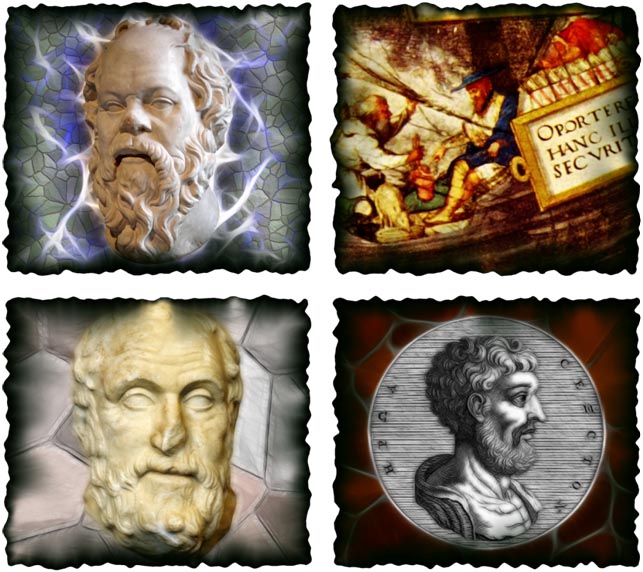
Head of the Philosopher Carneades. Room 10, Glyptothek, Munich, Germany.
Kant, Immanuel. “Critique of Pure Reason.” Trans. J. M. D. Meiklejohn. Project Gutenberg. July 2003. 2 July 2007. <http://www.gutenberg.org/dirs/etext03/cprrn10.txt>
Kaufmann, Walter. Neitzsche: Philosopher, Psychologist, Antichrist. 4th ed. Princeton: Princeton University Press, 1975.
Lammenranta, Markus. Forthcoming. “The Pyrrhonian Problematic” The Oxford Handbook of Skepticism. Ed. J. Greco. Oxford: Oxford UP. <http://www.philosophy.stir.ac.uk/postgraduate/documents/LammenrantaPaper.pdf>
Lysippos. Portait of Socrates. Department of Greek, Etruscan and Roman Antiquities, Louvre Museum, Paris, France.
Nietzsche, Friedrich. “Friedrich Nietzsche: Beyond Good and Evil, Part One.” Trans. Ian Johnston. Malaspina University-College. 23 Sept. 2004. 16 May 2007. <http://www.mala.bc.ca/~johnstoi/Nietzsche/beyondgoodandevil1.htm>
“nihilism.” The American Heritage® Dictionary of the English Language, Fourth Edition. Houghton Mifflin Company, 2004. 2 Jun. 2007. <http://dictionary.reference.com/browse/nihilism>
Patrick, Mary Mills. Sextus Empiricus and Greek Scepticism. Project Gutenberg. Cambridge: London George Bell & Sons, 1899. 29 Jun. 2007. <http://www.gutenberg.org/files/17556/17556-h/17556-h.htm>
Petrarca-Meister. The Equanimity of the Philosopher Pyrrho in the Storm. Alte Pinakothek, Munich, Germany.
“Philosophy of David Hume, The” The Radical Academy. 21 Dec. 2006. <http://radicalacademy.com/phildavidhume2.htm>
Railton, Dean. On the Impossibility of Real A Priori Knowledge. I Love Philosophy.com. 17 Dec. 2007. <http://journal.ilovephilosophy.com/article.php?id=157>
Robinson, Derek John Scott. A Course in Linear Algebra with Applications. Singapore: World Scientific Publishing Company, 1991.
Suber, Peter. “Classical Skepticism: Issues and Problems”. Earlham College. 1996. 17 Dec. 2007. <http://www.earlham.edu/~peters/writing/skept.htm>
Sextus Empiricus. Gallery of the Ancient Greeks and Romans, Augsburg, Germany.
Taylor, Alfred Edward. Socrates. London: Thomas Nelson & Sons Limited, 1939.
Wood, Allen W. Kant. Oxford: Blackwell Publishing, 2004.
Send questions and comments to Jacob Kinnun at: