(What does it tells you?)
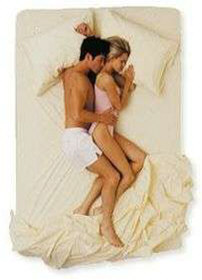 |
The Spoon During early marriage, couples tend to maintain the spoon position for much of the night, mirroring each other. "When one person turns, the other follows suit, so that the spoon position is resumed on the opposite side," says Dr. Dunkell. But just because you've been married a while doesn't mean you have to give up this closeness. "When my husband hits the snooze alarm in the morning, it's our cue to spoon until the day can't be postponed any longer," says one woman who just celebrated her seventh wedding anniversary. |
|
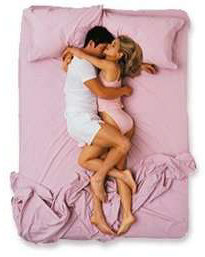
The Honeymoon Hug What if your husband likes the Hug and you find it stifling? Like other marital issues, sleep positions are negotiable, says Campbell. Try the Hug until he falls asleep, then sneak off to a more comfortable position. |
 |
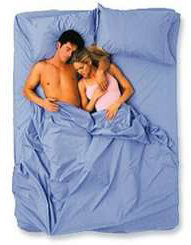 |
Like Shingles (on a Roof) Couples favor this position, which speaks of a strong commitment, early in marriage. "There's a high level of trust here," says Shirley P. Glass, Ph.D., a psychologist and marital therapist in Baltimore. "You're like a turtle on its back, exposing yourself, open to all kinds of touching." If you're not comfortable sleeping faceup, but want the coziness of such proximity, try the Reverse Shingle: Lie facedown, with your body overlapping your husband's. Not only might you sleep better, but you'll be delivering a sweet message: "Psychologically, this represents an attempt to focus total attention on your partner, even in sleep," says Dr. Dunkell. |
|
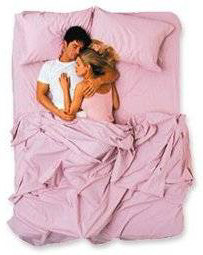
The Sweetheart's Cradle "When I was going through treatments for breast cancer, my husband held me in his arms as we drifted off to sleep," a 35-year-old woman remembers. "Even though we shifted into other positions during the night, we would return to cradling in the early morning hours. I'll always remember how protected and safe I felt." But there's no reason you must wait for a crisis to try this position. Nor must your husband always do the cradling. Wrapping him in your arms while you talk in bed at night is an intimate way to reconnect after a stressful day. It's also a great position to fall asleep in while watching TV — no matter who has the clicker. |
|
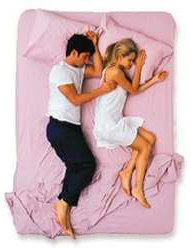 |
Loosely Tethered |
|
The Leg Hug |
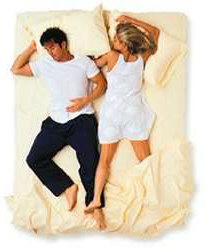 |
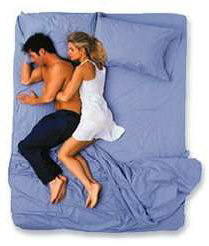 |
The Pursuit Sometimes, though, the message intended by the person pulling away isn't clear. As Shirley P. Glass, Ph.D., a psychologist and marital therapist in Baltimore, explains: "The partner who distances may actually want to be pursued. His or her distancing becomes an invitation: Will you take the initiative to come closer? Or maybe the partner feels tired of always being the one who initiates the hugs and is thinking, If I snuggle up next to you and you accept it, it's not the same as you coming after me. In this situation, rather than Illegal Spooning, it's a test, a dance of the spoons." Resist the temptation to treat your sleep styles like a pass-fail exam. Learn how to read your mate's body language as well as your own, but don't jump to conclusions. Sleep positions are a conversation starter, not an instant horoscope. |
|
The Cliff-Hanger And consider this: Maybe he's finally comfortable enough to admit he'd rather get a good night's sleep away from you than cuddle up together, listening to you snore or grind your teeth. If the distance leaves you lonely, maybe you can suggest that you at least start the night together. If you still sense distance, it may be time to have a heart-to-heart to find out what's really going on. | 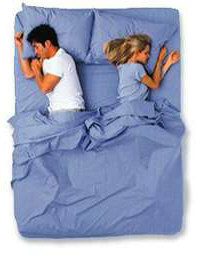 |
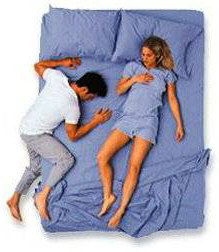 |
The Crab But unless there are other signs of discontent, don't assume that a weird new position is a nuclear strike. "Unless there appears to be a power struggle being waged during the night and the day, don't overinterpret," says Shirley P. Glass, Ph.D., a psychologist and marital therapist in Baltimore. "When you sit in a chair or on the sofa, you don't always sit in the same way. Sometimes when we're hurting we want closeness and sometimes we want space." And sometimes we're just very creative in bed. |
[Back]
Source:The Red Book, © 1995-2000 Women.com Networks. All rights reserved.
© 2000, Gloria Mae Gabriel - Boston, Massachusetts
Best viewed with Microsoft Internet Explorer 4.0 or higher or Netscape 4.0 or higher.
Stylesheets 800X600