|
|
|
|
|
|
|
|
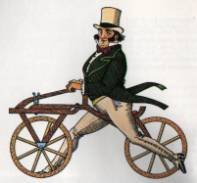
The first bicycle was made in France in the late 1700’s. It’s two wheels were about its only resemblance to the bicycle as we know it today, for this primitive vehicle, known as the Celifere, had no pedals and could not be steered. Its seat was a padded wooden rail. To make the contraption go, the rider straddled the machine and pushed it along the ground with his feet. Going downhill or for short distances on smooth, level ground, he could get up enough speed so that he could lift his feet and coast. To change directions, he had to drag his feet to stop the rolling wheels, then pick up the rig and turn it in the direction he wanted to go.
|
|
|
|
|
|
|
|
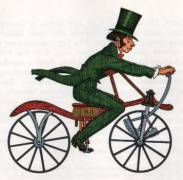
About 1816, Baron Karl von Drais, a
German forester, built a similar vehicle that soon became popular throughout Europe. The big improvement of this vehicle over the first one was that the front wheel could be turned for guiding. Soon a number of versions appeared. They were
called walkalongs, dandy horses, hobby-horses, or Draisines. Some types had iron tires over their wooden wheels. In time they were equipped with cushioned seats, usually of leather, and some were mounted on spring metal that took a bit of
bumpiness out of the ride. Models pushed along by two people were said to achieve the fabulous speed of six miles an hour.
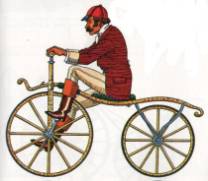
Within five years, inventive minds had begun to improve the comfort and efficiency of these early bicycles. A Scotsman used treadles to
transmit power to the rear wheel to drive the vehicle. An English inventor produced a vehicle that was pumped with the arms, supplying power to the front wheel by a ratchet device. Others arrived at the idea of pedals that were attached
directly to the front wheel.
But the great initial interest in bicycling died down. Only a few enthusiasts continued to work with the two-wheelers to improve them.
It was another half a century –shortly after the Civil War- before the idea of a pedalled vehicle again caught the general public’s fancy and another surge of bicycling got underway.
The first U.S. patent for a pedal-powered bicycle was granted in 1866 to Pierre Lalement, a Frenchman who began manufacturing his bicycles in Connecticut. The Lallement bicycle’s
front wheel was slightly larger than its rear wheel. The saddle was mounted on a spring, and the pedals were attached directly to the front wheel axle. The first pedals were three-sided, like wedges, and were difficult to use. Later they
were weighted to keep the tread facing up.
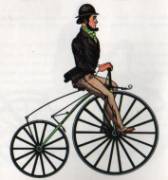
New versions of the bicycle began to appear rapidly. In each, the front wheel became a bit larger, and the
rear wheel a bit smaller. Other improvements included adjustable seats and cranks and, in the late 1860’s, the addition of rubber tires over the rims helped to reduce noise and also to prevent the wheels from slipping. By the 1870’s,
most of the wheels were fitted with wire spokes rather than with the heavier wooden spokes.
Riding schools were formed to teach people how to handle themselves gracefully on these revolutionary
“boneshaker” bicycles. Sunday afternoon races became the vogue, with women participating as actively as the men. Part of the day’s events often included exhibition riding, not only to demonstrate proper style and skill but also to
allow bicyclists to show off tricks and stunts they had mastered.
Unusual pedalled vehicles appeared in the 1860’s and 1870’s. Some had three wheels, other four.
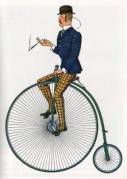
High-wheeled bicycles, with the addle mounted over the front wheel, began to be in vogue about 1875. In the most common models, the big front
wheel was four or four and a half feet tall. Five foot wheels were not rare, however, and one manufacturer produced a bicycle with an eight-foot front wheel. High-wheelers had disadvantages, however. They were not easy to mount, and a
“header” from the bicycle’s height was likely to be bone-shattering.
These high-wheeled bicycle, or ordinaries, were the first to give a rider full advantage of the power of his
thrust in pedalling. One complete turn of the pedals sent the big wheel on a complete revolution. This multiplied the distance travelled by the pedals. Speed became possible, and the ride was smoother and more comfortable than a bone
shakers.
Through the 1870’s and 1818’s, high-wheeled bicycles were manufactured in a variety of models. Wheelmen,
as the bicyclists were called, were proud of their skill in handling these big bicycles. In 1880, they organized the League of American Wheelmen, which became the most influential organization in the United States. The L.A.W. demanded equal
rights with horse-drawn vehicles and also insisted on smoother roads. One of their most sought-after achievements was a Century Run medal, signifying that a bicyclist had ridden 100 miles in 10 hours, still the mark of an accomplished
bicyclist.
Bicycle races with ordinaries became popular events. The tops speed was about 25 miles per hour, phenomenal
for its day but modest compared to present-day speed on bicycles. Bicycle parades, Sunday rides, and cross-country tours gave everyone an opportunity to sport his vehicle.
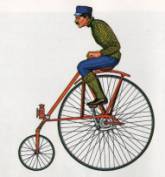
Most of the high-wheeled vehicles had the big wheel in front, but in a few their positions were reversed. The
rider still sat over the big wheel, but he guided the small front wheel. Guiding was somewhat easier, but when the little wheel dropped into a rut, it stayed there. The rider took a “header.”
Safety bicycles, which looked much like those in use today, were invented primarily to eliminate the hazard of
“headers” that plagued the riders of the big high-wheeled bicycles. For more than a decade both kinds of bicycles were in use, but the safety bicycle won out.
With both wheels about the same size, the safety bicycle looked much like the very first bicycles. The safety bicycle could be pedalled,
however, and it also incorporated other improvements. The most important of these was the use of a sprocket and chain drive. This increased the distance covered for each revolution of the pedals. The rider sat lower, more comfortably, and
between the wheels. By 1890, too, the pneumatic tire was added, increasing the softness of the ride. The coaster brake also became one of the growing number of improvements.
In the 1890’s a good bicycle cost a hundred dollars, about the same as today but in a time when that sum of money was much more
difficult to come by. Some 2 million Americans bought bicycles, however. Surprisingly, in proportion to total population, the number of bicyclists is greater today.
The principal difference between bicycling in the 1890’s and now is that bicycles than were the fastest wheels on the road. They
provided transportation for business as well as for pleasure. The thrill of bicycling kept people pedalling. They deprived themselves of other luxuries and even of necessities to afford bicycles and the time to use them. There seemed to be
no way to squelch the mania, and businessmen warned that continued emphasis on the bicycle to the exclusion of other products would bring about an economic collapse. The U.S. Patent Office was flooded with patent applications for new kinds
of bicycles and bicycling equipment.
Doctors endorsed cycling as a means of getting exercise regularly. Bicycling was the first athletic activity to take women out of the
parlor, and young men showed off their muscles in races.
Bicycle racing, in fact, became an international sport, and in those early years, many Americans ranked with the record setters. In June,
1899, Charles Murphy rode down a board surface laid between the rails of the Long Island Railroad to reach the unbelievable speed of 60 miles an hour. This record has since been beaten many times and a few years ago was more than doubled.
No one could imagine at that time that the bicycle would ever fade away from the scene, but with the coming of the automobile, the
bicycle slipped into the background. It was the bicycle, however, that prepared people for the mechanized world that was to come, paving the way for the automobile.
Bicycling
G.S. Fichter & K. Kingbay
Golden Press -New York-