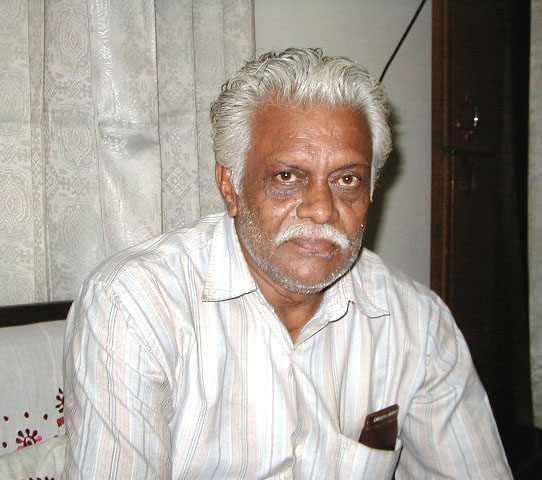
Commander Qazi Sayeed now in his mid-fifties
Portrait of a Genuine Mukti Bahini Fighter
By A.H. Jaffor Ullah
Sunday, June 10, 2001
Tejkunipara, Tejgaon, Dhaka
On June 10, 2001, while I was visiting Bangladesh, I went to Tejgaon Farmgate area. This is the place where I grew up in the fifties and sixties. I also went to my old neighborhood that has changed a great deal. In place of picturesque landscape filled with trees and ponds what we have is a jungle of concrete and a suburb where houses are lining one-by-one hugging the lanes. There is no plan whatsoever; thus, the suburb of Tejkunipara has the look of typical Thirld World city.
I went to Aolad Hossain Market, which is located north of our old neighborhood of Tejkunipara. I went there to hunt for an old high school friend whom I have not seen over three decades. I heard from my family that my old pal Qazi Abu Sayeed was a Group Commander of Bangladesh Mukti Bahini during the nine-month period. I thought it will be wonderful if I could meet and talk to him and hear from him his reminiscing of our freedom struggle. After some frantic search in the old neighborhood I was able to locate the house of Sayeed’s older brother Qazi Hashem. First I could not recognize Hashem because he has aged a lot. Hashem told me that his younger brother Sayeed now works as a manager of a restaurant in Ashulia, a resort place located 20-25 miles north of Dhaka. I have not been to Ashulia but my kids went there. They told me that there were lots of water surrounding Ashulia. From a recent news published in the Daily Star I read that a builder wants to build a theme park in Ashulia for the city folks.
Sayeed’s brother Hashem told me
that it will be close to sundown when he will return from Ashulia.
I replied that I will be at our house in Tejkunipara anxiously waiting
for him. Around 8:00 PM there was a heavy knock at the door.
A graying Qazi Sayeed was standing there staring at me like a Royal Bengal
Tiger. His eyes were glowing, literally. He was grinning ear-to-ear
seeing his old high school pal. After exchanging pleasantries and
other personal information over a cup of tea and some condiments, we started
talking about the 1971 freedom struggle. His eyes lit up and he started
to talk in evocative manner.
Commander Qazi Sayeed now in his mid-fifties
Before I go into the detail, let me bring to fore an incident that might give us some idea about Group Commander Qazi Abu Sayeed. In March 1973, I was visiting the new nation of Bangladesh hardly 15 months after it became independent. While vacationing, one day I went to meet Mrs. Zillur Rahman, wife of Dhaka Radio’s Regional Director in the 1960s. I asked her how was life during the none-month period of our freedom struggle. She told me that they had to leave Tejgaon in early December because of intense bombing of the Old Tejgaon Airport by the Indian Air Force. However, when she returned home after liberation (December 16, 1971) to her surprise she found some uninvited house guests; they were none other than some Mukti Bahini soldiers belonging to Group Commander Qazi Sayeed. The freedom fighters steadfastly refused to vacate the house because the neighbors complained that Syed Zillur Rahman sided with the military during the dark days of 1971. There may be some truth in it. Mr. Zillur Rahman and his family spoke Urdu even though they were originally from Burdwan, West Bengal. Also, Syed Zillur Rahman’s career in the government flourished during Ayub Khan’s time. Mr. Rahman was one of the few Bengali officers liked by the Punjabis in the sixties. He was transferred to Pindi (short for Rawalpindi) in the early sixties when it served as the capital of Pakistan before Islamabad was even built. I do not doubt for a moment where Mr. Zillur Rahman’s allegiance will fall when push comes to shove. His was a family who found it easy to converse with Urduwallas than their Bangalee neighbors. They always looked at the Bangalee with disdainful eyes thinking that Bangalees were unsophisticated clodhoppers.
Mrs. Zillur Rahman who I used to call Khala (Auntie) said to me, "They took my Sahib after liberation war into custody charging that he was a Razakar. They kept him locked-up for months. Then one-day they just released him. Those were difficult days for us"
My auntie not only lost her husband temporarily, she also lost the custody of her beautiful brick home, which became the command headquarters for Commander Sayeed's group of freedom fighters. Mrs. Zillur Rahman wanted to have her home back. However, Commander qazi Sayeed did not listen to her pleas. While this was going on in late January 1972, my eldest brother Kaiser was visiting home from London. Our Auntie then approached my brother to negotiate the transfer of the house. Kaiser then talked to Qazi Sayeed several times and negotiated the safe transfer of the house. Auntie was very pleased at the negotiation skill of my elder brother. She told me with a happy face, "Had not it been for Kaiser, I would have lost my home!" She told me in Bangla with her sweet Burdwan accent that had over abundance of nasal sound what we call chandrabindu in Bangla. This sweet-talking elderly lady had passed way in the year 2000.
I brought up this issue of Auntie’s house with Commander Sayeed when I met him in June 2001. He also told me that unless it was my brother who approached him, he would have not returned the house so easily. Actually, this house became the living quarters for Commander Sayeed’s platoon in the fag end of the war.
Qazi Sayeed was born in Tejgaon before the partition of Bengal in 1947. Qazi Samad, a burly individual that I remember was his father who is long gone from this mortal world. Sayeed went to school with me at Tejgaon Polytechnic High School. He even accompanied me to All Pakistan Scout Jamboree held in December 1958 in which Ayub Khan came himself as the chief guest. Sayeed may have been retained in class eight for one extra year. Thus, I graduated one year ahead of him from the high school. We then parted our ways in 1962. But I would see him from time to time whenever I returned home for college break. For financial reason Sayeed never did attend any college and he joined the workforce right after passing matriculation exam.
Qazi Sayeed told me his experience as a freedom fighter as follows:
Qazi Sayeed did not join Mukti Bahini for glory or personal gain. He did not sport a Rayban glass, nor did he trim his mustache with utmost precision. Like most other Muktis (freedom fighters), he also sported a beard and longhair. He felt being a young man in his twenties it was his responsibility to become a freedom fighter. Once the job was accomplished he returned to his civilian life.The crackdown came in the late March 1971. We were dumbfounded by the ferocity of Pak army’s brutality. In April, I decided to join the Mukti Bahini. In May, I reached a place call Hapania in Tripura. From there I went to Bagmara, which is also in Tripura. There, I received an intensive training for 3 days on guerrilla warfare given by professional soldiers. There was a whole bunch of us from Tejgaon Thana area (Police Jurisdiction). We were grouped together and I was made the Group Commander. I was ordered to take my group to Badda, which is near Gulshan, Dhaka after Eid ul Fitr. For logistical reason, we moved our base to a village by the name Isapura, which is located north of Badda. Our camp was located in Hossain’s House. All operations were planned and carried out from Hossain’s House. Before I took the charge in Isapura, Pak military came close by one day and a bloody battle broke out. One time we were ordered to make a guerrilla operation near Narshinghdi. As we were approaching our target area near Bolta, we ran into a Pakistani Commando. A severe fight broke out. There were casualties on both sides. It was nasty out there; I will never forget that confrontation. After this encounter, the Pak army never dared to come close to our area. They knew we can camouflage and with villagers’ aid we can out maneuver them even though they may have superior weapons.My group earned a solid reputation for our heroism. Others used to call us Nana’s Group. For some strange reason my soldiers used to call me Nana. On December 17, we were ordered to march into Dhaka. From Isapura we came to Gulshan. From there, we marched through Tejgaon industrial area, and finally we reached Tejkunipara my home turf. There, we found Zillur Rahman’s empty house. We used it as group’s temporary headquarters.
When we reached Tejgaon we found out that all the police officers and policemen ran away from the station. The police station was quite empty. For maintaining the law and order we needed some people to manage the police station. I volunteered my service. There we found a Mukti Bahini Officer by the name Dr. Shamsul Alam who was from Mothbaria, Pirozpur, Barisal. Dr. Alam is the brother of M.P. Sagir – who used to own a cement dealership in Tejgaon by the name Builder’s Corner. We made Dr. Alam as the officer-in-charge.
We brought all our equipment and military gears to Tejgaon Thana on December 19, 1971. We managed the Thana for over one month. I was the second in command in the Thana. Many Biharis were brought to us at the Thana. We saved the life of many Biharis. Finally in February 1972, the new government appointed Mr. Nurul Amin, who was also a Mukti Bahini Commander just like me, as the Officer-in-Charge. I never had any desire to serve as a police officer; therefore, I never approached anyone in the government. Once the new government appointed other officers at the thana, then I became a civilian. I joined the Mukti Bahini because I felt it was the right thing to do considering what the Pakistani soldiers did to us.
Qazi sayeed worked for many years
in the
Unani (Muslim Ayurvedic medicine) factory located
in Tongi. He told me that he could have become a wealthy man if he
wanted to by occupying some empty home and business left by Biharis and
Pakistanis. He also did not want to join in the army or Rakkhi
Bahini, which he could have easily joined with such credentials as
he amassed. It is very rare to find individuals like freedom fighter
Qazi Sayeed. I always wanted to meet him because many people in Tejgaon
told me that he was a living hero in the early days of our nascent republic.
Many people in his situation would have used the credentials he already
had to secure position in the government. But Qazi Sayeed is a man
of different breed. These days he is not wealthy by any stretch of
imagination; however, he does not complain. He had no regrets joining the
freedom fight. However, he laments that he had no idea that Bangladesh
would become a nation of rogue politicians and the nation itself had turned
into a Goonda-Raj.
----------------------------
A.H. Jaffor Ullah writes from New
Orleans, USA. His e-mail address is - [email protected]
To get back to the Index Page of Jaffor Ullah's Illustrated articles Click Here