The itinerant musician of Old Dhaka
By A.H. Jaffor Ullah
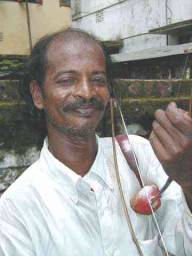
The itinerant musician of Old Dhaka
By A.H. Jaffor Ullah
In June 2001, while I was visiting Bangladesh with my family from New Orleans, I stopped at Tejkunipara where my boyhood home is still standing tall. As I stood at the front door of that house with my kids on that hot summer day, I heard an old tune being played by a wandering musician on a one-string bowed instrument. Nonetheless, the instrument’s tone, style of playing, etc., was very much known to me. It hurtled me half a century back into the fifties and sixties. The music was becoming louder as I stood there silently. I realized that the itinerant musician was coming towards our direction. When I saw the face of the musician, I was awestruck. Haven’t I seen this face before? However, the conundrum is that the musician was in his early thirties. Don’t the musician age? Is he the Orpheus, the mythical Thracian poet and the musician who simply won’t age?
I greeted the man cordially. I told him that I saw his face in the late fifties. He answered me in half Bangla and half English. He said his name is Monu Miah and he was not born then. After exchanging some kind words, he told me that I might have seen his grandfather who used to play the instrument and sell them too. Well, it certainly was the case.
Those of you who grew up in Dhaka
must have fond memory of this musical family. The family members
would play their one-stringed mini-violin like instrument. The musician
would play popular tune of the day. In the fifties and sixties he
would play such tune as – “san dole tera man dole… ai kon baje
basoria.” A tune from the film “Nagin.” In those
days, he also played the tune – “teri dwar-e khade ek jogi, na mange
mei sona chandi,
mange darshan devi teri, dware khade ek jogi.”
Those were terrific tune, to say the least. He would also play Bangla
popular tune such as “shono bandhu shono” or “amar shopn’e dekha
raj-konna thakey.”
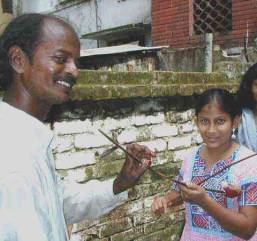
This man in his mid thirties whom I met in the hot sweltering day in June 2001 belongs to the same musical family. I took his photo. He didn’t mind. He sat with me to talk about the musical geniuses of his grandfather and his father. He said, “My father and grandfather played this instrument before many famous men.” I don’t deny it for a moment that what he said was very true. The man then played some soulful tune for me. My kids who are musically inclined could hardly believe that such a wonderful music can emanate from a teensy and unassuming instrument made out of a clay material and bamboo sticks. He gave free lessons to my daughter and son. We ended up buying 2 such musical instruments. My niece fussed that I gave Monu Miah too much money. In return I said, “Well, didn’t he play those beautiful tunes to soothe our sole?” In fact, the musician himself was very eager to play some tunes or else he wouldn’t be asking me to name a few popular tunes. And I did. He played those Bombay tunes from the bygone days. He also played the tune “hai apna dil to awara” – a Hemanta Mukherjee song. Those tunes brought back so much memory in me that I was awestruck by the power of his tiny and unsophisticated instrument to evoke such feelings.
Monu Miah told me that these days people in Dhaka do not pay much attention to the tune he plays. He heard from his father that foreigners staying in Shahbagh Hotel (now the Post-graduate Hospital) in the 1950s would pay a bundle to listen to his grandpa play the instrument. Our traveling musician then asked for some cold water to drink. After quenching his thirst in a hot June day he stood there in front of my parent’s house and played many songs one after the other. Some of those tunes I could recognize, but the others were too new for me. He even played the British tune “He is a jolly good fellow.” His repertoire has many songs; too numerous perhaps. He has to satisfy many ears as he moves around from one corner of Dhaka to the next. He told me that he even goes to posh areas of Dhaka such as Gulshan and Baridhara to sell his instruments to the foreigners. However, he never forgets his home base. The neighborhood in Tejkunipara where I grew up used to be middle to upper middleclass area in the 1960s. The middleclass neighborhoods are his home base. Lucky for me that he made his rounds to his home base. Or else, I would not have met him on that hot summer day.
This one-string bowed instrument is very close to our indigenous musical instrument Sarinda, which used to be very popular in our villages. Late musical genius S.D. Burman had used Sarinda copiously in many of his songs. Lately, the musicians all over India, Bangladesh, and elsewhere in South Asia are getting away from our traditional instruments. They have this fascination for electronic keyboard instruments or electrified guitars. No one wants to hear the acoustic sound of a Sarinda, Dotara, Sorod, Sitar, Esraj, etc. I was lucky enough to grow up with these indigenous instruments because my father was a real connoisseur of these antiquated acoustic instruments of our region. Harmonium had long been considered to be a deshi musical instrument although it was developed in Europe in 1840-1850. But aside from harmonium, the mainstream musicians of our subcontinent really adapted no other western instruments that I can think of. The western band instrument such as clarinet, trumpet, saxophone or even piano was only popular in the cities such as Bombay and Calcutta, and the reason for that being the availability of clienteles from British and Anglo-Indian communities. The Bombay films of the 1940s such as Barsaat and other Raj Kapoor films have taken advantage of these western musical instruments because those symbolizes modernity to the people of my grandfather generations. Nonetheless, the people from our villages have always liked the sound of Bansori (bamboo flute), Dotara, Sarinda, Dugdugi, Dhol, Tabla, etc. The austere Sufi musicians would only sing with their mellifluous voice with the accompaniment of a percussion instrument by the name Chimta.
In the 1960s, we used to have an itinerant Sufi vocalist in Tejkunipara near the Thana (police station) where stood a restaurant. This ganja-addicted sadhubaba from Muslim background was a phenomenal Dotara player. The restaurant owner was one Mr. Abdullah, a lungi-clad short and fat person from Comilla. Mr. Abdullah was a very enterprising man. He came to our neighborhood in late 1950s, virtually penniless. But he claimed to know the culinary art of making samosa, dalpuri, nimki, etc. He saw that our neighborhood lacked a restaurant. Our neighbors were very enthused about this new restaurant because we had none. They took collection, erected a temporary cottage made out of bamboo, and made their dream come true. Soon we had Abdullh’s Hotel. I think in Bangladesh if a place offer breakfast, lunch, and supper then we call that place a hotel. We never made a difference between the roadside hotel such as the one run by Abdullah and a residential hotel. The police constables and others who had reason to visit the Thana continuously used to come to Abdullah’s joint for a hot cup of tea and samosa (in Bangla shingara) and possibly for bribing the Thanawallahs. Abdullah’s specialty was having a Sufi singer at the hotel. In fact, the Sufi singer was a permanent fixture in Abdullah’s joint.
We used to hear many marfati or fakiri songs from this itinerant Sufi singer at Abdullah’s. The only requirement for a good song was to handover a chilim of ganja to this Muslim sadhu. The singer without any qualm used to give his dom (deep inhaling) to ganja’s kolki for about 30 seconds or so. The coal in the Kolki used to turn red hot. He would remain silent for a minute and only then, would he exhale. It used to stink up the whole place. His eyes would be bloody red by then. He would say something in grameen Bangla, which would be difficult to understand anyway. Then he will pick up his dotara gently and then he would play furiously for a minute or two. He would then hawk to clear his throat spitting his phlegm on the floor. Only then would he start singing his Bhakti songs. A crowd would gather soon up to listen to his mellifluous voice.
Bangladesh is very much endowed with these kinds of nomadic singers who would roam from places to places in search of new audiences. When I left for the US in 1969, Abdullah’s ramshackled restaurant used to do a thriving business in our neighborhood. However, when I went for a visit in 1973, that kutccha structure which used to house Abdullah’s hotel was gone. I was heartbroken not finding any vestiges of Abdullah’s hotel. I asked our neighbors what did happen to this fascinating joint because I was planning on having a cup of piping hot tea with some shingara while I visit my family in Tejkunipara. They said that after I had left for America Abdullah became very sick one day. They took him to a hospital and from there; they send him to his village. Abdullah never did return to our neighborhood and the restaurant thus folded right away.
I have seen many wandering musicians come to Abdullah’s joint for a brief stay. They all used to be Fakirs or Bauls of some sorts. Abdullah was a decent human being. He would treat these troubadours very kindly and gently often feeding them with whatever he had leftover from lunch or supper. Some of these musicians would stay for a week or so. Whenever these traveling singers would give their usual free concerts in Abdullah’s hotel, a throng of public would crowd up the place. Mr. Abdullah would then do a brisk business. It was good business policy of Mr. Abdullah who never took any courses in business advertisement or marketing. But his common sense would dictate him to have a resident musician all the time in his joint. I have seen so many traveling musicians come and go in Abdullah’s hotel that we the neighborhood kids stopped counting them. It was my observation in the sixties that the best singers were ganja addicts and their mind used to be somewhere else because they never made any sense if you would chitchat with them.
Let me reiterate the fact that Bengal had always been home to myriad Fakirs, Sannyasis, Paglas, and Bauls. Traveling musicians are very much part of Bengal, lest we forget. This is truer in rural areas than the urban city centers. In villages, the slower pace of life is very conducive to having musical gatherings as opposed to a faster pace of urban life. We were therefore very lucky to have Abdullah’s hotel, which was really an oasis for us.
In the villages there is a room for itinerant Sufi and Baul who occasionally would stop at some place preferably near a Bazaar or haat (weekly bazaar) under the cool shade of a big Banyan tree. These singers would often sing simple tunes with the accompaniment of a dotara or an ektara made out of dry gourd shell. Sometimes they would also carry a percussive instrument call chimta or a wooden clapper. Baul would give rhythmic accompaniment holding the chimta with his left hand while playing the ektara with his right hand. Thus, Baul hardly needs any other musicians for accompaniment. This style of one-man band is a very innovative concept. The Bauls of Bengal would thus be able to perform wherever his heart desires. He would not need any more musicians to accompany him.
The sighting of the wandering instrumentalist in Tejkunipara in a hot summer day in June 2001 brought back so much memories in me that I was overwhelmed. This lone musician was carrying a tradition may be for his livelihood. However, his rendition of popular filmi songs made all the difference in this world for me in that hot summer day in Tejgaon. Because of the tremendous growth in urban sprawl of Bangladesh a lot of traditions were exiting through the backdoor rather quietly. I was bitter about these vanishing away of our traditional things.
Others who live in Dhaka permanently did not think much about the loss of those vanishing arts and crafts. They seem to think that modernity will replace many things. Come to think of it, a prime example of this is the wiping out of traditional horse carriages or buggies from Old Dhaka by the tempos, babytaxis etc., of the sixties. All those humors associated with the Kutti Kochoans (the coachmen) had vanished into the thin air by the onslaught of rickshas, babytaxis, tempos, etc. In the pre-partition days, the Old Dhaka used to boast about the subculture associated with the horse-driven carriages and their coachmen. The modern automobiles have wiped this ‘horse and buggy’ industry and along with it the entire gemish of Kochoan subculture, their lingoes, humor, and their way of life. What took hundred of years to develop was bulldozed in just five decades.
When my family came to Dhaka’s Fulbaria Station in 1950 from Sylhet town via Surma mail for the very first time, there were hundreds of buggies (Ghora’r Gari) waiting at the frontgate of the railway station to offer their services. But now you won’t find a single buggy at the Kamlapur railway station. They stopped making the buggies in 1950s. That beautiful sound of horses’ prancing in the metallic road is all but history now.
Amidst this hopelessness, I find
the lone itinerant musician crisscrossing the narrow roads of non-glamorous
Dhaka with his small homemade instrument playing beautiful tune, which
I found to be very refreshing. Hopefully, his next generation will
continue to make and play the instrument like his ancestors did in the
1940s, 50s, and even in the 00s. Come to think of it, what is life
anyway? It consists of many small events. The big events may
change the course of history, but little incidents such as listening to
the tune of homemade instruments leaves an indelible mark in our mind,
which haunts us for the rest of our life.
--------------
A.H. Jaffor Ullah writes from New
Orleans. His E-mail address is - [email protected]
To get back to the Index page
of Jaffor Ullah's Illustrated articles Click
Here