Dhaka’s hopeless traffic jams stop everything but the clock!
By A.H. Jaffor Ullah
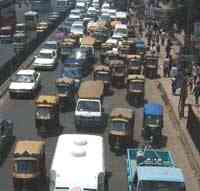
Dhaka’s hopeless traffic jams stop everything but the clock!
By A.H. Jaffor Ullah
June 11, 2001
Let me ask a blunt question. How many readers do think that Dhaka is simply unlivable? Read on. You will know why am I bringing this unpalatable topic for discussion.
Let us for once accept the fact
that Dhaka is one of the most unplanned cities of the world. It is
a small wonder how this megalopolis manages to survive. Nonetheless,
it manages to function somehow. To many Dhakaites, who had been living
in this city of nearly 7-8 millions, which is a guesstimate (guess + estimate),
the city may be limping and managing to survive somehow, but to outsiders
(read westerners) the city as it stands now, is quite unfit for living.
There is, however, some merit in thinking that way. For the sake
of discussion, let us only discuss the ailing traffic situation, which
is deteriorating by the days. There is no sign anywhere in the horizon
that anyone could see which may point towards a sea change. In one
word, the worsening traffic situation is at best nightmarish. And
at its worst, it could be a seen from hell.
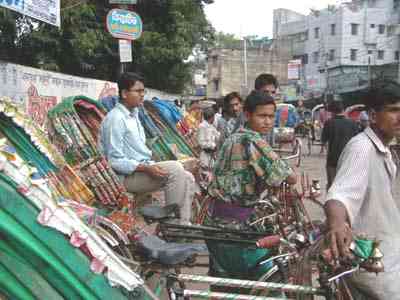
This side road leading to Farmgate is also
clogged with rickshas
Let me admit this fact that traffic
hardly moves in Dhaka’s main artery during rush hours. Many folks
from mercantile community would prefer to leave their house late in the
morning to simply avoid the all too familiar rush hour traffic jams.
But their number is few and far between. Most Dhaka folks who work
in government offices, schools, and other offices have no choice but to
hit the road during the morning rush hour. These folks obviously
take the brunt of rush hour traffic jam. If one thinks that it is
an exaggerated statement, then one should climb up to one of those over
bridges near Farmgate, Karwan Bazaar, or Bangla Motors to take a peek at
any of the ubiquitous traffic jams. One could see the crawling vehicles,
as far as the eyes would allow one to see, lining up the avenues near the
bustling intersections. Come to think of it, there are quite a few
intersections near Farmgate. This clearly indicates that Dhaka’s
road system is unplanned from the very beginning. Did anyone wonder
as to why there are many roads going East-West direction starting from
Old Mymensingh Road, which is now lovingly called the VIP road? In
the early 1960s, when some these roads were built, there were some powerful
people who lived at the far end of Indira Road. These folks exerted
undue pressure on DIT Urban Planners so that Indira Road should stay the
same. The government could have easily widened Indira Road then,
but that would have spelled disastrous for those powerful landowners.
Their houses would have been consumed by the widened Indira Road.
Therefore, the government decided to erect a parallel road next to Indira
Road. Well, now you know why do multiple roads go East-West parallel
to Indira Road. Incase you are wondering who is the mastermind behind
this manipulation, it is none other than Mr. Doha (popularly known as I.G.
Doha; I.G. stands for Inspector General of Police, which he was during
the late forties and early fifties in East Pakistan), who happened to be
in the cabinet of Ayub Khan in late fifties. Political connections
pay off in our part of the world.
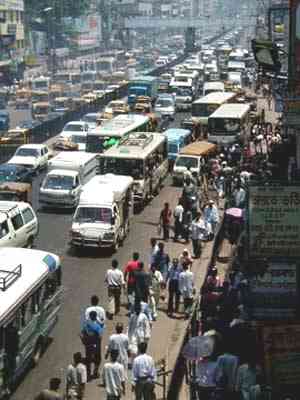
Oh, what a mess near Farmgate!
Forget the personal anecdotes! Let us move into the Twenty First Century Bangladesh. You see, by any stretch of imagination, Dhaka is not a huge place. The width (east-west direction) is hardly few miles. The city could have moved only in the North-South direction. This imposes a serious restriction on the availability of land. But this severe paucity of land had hardly diminished the growth rate of this burgeoning city. Any legitimate city planner worth his salt would not recommend the city of Dhaka for people over 1-2 million. The ever-growing population had easily exceeded this capacity by six folds, already. And there is no sign that the population growth in this city is abating. Where will it end? This is not mere a speculation if anyone says that Dhaka's population will be twice as much as it is now by 2016 at the rate of 5% growth rate. Can anyone imagine what will it be like then? The present road system of Dhaka, which is hardly adequate for moving vehicles for 1-2 million people, will virtually collapse when the population of this megalopolis will reach a staggering 10-12 million. It is to be hoped that urban planners of Dhaka are doing theirs clearheaded thinking right now or else the system will collapse right before their eyes.
There is no dearth of demographers
in Dhaka whose sole business is to make projection on population distribution,
its growth, etc. Respected institutions and NGOs dealing with Bangladesh’s
population problem also routinely hire some of these experts. Once
in a while, we read excerpts from their speeches or reports in newspapers.
But very seldom do we read or hear their forecast on ever-growing traffic
congestion. Do they realize that it is already causing a serious
problem? This massive traffic congestion is taking its toll on human
health, economy, environment, and myriad other anthropomorphic activities.
The price tag is rather high when people have to spend hours unnecessarily
on the road in sweltering heat. Never mind the high humidity.
The resulting misery generated by the high heat and humidity takes its
toll on human health. To add insult to the injury, the unpleasantness
this high misery index generates slows down the productivity of a person.
No wonder, the average productivity of our office worker in Dhaka is not
up to par with office workers in the West. But then who cares about
the productivity enhancement of our people?
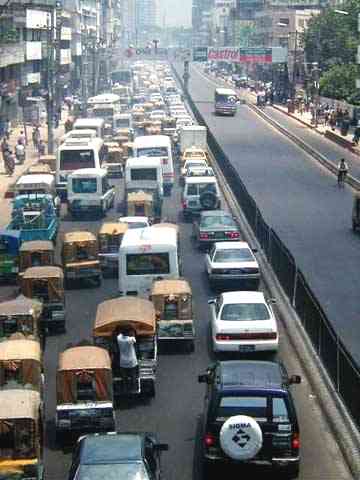
Unplanned traffic system in Dhaka.
One side is clogged while the other side is
virtually empty!
The traffic problem of Dhaka is
hindering the growth of the megalopolis and Bangladesh, both. The
traffic is not only stodgily slow, it is erratic and unpredictable.
On every intersection the drivers become quite unruly. A first time
visitor may think that Bengalis are the most wild bunch who have no respect
for law of the land. This is indeed a serious matter. It will
be unwise to think that a would-be-investor would bet his bottom dollar
thinking that productive work could be generated in this chaotic nation.
In any roundabout in Dhaka the plying babytaxis, rickshas, buses, etc.,
form multiple lines. They do this to grab a tiny space out of sheer
desperation. Behavioral scientists have long since done experiments
to show that even insects demonstrate aggressive behavior when they are
placed in a crowded situation. Therefore, it comes as no surprise
to see that Dhaka’s pedestrians, thelawallahs, rickshawallahs, babytaxiwallahs,
vanwallahs, and bus/truck drivers all vie for tiny spaces with noticeable
aggression and utter disregard for others’ right of way . This obviously
creates serious problems such as unnecessary traffic holdup and minor fender
bender incidences. Nonetheless, there is a price tag for such bizarre
behavior. Serious vehicular related accidents are growing with an
accelerated rate everywhere in urban areas of this impoverished nation.
But somehow the urbanites of Bangladesh -- more specifically the Dhakaites
-- are oblivious to growing traffic prooblem. Some even shrug off
this urban nuisance calling it a mere unpleasant experience.
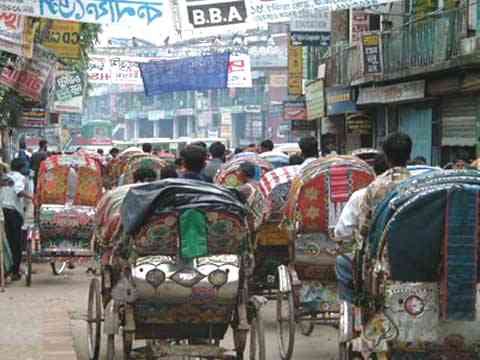
Rickshas and more rickshas near
Holycross College in Tejgaon
While I was in Dhaka and Chittagong
city in June 2001, I saw a whole slew of babytaxis plying the main thoroughfare
without any regard to pollution control. Mind you, these two-stroke
engine babytaxis are renowned for being the principal polluter in Dhaka
and elsewhere in Bangladesh cities. Whenever the traffic stops near
an intersection, one can clearly see a plume of engine fume coming from
the tailpipes of babytaxis. It is a small wonder why these vehicles
are allowed to ply the streets of Dhaka, Chittagong, and elsewhere.
There must be a strong lobby from the babytaxi owners’ association to keep
this pollution maker from crisscrossing the streets of our megalopolis.
Through legislation, the government could very easily stop importation
of the new engines from India. We all know the phrase – "If there’s
a will, there’s a way." If the Civil Society of Bangladesh wants
to stop these polluting machines, then they could easily start a movement
to ban these two-stroke engines from entering Bangladesh. Until that
happens, more lungs will be damaged by the toxic fumes. More benzene
and other harmful toxic organic molecules will find its way into human
body as babytaxis shoots out black stuff into our airspace. The other
wholesale polluter that I saw in Dhaka and Chittagong was diesel-fueled
bus and trucks. In the West we have seen diesel-run vehicles but
they don’t seem to emit black fumes through their tailpipes. Surely,
there are mechanisms to trap the black particles from leaving the engine
exhaust system. But in Bangladesh, either the mechanics tweak the
system or the pollution control device stops from working. In the
end, the results are same. They pollute heavily. But there
is an air of apathy. No body seems to care about this fouling of
the air. I hope this attitude change in the near future. Or
else, there will be a whole bunch of people afflicted with respiratory
problem. There is such a thing call Price Tag for modernity.
The Bangladesh civil society cannot afford to look the other way thinking
that everything will be A-Okay if things go unchecked with the proliferation
of two-stroke engine babytaxis and diesel-fueled trucks and buses.
These are truly ugly machines that mankind has invented. Sooner they
leave Bangladesh’s soil the better it would be for our people.
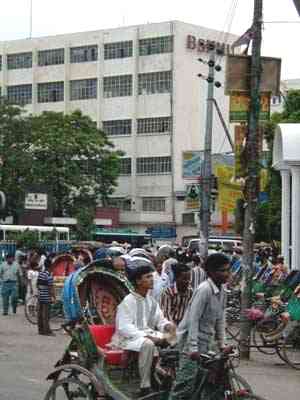
Anatomy of a traffic Jam.
Rickshas, buses, people all comingling...
In this short article, I have covered a lot of base concerning the congestion of traffic and potential pitfall stemming from stalled vehicles on the road. There should be more write-ups in Dhaka’s newspapers, especially in the vernacular one so that ordinary folks know the danger of traffic jam and related pollution problem. What ideally one wants to see is Dhaka’s road unclogged and pollution free. The government thus far is keeping a blind eye to all this hoping that the problem will be solve by it self or by a divine intervention. We all know that none of these will happen. The civil society has to find a realistic solution to it. Is it possible to decentralize the government and move a big part of it outside Dhaka, may be in Joydebpur area or in Tangail? Also, is it possible to limit the population of Dhaka? Something drastic should be done to check the unruly growth of Dhaka city. Instead of a planned growth, which is healthy, the city is growing like a cancer (unchecked and uncontrolled). This might cause problem further down the road. May be the time is ripe for calling an international meeting to address this rapid urbanization problem that is causing some concern.
One more thing. While I was
visiting Dhaka, I kept my traveling to a minimum for the fear of inhaling
some foul air. Like me thousands of other people inside Dhaka are
doing just that. Don’t blame the folks for not being on the road.
Have the air pollution free, and I will travel.
---------------------
A.H. Jaffor Ullah writes from
New Orleans. Comments should be directed at - [email protected]
To get back to the Index Page of Illustrated articles