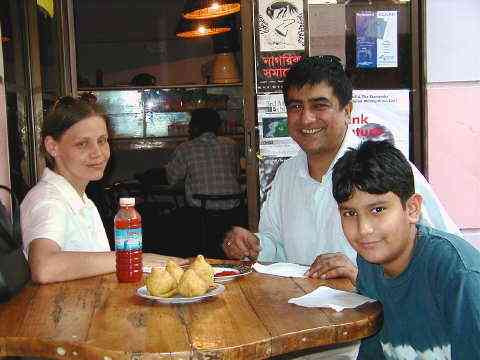
From left: Heli, Tanvir,
and Riaz about to enjoy Shingara with ketchup in Drik's cafeteria
Part Eleven
A trip to Drik on a very short notice!
By A.H. Jaffor Ullah
July 3, 2001
Ever since I came to Dhaka in June 2001, I wanted to meet Dr. Shahidul Alam, the founder director of Drik. I have seen his photos; however, I never met him personally. For the last 2 years we have been communicating with each other over the Internet. He knows me through NFB where he served as a member of the editorial board. I read about him here and there in some web sites about his work in Bangladesh. Even though he has a doctoral degree in chemical engineering or something close to that, he is running an organization by the name Drik that has nothing to do with chemicals or anything like that.
In Sanskrit Drik means seeing or viewing. Dr. Shahidul Alam is using his camera to look at Bangladesh society. He was an avid photographer and he still is. After returning from England he did not secure a job for what he was trained for. Instead, he took up his camera and started to shoot not only photos of our poor and neglected people of Bangladesh, but he started at the same time to build his dream organization, which he named Drik. Dr. Shahidul Alam is known to his friends and well-wishers as Shohidul Bhai. He prefers the Bangla rendition of his name. You won’t find him in suit and tie and that is for sure. He prefers our local dress that are unpretentious but practical for tropical climate. Parenthetically, I would like to add here that I feel sorry for Bangladesh’s present high-level bureaucrats who are seen with the Prime Minister. These bureaucrats bedecked with suit and tie in sweltering heat looks very weird in the photos. The lady prime Minister also wears sari made out of either synthetic or silk material that is impervious to air. God almighty only knows the real temperature beneath the fabrics. What about our beautiful cotton hand-loomed saris? Mrs. Indira Gandhi was a champion of wearing hand-loomed cotton saris. She looked gorgeous too. But in Bangladesh incongruity is the hallmark of our collective psyche. I was therefore not all that surprised seeing Dr. Shahidul Alam in deshi clothes. I only wished if our educated people in Bangladesh would follow Dr. Alam’s example, they could have inspired millions of folks in wearing comfortable clothes during the oppressive summer months. Come to think of it, our literary icon poet Rabindranath also used to wear flowing long dress made out of cotton. Smart men think alike and that is all I can say. May be I ought to write a separate article on dress habit of rich and famous people of Bengal.
I promised Dr. Alam in one of my
many e-mails to him that next time I visit Bangladesh, I will look him
up. Therefore, ever since I came to Dhaka this time, I have been
meaning to visit the Drik Gallery and say hello to this man who has become
one of my cyber friends. NFB’s editor, Tanvir Chowdhury knows Dr.
Alam very well and he calls him endearingly Shohidul bhai.
From left: Heli, Tanvir,
and Riaz about to enjoy Shingara with ketchup in Drik's cafeteria
After coming to Dhaka in June 2001,
I made up my mind to meet many of my old acquaintances. However,
Dhaka’s traffic problem had worsened so much lately that I dared
not to hop into a babytaxi or a ricksha to go from one place to another.
Therefore, I had to restrict my travel inside Dhaka.. On top of it
traffic barely moves in the main streets during office time. I asked
Tanvir quite a few times that we ought to visit Drik’s office and say hello
to Dr. Shahidul Alam. Tanvir nods his head and says, "Oh, sure…sure."
But for one thing or other, the trip I wanted to complete so badly never
did materialize. On July 3, I gave my ultimatum to Tanvir as I was
ensconced in his cozy office. His associates were feverishly typing
the news for that days issue of NFB. It was already past 2:00 PM.
He normally uploads the current version of NFB by this time. Today,
I brought my 13-year old son Riaz to NFB’s office to show him how they
put together the cyber newspaper. Riaz also wanted to log on to the
web site of his e-mail provider to download all the mails he has not read
in last 3-4 weeks. That was an incentive for him to come to NFB office.
Tanvir called Drik office and finally he was talking to Dr. Shahidul Alam.
A quick plan emerged after Tanvir talked to Dr. Alam. We are visiting
for sure the Drik office within half an hour. Tanvir stepped out
of the room for few minutes. When he returned he said that his Finnish
wife Heli would accompany us to see Dr. Alam.
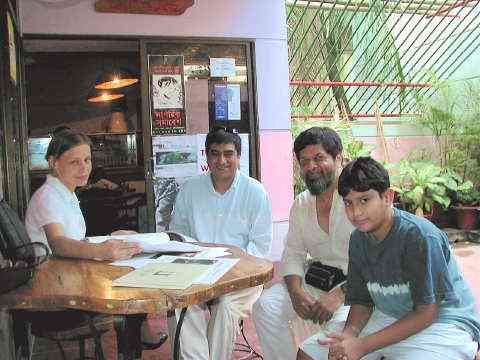
Dr. Shahidul Alam
(third from the left) now joins the group
The tropical sun in July could be
ruthless and it was. Tanvir’s car was a god-send to me because it
was air-conditioned. We started our trip at the scheduled time.
To go from Gulshan to Tejkunipara’s ‘Bijoy Shoroni’ was a cinch because
we chose to hit the road in an off peak time. But as we crossed the
Sher-e-Bangla Nagar to hit the crowded Mirpur Road, the traffic came to
a virtual halt. We spent more time on this road plodding through
a mountain of traffic. However, since we were having some good conversation,
which is always the case when I am with Tanvir, the time passed by quickly.
I must admit that Tanvir is a seasoned driver in Dhaka who knows the modus
operandi of other drivers on the road. I had hard time believing
that the same person who drove cars in the highways in Wichita, Kansas
could drive so confidently in Dhaka. Swear, I won’t be able to drive
in the streets of Dhaka. But its is a breeze for Tanvir. Indeed,
he is a jack of all trades!
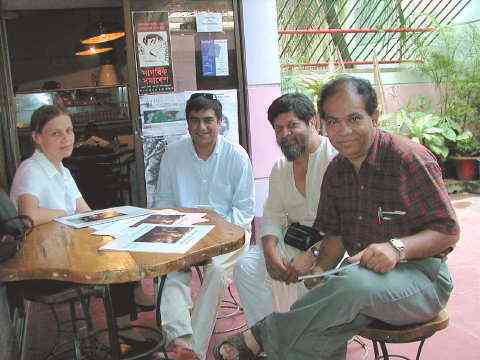
I was asked to join
at the table for a photo session
Finally, Tanvir stopped his car
in front of a large sized multistoried house in Dhanmandi. The sign
outside says it is the office of Drik. As we entered the building,
we saw many busy people doing office works in groups of 4 to 6. It
was a lively place. Tanvir already knew some folks in the DRIK building.
He inquired about Shahidul Bhai. They said he is out of the building
but will return any moment now. Tanvir knew this place in and out
and he showed us various departments of the Drik organization. We
saw some young folks in the multimedia lab. We climbed the stairs
to go on the rooftop where we saw few more rooms. On the penthouse,
we found a small but cozy cafeteria. They were serving some jumbo-sized
Shingara, ice cold soda pops and hot teas. It was the time of the
day one could go for lunch or have a mid-day snacks. Those mouthwatering
Shingara in the cafeteria was too good for satiating our taste bud and
stomach too. Tanvir asked humorously, "Jaffor Bhai, Cholbe?" pointing
to the Shingaras. I said, "Oboshshoi!" He ordered soda pop
for my son. Hot teas also complemented our mid day snacks.
As we were having our abbreviated lunch Tanvir gave me some ideas of the
Drik organization. When we are about to be done with our snacks,
everyone’s lovable Shohidul Bhai showed up before us apologizing profusely
for his delay. We said we didn’t mind his delay because those Shingaras
were too good for our taste buds.
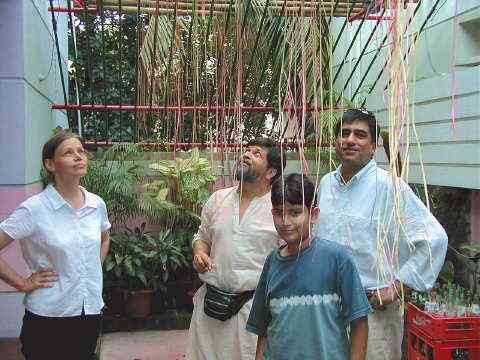
Dr. Alam explains
the hanging roots that came from potato plants from top.
He planted potato
plants on tubs and put those om bamboo scaffold. The hanging
roots created an artifact
that is aesthetically pleasing to look at.
Here is a primer on Dr. Shahidul Alam and his brainchild Drik.
Dr. Alam comes from a very enlightened family. His father Prof. Kazi Abul Monsur now deceased was a renowned medical microbiologist who had his education Calcutta in the pre-partition days. He later developed a synthetic media for bacteria that causes cholera, which is widely known as "Monsus’s media." Dr. Alam studied and taught chemistry in London University before taking up photography. He returned to his hometown Dhaka in 1984, where he photographed the democratic struggle to remove General Ershad. Dr. Alam was a former president of the Bangladesh Photographic Society who set up the Drik Agency, the Bangladesh Photographic Institute and Pathshala, the South Asian Institute of Photography. He has been a recipient of the Mother Jones, Howard Chapnick and Andrea Frank Awards.
A small group of people headed by Dr. Shahidul Alam set up a picture agency in the unlikely location of Dhaka, the capital of Bangladesh. They named Drik, the Sanskrit word for vision, the agency set out to represent a group of media professionals that other agencies did not cater for, practitioners living and working in the majority world. In the years that have followed, many others from Asia, Africa and Latin America have joined the original group. All of them share a common vision; one that sees the majority world, not as fodder for disaster reporting, but as a vibrant source of human energy and a challenge to an exploitative global economic system.
Drik also pioneered the introduction
of email into Bangladesh and it continues to take the lead in new media,
through not only the launch of the nation's first webzine Meghbarta, the
web portal Orientation, and the country's human rights portal Banglarights.
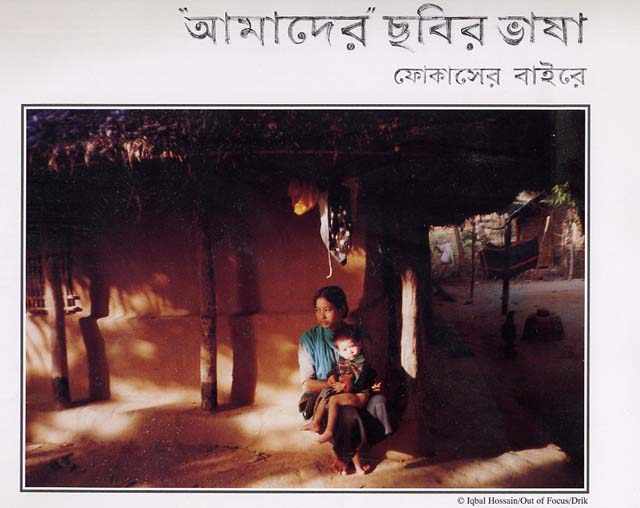
One of the photos
taken by a student of Drik's Pathshala Iqbal Hossain.
This is a image from
Rangamati, Chittagong Hill Tracts
In spite of my good intention to visit Drik’s picture gallery because of lack of time and due to impromptu arrangement for coming to see Dr. Alam, I did not even bother to step inside the library. I am a great fan of picture library. A quarter century ago I visited New York City’s MOMA (Museum Of Modern Art) in the mid-town Manhattan where I saw some rare photographs of world’s leading exponents of black and white photography such as Edward Steichen, Ansel Adams, Alfred Stieglitz, Edward Weston, and few other leading photographers of early twentieth century. Now I hear that Dr. Shahidul Alam and his Drik library is the proud owner of some very precious photographs of early days of Bangladesh.
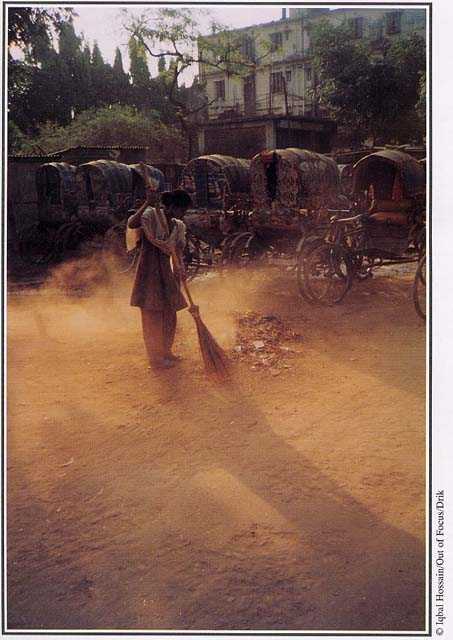
Street sweeping by
Iqbal Hossain, a graduate of Drik's Pathshala
I hate to admit that we superficially went over the Drik building to see their media lab and few other rooms. I was told that the best time to visit Drik is when they are having an exhibition on a theme. This organization is one of a kind in entire Bangladesh. I am intrigued by Drik’s Pathsala where young students come from every walks of life to learn photojournalism. I have seen some of the prized work of Pathshala students. These work of art may compete head-to-head with other countries’ photojournalists. Children from disadvantaged families are acquiring a skill of lifetime with which they can capture a news story or perhaps they could document a phenomenon which otherwise cannot be documented. Thereby, these kids are becoming an asset to Bangladesh societies. Dr. Shahidul Alam has thus embarked on an ambitious journey that is limitless in scope and effect. If Bangladesh would have many more Shahidul Alams, then they could have developed many prized institutions in myriad fields. In the West, this has already happened. However, comparatively speaking, Bangladesh is still an infant nation. I am sure looking at the progress made by Drik already many more worthwhile institutions will grow to enrich the minds of our people back home. In a sense, Dr. Shahidul Alam is a peerless intellectual, leader, and an educator.

Girls combing each
other's hair by Refanur Akhtar Moli of Pathshala

Fallen petals of Krishnachura
on a ghat by Rubel Pal, Drik Pathshala
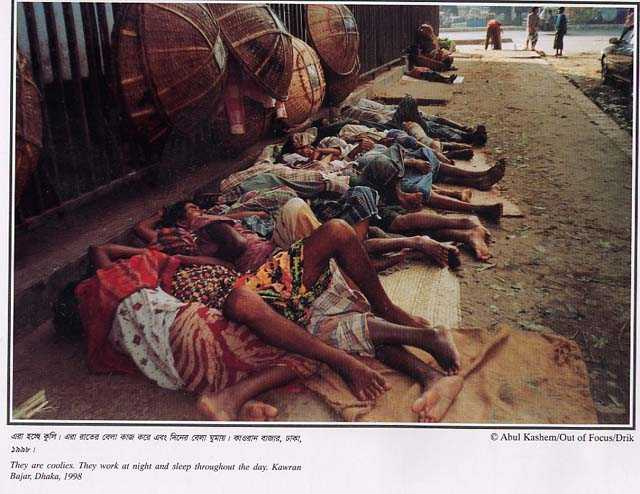
The sleeping coolies.
They work at night and sleep like log through the dawn.
The photo by Abul
Kashem of Drik's Pathshala
May I request readers to pay a visit
to Drik Library when they visit Dhaka next time. Drik is located
at House 58, Road 15A (New) in Dhanmandi, Dhaka. Their e-mail address
is:
[email protected] and their web
address is - http://www.drik.org Tell
Dr. Alam that they were enthused by a simple write-up from me.
------------------------
A.H. Jaffor Ullah writes from New
Orleans, USA. His e-mail address is -
[email protected]
To get back to the Index Page of Jaffor Ullah's illustrated articles Click Here