By A.H.
Jaffor Ullah
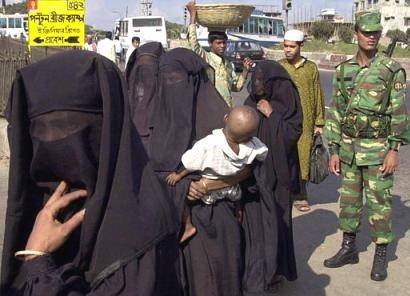
A mini Buqa brigade
invading the Ijtema ground on Friday, Dec 13, 2002.
Photo: Courtesy of Pavel
Rahman, AP
By A.H.
Jaffor Ullah
A mini Buqa brigade
invading the Ijtema ground on Friday, Dec 13, 2002.
Photo: Courtesy of Pavel
Rahman, AP
Once again, Bangladesh is hosting the most participated Islamic conference on earth calling it “Bishwa Ijtema” or “World Congregation.” Why shouldn’t they? An estimated 3 to 4 million Bangladesh citizens are expected to participate in Ijtema on Sunday, Dec 15, 2002, when Akheri Munazat or 'Final Supplication' will be performed to end the 3-day marathon preaching session. More devotees will visit Ijtema ground the Hajj ceremony (1.9 million for Hajj versus 3 million for Ijtema on the Akheri Munazat day!). Nonetheless, all newspapers from Bangladesh call this Islamic congregation the number two assembly only after Hajj ceremony.
This year’s Ijtema has started in time but the mood must be subdued in Ijtema ground because of what did happen in recent days in the country. During Ramadan, 30 or more indigents have succumbed to death while a stampede ensued in Gaibandha only to mar the sanctity of a zakat-giving ceremony hosted by a rich businessman. Then on Eid day, some fringe groups blasted four powerful bombs in several cinema halls in Mymensingh claiming at least 18 lives. Aside from these casualties, Bangladesh is also experiencing a tough time because of political dissension, which is widespread in the nation of 130 million mostly impoverished people. The government has brought the army, BDR, Ansars, etc., in late October this year to catch Bangladesh’s garden variety thugs, mastans, troublemakers, etc., in which 36 or more people have died because of questionable ‘Cardiac Arrests’ by the army. On top of it, the Government has compromised the good name of Bangladesh by arresting 2 foreign journalists and two of their Bangalee “accomplices.” The arrests of the foreign reporters were a PR disaster of monumental proportion by the government. Another odd development is the arrests of two intellectuals including a respected historian who also teaches at Dhaka University and arrests of opposition leaders right after the Mymensingh bomb blasts giving the impression that these arrested people are somehow connected to serial bomb blasts in Mymensingh on Eid day.
Because of all the above-described
incidents that have created a negative feeling amongst Bangladesh citizens
this year’s Ijtema is being celebrated with a somewhat subdued mood.
Gone are the vivid descriptions of each day’s event in the national news
dailies. Yes, we have seen copious write-ups on Ijtema on
Friday, December 13, 2002, in most newspapers. But not many photos
accompanied the news. However when I visited the Yahoo news site
in the Internet, I saw two recent photos taken at the Ijtema venue by Associated
Press (AP) photographer Mr. Pavel Rahman. In one of the two photos
published by the AP on the Internet we saw that a septuagenarian who could
barely walk is being assisted by his companions is being helped in the
Ijtema
ground.
 |
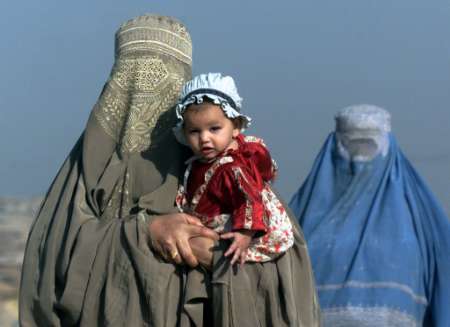 |
On Saturday morning, December 14, 2002, I visited the Yahoo site again hoping to see some colorful photos of the Bangalee Musulli (an Arabic term used endearingly by the Bangalees to distinguish pious folks in Bangladesh) who are attending this year’s Ijtema. Nonetheless, I was very surprised to see a digital image of a bevy of Burqa-clad Bangalee women venturing out to the Ijtema ground. I liked the photo taken by Mr. Pavel Rahman so much so that I thought it should accompany my article because I am a firm believer of the axiom “a picture is worth thousand words.” This photo was composed beautifully. It epitomizes everything Ijtema and modern-day Bangladesh stand for. An army Jawan (soldier) is standing tall on the right side. He is appropriately armed to signify that he is the emblem of power and authority in Bangladesh, which is very true today than any time in the last 10 years. The centerpiece of the photo is a group of 4 Bangalee women who are all Burqa-clad. The color of the Burqas is all black. The Bangalee women are not as fashionable as Afghani women who do not mind wearing Burqas made of pastel colors. Never mind that Herati Burqas with hundreds of pleats are prized for fashion all over Afghanistan. As compared to “Designer Burqas” made by Herati seamsters our Deshi made Burqas look like they are only meant for attending funerals and I am not kidding folks!
The Burqas as displayed by the Bangalee women in Pavel Rahman’s brilliant photo are made of three parts: head gear to cover the head and then one extra piece to cover the lower part of face, and the big cloak or cape like piece to cover the entire body. The only part of the body that is discernible to outsiders is the women’s eye and part of her nostril. That is all. No doubt that the Bangladeshi variety Burqa has the approval of the country’s clergy and fundamentalists. And I bet some of the Mussullis on Ijtema ground in Tongi must be ecstatic since our own Bangalee women have finally draped their body as per the dictum of Islam. Can you imagine our college and university girls all wearing this oppressive dress in the campus? It surely will create one hell of a confusion (no pun intended, of course!). The AP photo of the gaggle of Burqa-clad Bangalee women entering Ijtema ground also shows other subtle things that are worth mentioning here. A young man with Tupee (skullcap) is seen following the Burqa-clad bevy of women who is also carrying bags. Why not? We see in the photo a child clinging to the arm of one of the women. In Bangladesh, a good Islamic woman is not allowed to venture outside her home all by herself. Therefore, she must have a Guardian Angel. The young man who is wearing a “devotional cloth” – an Islamic dress is acting as the Guardian Angel for the bevy of women. To complete the photo we badly needed some onlookers! The photographer Mr. Rahman knows how to compose a good picture. Here we have a traveling salesman (Feriwala) with a basket on his head who is ogling the bevy of Burqa-clad women. Quite a spectacle, may I say? To create a tension, the photographer captured quite a few automobiles in the background. This juxtaposing of ancient mindset symbolized by the Burqas with modernity represented by automobiles was done wonderfully. And I thank enormously Mr. Pavel Rahman for this great photo. The placement of a tall and stout army man manning the entrance to the Ijtema ground in the picture was also wonderfully done. Mr. Rahman gets A++ for his compositional skill.
A woman going to public places for religious purposes is somewhat a new development in South Asia. Correct me if I am wrong. Women are barred from going to mosques and Muslim burial ground. When I grew up in the 1950s and 1960s in East Pakistan, I never saw Muslim women going to mosque or visiting a burial site or Kabarsthan. Muslim women shun visiting such places. When someone dies in the family, Muslim men go to the burial site for the last rite of deceased person. Women stay house to lament the death of their dear ones. Similarly, I never saw any women offering salat in a mosque. But things have changed over the last three decades ever since Tablig Al Jamaat organization that is the sole organizer of Bishwa Ijtema started their purification movement exactly the same as “Born Again Christian Movement” that was popularized in the 1950s and 1960s in America. One may call these fundamentalist movements as “Rejuvenation Movement.” The Tablig movement draws inspiration from Deodand Madrassah of U.P, India. That school had received enormous funding from Saudi Arabia since 1950s to promote Wahhabi brand of Islam, which is an austere kind of Islam favored by the Saudi royal family. The Wahhabites have first captured a small mosque in Kakrail in the early 1950s. This mosque is very centrally located in Dhaka near the Ramna Green, which was the name of Ramna Racecourse ground at one time. In the winter months pious villagers used to come to the mosque in the dry winter months to listen to many erudite mullahs perform Tafsirs and Boyan of Qur’an. By word of mouth this Tablig Movement grew from obscurity. In the late 1960s and early 1970s the Tablig Movement moved to the bedroom communities of Dhaka, Chittagong, Khulna, Rajshahi among the educated middleclass. In mid 1960s the venue of the Ijtema moved to Tongi. They never called the Ijtema as “Bishwa Ijtema” in the 1960s. Once the first military dictator of Bangladesh, Gen. Zia, took the control of the nation, this Tablig Movement got the boost in the arm. We heard from our relations and friend that in the late 1970s the Tablig Movement had spread its roots into Bangladesh’s cantonments too. During the time of second despotic ruler, Gen. Ershad, the name and fame of Bishwa Ijtema spread to the four-corners of the world. It then became a huge convention for Islamists. Foreigners started to flock the Ijtema site in droves. The Tablig Al Jamaat organization used to run 5-day Ijtema in those days. Very recently though they have trim it down to 3-day session. Well, within short three decades an obscure movement shunned by the intellectuals and the educated folks of Dhaka has become the number one public gathering in Bangladesh. Only time can tell whether this marathon preaching session will grow even more to accommodate millions of pious Muslims from all rungs of Bangladesh society. My intention was never to tell the readers the history of Ijtema and its growing popularity among the plebeians of Bangladesh. However, it is very tempting to tell the success story of Ijtema because if reform-minded Bangalees and secularists could ever fashion any social movement with grassroots organization such as Tablig Al Jamaat, then there is the possibility that we could be successful. Unfortunately, we do not have both the tenacity and foresight to launch a movement that may take close to three or four decades to show some perceptible results.
Aside from the story of Tablig
Al Jamaat’s successful Ijtema hosting for three decades what
I tried in this article to show that women are participating in marathon
preaching session. As I was giving a finishing touch to my current
write-up I was reading some of the leading English news dailies published
from Dhaka. It was mentioned in several newspapers that the two Prima
Donnas of Bangladesh politics, Mrs. Khaleda Zia and Hasina Wazed, would
participate in Akheri Munazat on Sunday, December 15, 2002.
It was not mentioned anywhere though whether these two leading ladies would
don the traditional black Burqa to match the sanctity of Bishwa
Ijtema. In the meantime, many plebeians amongst the participants
who are females would wear the Islamic garb, Burqa, to participate in the
final supplication ceremony. When it comes to earn some Swab (supplication)
for afterworld (Akheraat), women should not be barred from such
program. The Mullahs manning the program would not appreciate though
seeing gals from colleges and universities attending Ijtema ground
in fashionable designer jeans. Whether a fashion industry dealing
with Burqa culture will ever flourish in Bangladesh or not, that
remains to be seen. Perhaps Bangladesh government should take an
initiative to send a delegation team to visit Herat, which is considered
the Burqa fashion capital of the world. The Afghanis may be down
and out after the disastrous war of 2001 in the aftermath of 9-11 incidents,
but I bet their Burqa industry is flourishing one more time.
Habits don’t die out that easily. If Bangladesh’s Tabligis
have their way, all adult women should wear Burqa or Hijab
of some sort. Is Burqa going to be fashionable anytime soon
in Bangladesh? You can never tell! I never thought for a moment
that Ijtema would become such a big media event in Bangladesh either.
------------------------------
A.H. Jaffor Ullah writes from New Orleans. His e-mail address
is - [email protected]
Jaffor Ullah's Illustrated article's
Index Page