Hindu
belief system: Pictures worth a thousand words
(Part Two)
By A.H. Jaffor Ullah
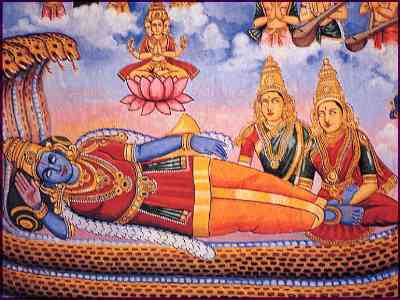
Vishnu reposing on serpent Ananta with his
retinue by the side
Hindu
belief system: Pictures worth a thousand words
(Part Two)
By A.H. Jaffor Ullah
Vishnu reposing on serpent Ananta with his
retinue by the side
Unlike the Greeks of ancient time, who had penchant for writing down their history in great detail, the people of Indian peninsula never thought of jotting down the account of their personal, societal, and national life. They were simple folks, their life was equally simple, their climate would not allow preservation of artifacts, and they cremated their dead. Therefore, the scholars had to speculate the ancient history of this great civilization.
Our understanding of the ancient people of this land we now call Bharatbarsha comes from Vedas, the Sanskrit hymns, which are believed to be about 3,500 years old. The hymns had the influence of ancient Indo-Iranians of Paras or Persia. Some scholars think that the Aryans (Indo-Iranians) may have entered the northern part of Bharatbarsha sometime 5,000 to 3,500 years ago. These people must have their gods and their belief system. How much of their belief have shaped up the Vedic wisdom is a matter of speculation.
When the Aryans lay their steps in North India through the mountain pass such as Khyber Pass (now in NWFP of Pakistan), the Bharatbarsha already had a full-blown culture established on the riverbanks of Sindh at Kot Dijji, Mohenjo Daro and other such places. The archeological evidences point out a civilization as old as 3,700 to 5,500 years old. In South India too, they had a flourishing culture that is called the culture in, around 2,500 BCE, and 1,000 BCE. Therefore, it follows that the belief system in Hinduism and its mythology must have had the influence of these three cultures.
The ancient Vedic hymns
From time immemorial, in Bharatbarsha we had an oral tradition of passing Vedic hymns. Thus, Vedas or Ved Bakyas were also called Srutis (literally mean to be heard). These Slokas were first heard probably around 1,400 BCE. The Slokas were handed down to the next generation through Brahmins, who were the keepers of Vedic hymns. The ancient Brahmins thought that the Vedic hymns (Vedic wisdom) were given to Adi Brahma when the universe was created. Therefore, they Slokas were too sacred to be uttered only by the Brahmins. In Hinduism, the times (eons) were divided into four Yugas (Bangla Jug), namely, Satya, Treta, Dwapar, and Kali. The Vedic hymns were passed on to the next generation aurally until the Kali Yuga, when the Brahmins thought that the human memory and intelligence were deteriorating. Thus, for the sake of preservation all they hymns were compiled into four Vedas, namely, Rig-Veda (containing about 1,000 hymns), Jaju or Yajur-Veda (technical instructions for the priests), Sama or Shamya-Veda (ritual formulas), and Atharva-Veda (magical spells). I have seen many paintings of god Brahma in which He carries four Vedas in his four hands. The following painting is a glaring example of Brahma holding the Vedas.
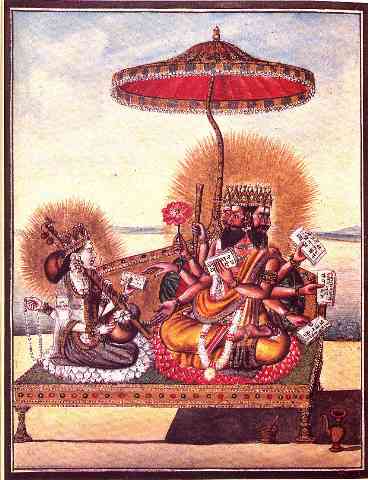
Brahma with four Vedas shown with his consort
Devi Saraswati
The vast body of spiritual learning encoded in four Vedas is collectively known as Vedic literature. The stories of Gods and Goddesses and their actions that are entwined with the lives of the mortals are the lifeblood of Vedic literature. The ordinary mortals interacted with the higher beings such as Vishnu, Shiva, and the Supreme Being, Brahma. Besides Veda, there are other Hindu literatures where commentaries were made on Vedas. These are the Brahmanas, the Aranyakas, and the Upanishads. The Upanishad is also called Vedanta (Veda + Anta) or the end of Vedas. It is any of a group of philosophical treatises contributing to the theology of ancient Hinduism, elaborating on the earlier Vedas. The Samsad Bangla dictionary calls Upanishad "a collection of Gyan-Kanda" (Wisdom Literature) of Vedas. Therefore, Upanishad deals with ancient knowledge. Hindu scholars think that Upanishad was developed around 1,000 to 500 BCE. It is worth mentioning here that Bengal’s greatest poet Rabindranath Thakur mentioned Upanishad’s Slokas instead of Gita, which is more of modern development. More on Vogobat-Gita later in this series. In Upanishad -- which is a collection of philosophical treatises -- the main emphasis was given to mystical significance of rituals rather than their practices. Therefore, the Upanishads explain a whole variety of speculative interpretations of the universe and man’s unique place in it.
We all know that every religion on earth deals in the creation theory of their own. The Hindu religion is no exception. Most of the myths dealing with the creation of Hindu heavens and earth and everything in between these two are contained in Rig-Veda. The hymns of the Reg-Veda were addressed to the Vedic gods, who are: Agni (the fire god), Indra (the thunder god), Vayu (the wind god), Surya (the sun god), Aditi (the sky or firmament god), Varuna (the rain and sea god), Ushas (the dawn god), Prithivi (the earth god), Yama (the death god), Rudra (the storm god), Vritra (the draught god), Marut (the god of the whirlwinds), etc.
The above mentioned gods of the Vedic pantheon were part of Hinduism in the ancient times perhaps for centuries dating back 1,000 BCE. However, their importance and sphere of influence were diminished to great extent because of the emergence of more complicated order of gods.

The thunder god Indra riding an elephant brandishing
daggers
The god Indra is a perfect example of how his stature was diminished with the emergence of the concept of Hindu Trimuti (Trinity). Indra was an Aryan god of war who was considered king of heaven in early times. However, at later time Indra was given a lower status. Nonetheless, the Hindus continued to worship him as a ruler of skies and god of rain shower and thunder. In ancient time long before the arrival of Brahma, Vishnu, and Shiva the Hindus had Indra as one of the powerful gods. He was a god of heroes and of war, who must have goaded the Aryans in battles and used lightning bolt as his weapon. Indra was more than a war god. He was a pleasure loving and quite amoral. The Sanskrit word Indrio (Senses) may have some connection to god Indra. His fondness for feasting and drinking, gambling, and dancing is well known. There is such a term call “Indre’r Shova” (Indra’s assembly) in Bangla literature and music. He is also famous for leading people into war. Therefore, his is a character of robust, boisterous, and extrovert people who lack spirituality.
In the earlier time, among Hindus the cohesive force in the society was not the rule of the gods. There was no orderly system among the gods. Therefore, the cosmic order was maintained by a set of rules called Riti. Thus, Riti was the law that “both sustained the universe and regulated the conduct of men.” The scholars put much emphasis on Riti because it governed such rhythm as the cycle of day and night, sequence of the seasons, and it fixed the relationship of men to god and of men to other men. Therefore, if a man had a disorderly conduct, he breached the cosmic order Riti.
God Varuna was associated
with Riti or cosmic order. He was an important god who had
a place in heaven. According to Hindu scholar, Varuna had
not created the cosmic order; he was simply its guardian. Varuna
must
have been a stern god because he guarded Riti very jealously.
That is the reason why Aryans really feared Varuna the most among
other gods in ancient time.
--------------------
A.H. Jaffor Ullah writes from New
Orleans. His e-mail is: [email protected]
Return to the Index
Page of Illustrated article?