Hindu
belief system: Pictures worth a thousand words
(Part One)
By A.H. Jaffor Ullah
Hindu
belief system: Pictures worth a thousand words
(Part One)
By A.H. Jaffor Ullah
The Old Bengal used to be one of the citadels of Hinduism. Granted that the fabled cities such as Brindaban, Mathura, Ayoddha, Obonti, Ujjaini, and more like them were never a part of Bengal, but the importance of Bengal and their Brahmins comes way later. Bengal was and still is a major supplier of Brahmin who could read slokas from Bhagavad-Gita, or from ancient Upanishad, Veda, or even Puranas with near perfect Sanskrit pronunciation. The story of Bengali Brahmin serving as purohits is mentioned copiously in the work of Bibhutibhushan Bondopadhaya’s Apu’s trilogy, which the late Satyajit Roy captured in celluloid films. Indeed, in the pre-partition days, the Bengal’s Brahmins were very much sought after purohits elsewhere in Bharat from Mount Kailash at the far north to Cape Coumarin in Deep South.
As a child growing up in East Bengal, I was lucky enough to see Hinduism alive when we attended some of the Puja ceremony both in the cities and in the villages. A trip to Durga Puja mondop in the village in Mymensingh brings back a lot of memory in me. The communal harmony was there before. That is what I learned from my father and my uncles. But that age-old harmony vanished into the thin air when the Muslim Leaguers brainwashed our people in East Bengal in the aftermath of 1940 Lahore Resolution. The communal strife was on the rise all through the 1940s, which culminated in the establishment of Jinnah’s Pakistan in August 14, 1947. Sir Cyril Radcliffe’s cold scissors divided not only Bengal but also Punjab in the northwest to give birth to a nation call Pakistan. However, that nation, which was based on religion, did not last for too long. Only after 24 years, the East and the West parted their ways (actually the East said Sayonara to the defiant West) and we got Bangladesh in the process.
In the last thirty years ever since Bangladesh was created, the Hindu population had decreased tremendously in this tiny land. The casualty in the rise of Wahhabism in Bangladesh is the communal harmony. The kids who grew up in the last quarter century in Bangladesh would hardly understand the Hindu philosophy. Therefore, one hears nothing but derogatory comments from Bangladesh’s Muslims. The nation under the spell of Wahhabism has become intolerant. We saw how the minority Hindus fared in the hands of Islamic goons in the wake of October 1, 2001, general election. We all should try to teach our majority population in Bangladesh to live in peace and harmony with our minorities. The antiquated Hindu philosophy had tried to answer the meaning of life and death to millions of people of Bharat for quite some time. This religion, which is a way of life for six hundred million plus people in India alone, should be understood by 280 million Muslims living in this subcontinent if we want to co-exist peacefully. Let their belief be theirs. There is no reason to taunt a Hindu telling him that it does not make any sense to worship a icon. I understand that in Islam no one is worse than a idolater. Nevertheless, that does not give us a carte blanche to ridicule a Hindu telling him that Islam is superior to Hinduism. Since both the systems are based solidly on blind belief system, to me no one is superior to the other. I surmise very little is known about Hinduism and their belief among Bangalee Muslims. Therefore, this is a very amateurish attempt on my part to bring the elements of Hinduism into the fore. However, a feeble attempt is better than no attempt. I ask the Hindus to forgive me for attempting to discuss Hindu Philosophy in couple of pages when I know fully well that it took close to a couple of thousands of years to develop the religious philosophy of Hinduism. Indeed Hinduism has grown from the days of Puranas to the modern days when Sri Rama Krishna Porom-Hongshadev developed his Bhakti School Hinduism for the most common and ordinary people.
This primer on Hinduism that I am about to narrate is for non-Hindu readers only. In addition, I will take the help of modern-day paintings to describe the essence of Hinduism. This article of mine is by no means an authoritative one on Hinduism. The intent was not to write one such article. Moreover, I claim to be no expert in Hinduism. If I err unwittingly, I beg forgiveness from my Hindu readers. By all means correct my mistakes by writing rejoinders. It is only through this process, could we enrich our mind on any thing and that includes Hinduism too. If I may add here a sentence to the effect that these days in Bangladesh most policymakers who are at the upper echelon of politics and bureaucracy are not Hindus in the first place and as such, they do not understand Hindu philosophy to the level to appreciate the age-old religion. Because of this, Hindus and their way of life is not much appreciated by them. This is adding fuel to the fire for sure because when the hoodlums go into the rural areas to wreak havoc on Bangladesh’s Hindus, we do not hear much condemnation from the folks whose opinion matters for keeping fragile peace and harmony between the Muslims and Hindus. I would consider my small effort -- in exposing Hindu belief system to my Muslims readers -- a success if I could induce few of my Muslim readers to understand the view that we should not discriminate people solely based on religion.
Om
or Aum, the holy word
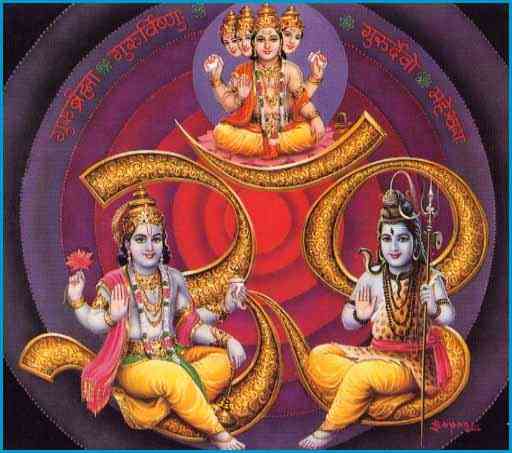
We often hear the word Om or Aum uttered before any slokas from Gita or Veda. Even musicians also utter this sacred word before singing Hindu hymns. Pundit Ravi Shankar made a CD under Angel label in 1997 by the name Chants of India, a very pleasurable collection of Hindu devotional songs with copious utterance of mantras. Many of the songs in this CD start with the word Om. Thus, Om is a mantric word, the Hindus call it Prana Mantra, they believe it to be a complete expression of Brahman and interpreted as containing three sounds -- a, u. and m -- each representing Brahma or creation, Vishnu or preservation, and Siva (also Shiva) or destruction. Others also interpret the sound Om as consisting of the same three sounds each representing walking, dreams, and deep sleep, which is followed by silence—meaning fulfillment. Other Hindu scholars believe the word Om to be the spoken essence of the universe. Therefore, it is uttered as a mantra and in affirmations and blessings.
This painting tells it all. The sacred word Om had encompassed all three Gods among Hindu pantheon. On the top Chandrabindu (half-moon shaped alphabet) is seated four-headed Brahma (The Creator God) who is the first member of the Trimurti (Hindu Trinity). In this painting, the front face of Brahma is male, however, the three other faces are very effeminate. On the forehead of each four heads, one could see a symbol - a rectangle with one stripe in the middle - reserved for Brahma only. Lord Vishnu has a U-shaped mark on his forehead, while Shiva has three horizontal bars on his forehead. In South India, many Vishnu disciples put three short vertical bars on their forehead.
In the above colorful illustration, one could see four phrases written in Devanagari script. From left to right they say, Guru Brahma, Guru Vishnu, Guru Deva, and Maheshwara (Maha + Eshwara). The other minor features associated with each god are the following: Brahma sits on a lotus flower and he has a Kundu (water container) next to him; Vishnu carries a lotus flower on his right hand, a conch shell on his left hand; Shiva carries trident (Trishul) by his left hand in which is attached a small drum (dugdugi), water comes out of his head (The Ganges), a half moon shows up near his forehead, and cobra wraps around his neck. All three Gods lift their right hand to bestow ashirbaad (blessings) to their disciple.
Each geographical region of India has their preference for Hindu Trinity. While Brahma is pretty much left alone so that he could create things for a living world, some region shows preference for Shiva. The entire Bengal, Orissa, Assam, parts of Bihar and Uttar Pradesh show a liking for Shiva. They are called Shaivaites. To identify a sadhu or a Brahmin whether he is a Shaivaites or a Vishnuvites (Baishnavas)all one has to do is look into his forehead. If one can find three horizontal lines on the forehand, then this would mean that the person sporting the three short horizontal lines is a Shaivites or a lover of Lord Shiva. The western and southern states are the domain of Lord Vishnu. Krishna is an avatar of Lord Vishnu. Most Krishna story happened in Uttar Pradesh’s Mathura and adjoining place. I think Indian scholars would agree with me that Vrindaban (or Brindaban) is a mythic place where from the Krishna legend flourished.
{To be continued]
--------------------
A.H.
Jaffor Ullah writes from New Orleans
Return to Index
Page of Illustrated articles?