Paganism 101
Some basic facts about Paganism in general that may ease some confusion:
- Most Pagan religions are modernized versions of ancient Earth religions. Some, like technopaganism, are more modernized than others. Some Pagans may refer to themselves as "eclectic," which means that they don't follow one traditional path, but meld customs and beliefs from many paths into a personal dogma that feels "right" to them.
- Most Pagan religions believe in multiple deities. Many have a Goddess as the main deity, but not all. However, some Pagan faiths don't have any deities at all- some may worship a "life force" in an unpersonified form. Buddhism seems to be on it's own, since it doesn't have a deity- "Buddha" is the term used for the enlightened man who founded and taught the religion.
- Since many Pagan religions are Earth-based, a lot of Pagans have a high respect for nature and tend to be enviromentalists.
- Pagans don't worship the devil. In fact, most Pagans don't believe in the devil at all- the concept originates in Judiaism. Technically, Satanists are a Judeo-Christian sect, but with their focus in a different direction.
- Most Pagan religions teach the idea of karma- what you do comes back to you, so many have the golden rule in one form or another as one of their main laws.
- Many Pagans seem to be very open minded, because so many Pagan faiths teach that everyone is basically the same.
- Many Pagans believe in a life force, or magick, using the 'k' at the end to seperate the idea from that of stage illusions. A lot of them believe that this is just the next scientific discovery- after all, magnetism was once thought of as a form of magic.
- The term "warlock" should never be used to refer to male Pagans, as it means "oath breaker". Pagans of both genders are commonly reffered to as "witches" or "pagans".
- Even though some people believe that the word "witch" is negative, it really isn't. The term "witchcraft" comes from the Celtic term meaning "wise, good people."
- Pagans dress just like everyone else. Just because someone dresses "goth" doesn't mean that they're Pagan. Also, the fact that someone is a Pagan doesn't mean they dress in black and wear a pointy hat.
- Anybody can be Pagan- it isn't just little old ladies who live in scary houses and have a thing for cats, or loner teenagers with dyed hair and lots of piercings. While these people may- or may not- be Pagan, Paganism includes people like your doctor, or lawyer, or teacher.
- Many Pagans do use spells. Spells are like a form of prayer. Along with that, rituals could be compared to Judeo-Christian mass, and Sabbats are holidays. Some Pagans may meet in covens to worship as a group, while others prefer to worship on their own.
- Pagans also use wands in spells. Unfortunatly, it's not like the cartoons- you can't wave the wand and make a new car appear, or clean your room. Wands are used in spells and rituals to direct energies. Some pagans prefer to use an athame (a dull bladed knife), sword, or staff instead of a wand, but the function is the same. It's just a matter of personal preference.
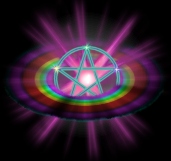
- The pentacle is a common symbol in Pagan faiths. Contrary to many media depictions, pentacles are not a symbol of evil.
More on pentacles
Thank you to Mystic Sam for sending me the articles I got this information from.
If anyone thinks of anything I should add to this list, send it to me at [email protected]

Info Pages
Home