Welcome
I have had the priviledge of receiving one of these beautiful rings from a
very dear friend of mine. I have never seen one of it's kind before, until
I was givin one for Christmas. It is simply beautiful. And the story behind it
is also beautiful. Here is a History of the Claddagh Ring....
The Claddagh Ring History The Claddagh ring is
so called because it is believed to have originated in the
Claddagh, Galway, and is unique in as much as it is the only ring
in the world of a distinctive design used exclusively by a small
community for over 400 years. "Claddagh" means a
village situated near the seashore. In Galway the village
was outside the walls and was divided from the city by the River
Corrib. It was irregularly built but very extensive.
It was the first residence of the Celtic settlers in this
area. They were an exclusive community and strangers were
never allowed to settle amongst them. From time immemorial
the Claddagh was ruled by one of its inhabitants, periodically
elected, who was called King. He administered their laws
and settled all their disputes according to old age
customs. His only distinctive mark was a white sail at his
masthead when the fishing fleet put out to sea. The sole
occupation of this colony was fishing; in fact, they were not
allowed to use spade or hoe. The municipality compensated
them for their fish by giving them sustenance in all their needs.
The Claddagh was used by these people as a marriage ring.
Even to the present day the ring has associated with it special
customs, for instance, it is not right for a Claddagh person to
buy a ring - they must obtain it as a gift. If married, the
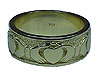
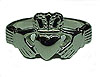
ring should be worn with the crown nearest the knuckle. The rings
consists of two hands holding between them, or presenting, a
heart. Over the heart is a design representing a crown or
fleur de lis. The phrase or posy, that usually accompanies
the ring is: "Let love and friendship reign." There are
two interesting versions of the origin design used in the
Claddagh, both of which are associated with the "Joyce"
family, one of the famous "Tribes of Galway." Margaret
Joyce, surnamed Margaret of the Bridges, from the great number
that she built, first married Domingo de Rona, a wealthy Spanish
merchant who traded to Galway, where he fell in love with
her. Soon after departing for Spain, he died there and left
her his immense property. She subsequently married Oliver
Ogffrench, who was mayor of Galway in 1596. During his
absence on a voyage she built most of the bridges of Connacht at
her own expense. One day, when reviewing this work, an
eagle dropped a gold ring into her lap. It was preserved by
her family in 1661 and was considered as a providential reward
for her good works and charity. This ring could well have
been the original Claddagh ring. The story of Richard Joyce is
more factual. A native of Galway, he was captured by an
Algerian corsair while on his way to the West Indies. At
Algiers he was sold as a slave to a wealthy Moorish goldsmith,
who found him tractable and ingenious in this trade in which he
soon became an adept. In 1689, William III of England sent
an ambassador to Algiers demanding the release of all the British
subjects detained there in slavery, with which demand the Dey
reluctantly complied. The Moor offered Joyce his daughter
in marriage and half his wealth as an inducement to remain but
this offer was refused and Joyce returned to Galway. Here
he set up as a goldsmith and prospered. Some of his work,
stamped with his mark, an anchor signifying hope and initials
R.I., is still in existence. To Richard Joyes or Joyce, is
attributed the Claddagh ring design. Some hold that he
brought the design from Algiers, but could have also have
obtained the unique and original design from his kinwoman
Margaret of the Bridges. This ring became popular outside the
Claddagh about the middle of the last century, especially as it
was claimed to be the only ring made in Ireland ever to be worn
by Queen Victoria and later King Edward VII. It is daily growing
in popularity because of its unique design, its peculiar history,
its sentimental appeal and its close association with the ancient
Claddagh of Galway.

If you would like to purchase one
Please visit the link that I have here