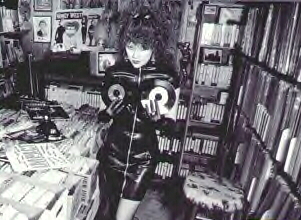
�Poison Ivy, a golden harem sphinx, a sheen of perspiration over her alabaster body. Sweat streaks her guitar as she plays keen bloodnotes. The songs are of decapitations, transmogrifications, psycho frenzies, invading saucermen, voodoo, and pussy. Always pussy. It�s a smoking, fuzzy, wild sound, full of an intensity that lies halfway betweebn sexual stimulation and demonic possession.� For once a record company promo write-up smacks of accuracy.
Stay Sick!, the first Cramps album to come near the mainstream, positively slithers with the procreante urge. Poison Ivy�s distorted rockabilly riffs cover Lux Interior�s monstrous, monotone vocals like cool Calamine � maximum reverb and tremolo, please. While Lux lampoons images of smoking poodles, drag racers on acid, and women swimmin� in chilli, Poison Ivy plays the straightwoman, creating �50s-approved guitar parts that pay tribute to the likes of Link Wray, Paul Burlison, and friends. Seldom has psychobilly been so appealingly packaged.
The Cramps saga began more than a decade ago - at a roadside near Sacramento, California, to be precise. Lux, cruising along in �a very psychadelic mood,�� picked up little Poison Ivy and, discovering their mutual passion for obscure rock�n�roll records, the hitcher and the hitchee became inseperable. Some serious metamorphoses took place during the next several years, leading Lux and Ivy to move to New York City with �Papa-Oom-Mau-Mau� and Link Wray ripchords echoing inside their skulls. With Nick Knox on drums and an ever-changing line-up of second guitarists � �a cavalcade of swashbucklers,� Ivy calls �em � the band got to work.
Their first recording session � produced by Alex Chilton at Sam Phillips� Sun Studios in Memphis � yielded a 45 of �Surfin� Bird� backed by �The Way I Walk.� The first Cramps EP, 1979�s Gravest Hits, explained:
�The Cramps began to fester in a NYC apartment. Without fresh air or natural light, the group developed it�s uniquely mutant strain of rock�n�roll aided only by the sickly, blue rays of late night TV. While the jackhammer rythyms of punk were proliferating in NYC, the Cramps dove into the deepest recesses of the rock�n�roll psyche for the most primal of all rythmic impulses � rockabilly - the sound of Southern culture falling apart in a blaze of shudders and hiccups. The Cramps also picked and chose amongst the psychotic debris of previous rock eras - instrumental rock, surf, pychedelia, and �60�s punk. And then they added the junkiest element of all � themselves.� Seldom had the electric guitar sounded so tortured.
Dressed in jet black, the Cramps became favorites at New York�s CBGB�s and Max�s Kansas City, with Lux destroying up to a half-dozen mikes per night (an impressive feat since they were usually nestled down the front of his leather pants or deep down his throat) while Ivy looked on with a vaguely glazed expression. Fans who made the mistake of trying to grab the outrageously displayed guitarist usually received a swift kick for their efforts. Soon outdrawing most punk acts in town, the band was ready for the road. Their next dose of psychobilly, Songs the Lord Taught Us, was followed later in the �80s by Psychedelic Jungle, Smell of Female, A Date with Elvis and Bad Music for Bad People, as well as guest appearances on � what else? �the soundtracks of Return of the Living Dead and Texas Chainsaw Massacre, Part 2. The Cramps� current lineup was completed when they met bassist Candy Del Mar while fighting over a parking spot outside the Hollywood Liquor barn. True to form, rock�n�roll�s Addams Family signed their latest contract with Enigma Records � while standing over Bela Lugosi�s grave.
Oddly enough, the vamp who-cowrote and produced �Bikini Girls with Machine
Guns,� �Daisys Up Your Butterfly,� and �Saddle Up a Buzz Buzz� provided
a very soft-spoken interview.
________________________________________________________
The Cramps finally seem to be crossing over into the mainstream.
Or are they crossing over to us?
Has your image or over-the-top performances style caused you trouble?
Not too much. Not anymore than most bands. In fact, lately not too
much at all. We used to get in fights and stuff; people tried to pick fights
with us. We haven�t been arrested . I think we�ve been pretty fortunate.
It�s great that this band has been a success for us on whatever level its
been at. I don�t think Lux and I can do anything else (laughs). I�m not
sure we�re even employable doing something else, so it�s good we�re allowed
to do it.
Has your audience evolved?
Every time we play there are newer, younger people. When we started
out in New York at CBGB�s and Max�s Kansas City, fixtures would always
be at the show, but since then its changed. I actually see more variety
at our shows than I do at other people�s shows. I think there�s these facets
that reach different kinds of people. Some people like us for the instrumental
aspects and someone else will like us because we�re dangerous or scary.
How do your shows compare to the records?
They�re different. Some people think that we don�t get that thing we
have live onto our records, and I don�t agree. They�d feel different if
they heasrd a tape of a show which I do a lot of times, because we tape
all our shows. They don�t always sound that great, and I think people get
confused by the visual things that are going on. You have to be there.
But when they talk about the wild aspect not being on the record, I think
they�re just wrong. They�re just remembering how they felt, or maybe they
were loaded at the show when all that stuff was going on. It�s different.
It�s not sloppier live, but even if we play the same songs every night,
they�re never the same way twice. I suppose with recording, we do try to
concentrate on the ultimate arrangement, the ultimate impact.
Do you record live?
Some songs on the new album had to be recorded live - �Muleskinner
Blues,� �Shortnin� Bread�� and �Her Love Rubbed Off� couldn�t be recorded
any other way because of the way we have to interact with each other and
Lux singing. Other ones, though, were tracked with drums and bass first,
although we do that together. We try to track the rythym together; it makes
it easier to record songs.
Where did your idea of the marrige of rockabilly and punk originate?
Well we didn�t think of it as that; others call it that. What happened
was that Lux and I were living in Ohio, just finding wild records. At the
time, the only way you could find rockabilly was on the original 45s; there
weren�t any reissues of it. We were finding some incredible records around
the Akron area because a lot of people from the South had moved up North
to work in the factories and dumped their records. So we were hearing all
this stuff, and at the same time there were contemporary bands we liked.
We loved the New York Dolls and the Stooges, so we were excited by that.
We had boring jobs, we were taking speed, and with the combination of those
things, we ended up going to New York. There was no place in Ohio where
you could have an original band, and we knew that CBGBs was starting�
to happen. We even bought a P.A. � we thought you needed to own your own
P.A. in New York. I mean we didn�t know anything about having a band. We�d
written songs, so we got together with several various configurations before
we actually played CBGBs. When we moved to New York, we saw the Ramones
several times and it was all a combination of our excitement. We knew that
rockabilly and the kind of music we were listening to was what everybody
in the world wanted to hear! At the same time we were really moved and
inspired by punk-rock bands that were happening in New York at the time.
We didn�t have any concept about putting it together; it just happened
kind of naturally. Who we were was more out of control than some of the
music we were listening to, and we were just shoved on in there.
What are the essential elements of the Poison Ivy sound?
Live it�s always pretty much the same. My main live guitar is a 1958
Gretsch 6120 with the pre-patent Filter�Tron pickups. I play it through
a Fender Pro Reverb with a blackface that�s kind of unique - it has one
15� JBL that appears to have been done at the factory. I don�t know if
someone had it custom ordered or what. I found it that way as a used amp.
The big speaker sounds really great with that hollowbody guitar. I�ve started
using a modern pedal, an Ibanez delay computer. It�s pretty cool. And then
I use two distortion units, A Univox Super Fuzz � that�s the fuzz sound
of the Cramps � and a pedal called (Tube Works) Real tube, whuich supposedly
simulates overdrive, but it doesn�t really. I don�t use it on many songs.
Do you play any styles that might surprise your fans?
Not anything unusual, like, you know, classical.
You�re not a closet bluegrasser?
Well, actually maybe some of the more country styles� - you know
some fingerpicking country that�s not quite bluegrass. It�s a simple. pure
country style just when I�m foolin� around. I do straighter blues stuff
too.
Do you practice?
I should. Not as much as I like. Most of the practice I get�s onstage.
Seems like I get spread thin doing other things. I�d be happy if all I
did was play guitar, but I don�t get an opportunity to. I�m not working
on improving anything specific about my playing. I�m alwsys listening to
records and watching people. As I go along, things kind of become unveiled
or revealed to me. After years of wondering what was gong on, things that
seemed unfathomable sometimes become clear. It�s kind of fun, and I guess
that happens with any guitar player. That�s going to happen for the rest
of my life.
Do you always have a guitar around at home?
Oh yeah. The one I have at home � I never play it live � is a 1952
Gibson ES295. It�s gold guitar and even has ivy on the pickguard. It�s
that famous Ersel Hickey guitar that everyone copies for the classic rock
profile. It�s a really great guitar. The neck is hard for me to play; it�s
really big and bulky, but it�s a great-sounding guitar.
What�s the best way to get a visceral tone in the studio?
Mainly just try to get the recorded sound as close to what you�re gonna
want it to be before you mix, just through miking it. I play loudly on
really small amps � almost the whole Stay Sick album was recorded on a
Valco amp from 1959 or �60. This one has a tiny 10� speaker. The less processing
the better.
You seem to have a tougher sound this time.
Yeah, well it worked (laughs).
What about microphones?
Actually, the same that�s good live for a guitar � the Shure SM57 -
is really great for those vintage guitars and amps. It�s a cheap mike but
it�s good for recording.
What are the essential Poison Ivy guitar tracks?
Um. one I�m thinking of just becaue it cracks me up now, is �Mama Omm-Pow-Pow�
when I did that take, I had no idea what to play on it. I was just kind
of stumped as to what to play on that song and that�s what I did, that�s
what�s on it. They were saying, �You sure? Don�t you think you need to
do another take?� I said no. I kind of liked the idea they were horrified
enough to think that I should do another take. I thought it was kind of
an amusing guitar part. I just winged it from beginning to end. I thought
it might have been something horrible at first, but when I heard it that
evening I really dug it. And there it is. That thing in the middle � as
I was driving to the studio, I was listening to The Cats And the Fiddle,
this vocal group from the �40s doing harmonized riffing, and I just threw
that in the middle. I was exhausted, because I hadn�t been sleeping for
days, so I just played whatever I flashed on. What else? I don�t know.
(Long pause.) It�s hard for me to pick out things self-consciously.
What conditions help you play your best?
When I�m least distracted, I guess, when I�ve just been listening to
a lot of records and all I�ve been doing is just thinking about music.
Any inspirational tapes you always carry on tour?
Not always the same. Lux makes great tapes with really good segues,
because we have a big record collection. We actually try to vary it when
we go on tour.
How extensive is the collection?
I don�t know the number of thousands. It�s mainly rock and roll from
the �50s and �60s but we do have blues, some stuff from the �40s, and not
much earlier than that, except for some really old blues 78s. Not much
in the �70s or later. Psychologically, I kind of think of the �50s as lasting
through the early �60s. There was still a really cool instrumental thing
going on until �63 or �64. What�s weird is that people say that nothing
happened between rockabilly and the British Invasion, but, man, that�s
when the instrumentals just flourished. It was really wild stuff. I wish
I knew what name to put on that kind of music, because it was not rockabilly,
but it was just really stomping dance�music instrumentals. I guess electric
guitars were still new and people were impressed by something as simple
as reverb and tremolo, so they just pushed it as far as they could. Everyone
thought it was the sound of the future, so you had that kind of futuristic
innovation applied to it.
Which 1950s sessions would you like to have witnessed?
Any of the Sun sessions, just to check out what the energy was like.
It would have been fun to be there when Screamin� Jay Hawkins recorded
�:I Put a Spell on You.�
Are there any rare �50s rock guitar records that you�re looking for?
Oh God, I don�t know. The thing about collecting rockabilly music is
that a lot of things exist that we haven�t even heard of. It amazes me,
because we used to say �Oh boy, eventually we�re going to own every record
there ever was.� We thought you could do that. The longer we kept accumulating
records, it became almost frightening. What a bottomless pit it is! There
are so many obscure records where somebody must have pressed a hundred
of them. It�s just endless and I don�t understand it. It defies logic.
It�s a weird phenomenom.
Where did rockabilly guitar come from?
Oh, God, I don�t know. I don�t know why rock and roll even happened.
I mean, it was a product of the �50s, even though people will argue it
was invented in the �20s and �30s. Well, it wasn�t. It was a phenomenom
of the �50s. I don�t know if it had something to do with the atom bomb
or Sputnik or what. I just think people were thinking really big. Electric
guitar came to life in the �50s. It was just like dynamite in the hands
of these players who were mainly teenagers. They were capturing electricity,
making this music out of it. Have you ever seen this movie, Carnival Rock?
James Burton is backing up both David Houston and Bob Luman, who were both
Louisiana acts. Burton is just a kid, but oh, man, he�s incredible.
Besides Cliff Gallup, James Burton, and Scotty Moore, who are some
of the must-hear �50s cats?
Link Wray. Even though he�s known, he�s not credited well enough. He
had the most apocalyptic, monumental sound I ever heard � real emotional
and so simple and so violent. That stands for rock and roll, which is supposed
to be violent and dangerous, and have this dangerous sound. Ike Turner
isn�t that well-known for his guitar playing � he�s more known for his
associations with Tina, I guess � but he had an incredibly wild, unique
guitar style, and he was also responsible for being a producer and an A&R
man in the �50s. He backed up just everybody. Mickey Baker not only backed
blues guys in New York, but he backed Joe Clay on about the ultimate wildest
rockabilly. That�s considered some of the most classic rockabilly guitar,
this searing, burning guitar. It�s just a shocker. I knew that Hank
Garland played on some of it, and he�s great too, but some of those
really burning, rocking parts are Mickey Baker�s stuff. You hear that same
sound on some of his work with R&B vocalists, too. Charlie Gracie is
famous for being a pop singer singing �99 Ways� and �Butterfly� but he
was really good at this wild, simple, violent guitar boogie. A guy who�s
good now who was good in the �50s is Ronnie Dawson. Her�s famous for his
rockabilly singing, but he�s also a great guitarist. He�s still making
records, and he�s still young, because he was a teenager back then. He�s
really hot.
Have you encountered much sexism in the business?
Anything negative has been pretty much trivial � like, I go into a
guitar store and they call me sweetheart and tell me how to hold the guitar.
I actually haven�t had any obstacles. The main thing that�s been sexist,
I guess, is that if I am recognized or credited, people will say I play
as tough as a guy. In a way that�s insulting, because for one thing, I
play different. It�s got nothing to do with guys. No guy taught me how
to play. I taught myself. And you�d be surprised how much you can learn
yourself, just listening to a lot of records and watching people play and
hanging out with a lot of players, rather than having someone show you
his cliched way of playing. Try something original. And I�m sure there�s
even something about being a girl that has an original flair to it, and
women should try to allow that to come out in their playing. And that can
be something pretty scary, too. People expect us to be timid, and it can
be the other way around.
What�s the appeal of working with your new bass player, Candy Del
Mar?
She�s the fourth member of the Cramps who�s been into the music that
the rest of the Cramps are into. It�s been really hard finding someone.
I guess we�re really demanding with what we want out of a member. To play
the music the Cramps make, you have to like a lot of the music that we
collect and listen to, whereas if you were just a fan of the Cramps, that�s
not important at all. You don�t need to know anything at all � just show
up, and it�s fine. But to make the music, you have to have a pretty profound
understanding. You have to really live this music. It can�t just be an
idea; you�ve got to have been listening to it.
You�ve relocated from New York to L.A. Does that add any special
warp factor to your music?
It�s a great place for finding records. When you live in different
regions, you find out that there�s certain musics that only hit those regions.
L.A.�s great for finding really great instrumentals, and that�s fun. We
just got a really great �56 Dodge, and it�s easy to maintain a cool car
in L.A. because it doesn�t snow. I think it�s important to stay in a certain
mood when you play music. I actually hear music better in the car, too.
When I listen to cassettes in the car, I hear things that I never hear
when I listen at home. When you�re trapped in your car, you�re forced to
listen to more deatil. That�s my favorite way of listening to music. And
L.A.�s just a great place to drive and listen to music. You can learn a
lot doing that.
Do you do anything special to keep your sanity on the road?
No, I�m hopelessly insane. It�s too late now.
Any special messages for guitarists?
Just stay sick and turn blue!
