
7:30pm at Highland Baptist Activity Center, 34th and Quaker. Patrick Pritchett will present "The Allure of the Train".
at http://home.earthlink.net/~jackseay . My email is [email protected] mailto:[email protected], . If you want to write a newsletter article, give it to me at the meeting, email it to me, or call me.
Some suggested topics you might write about, volunteer a clinic on, or give a program for a meeting: grades (water-level track, helper engines, splitting trains, friction, power needs, planning, and helixes); trees (types, materials, and making); rockwork, rubble, and embankments; ballast (size, color, gluing); locomotives; freight and passenger cars; jargon; hand-laid track and turnouts; trestles and bridges; wiring a loop; and building structures.
The downtown library has a couple of computers now for Internet use. Check out www.railserve.com for hundreds of things to see and read about trains. They also have some good books, as does our clubs' library.
$12 individual, $18 family, for a whole year.
January 3, 4. Thanks to everyone who helped.
Henry Crawford has let me know that the date given at the last meeting was incorrect. The actual date of the RR Club event at the TTU Museum is Feb. 21, a Saturday. Note also that we may set up Friday afternoon and take down Sunday afternoon. Also members should plan on having demos, clinics, etc., just as any open house. Questions may be directed to Henry at [email protected] .
Jan. 15, Thur. 7:00pm at Patrick Pritchett's house, 4702 - 16th St. Slides of Switchers will be shown.
Friday, January 23rd. Contact Bob Batson for details and to help.
Jan 20, 7:30 at Patrick Pritchett's house, 4702 - 16th St.
Super Trains - Kaos Entertainment. The best video I have ever seen about trains. This is the one to show to your friends who think trains are boring. I did and they don't think so anymore. The first half shows the monster steam locomotives and the high-tech modern super-diesel freight locos. The last half is about the French and German super-speed passenger trains that are replacing airplane travel throughout much of Europe.
The Perfect Machine, by Ronald Florence. 1994. This is about the design and construction of the giant 200" Hale telescope at the Palomar Observatory. If you thought people scratch-building Z-scale locomotives were meticulous, wait till you read about the eleven year grinding and polishing process of this mirror. Every point on the face was polished to within two millionths of an inch accuracy. The last stage of polishing involved removing the huge mirror, taking a few swipes at several spots with a thumb and a little jewelers rouge, remounting the mirror, and waiting until night to test it. The next day, the whole process was repeated. This went on for months. The rails on which the huge dome rotated were polished until there was zero measurable error, and inspected with microscopes.
I put this book in the same class as Soul of a New Machine, by Tracy Kidder. The Hale Telescope has to be classed among the top man-made wonders of the world.
There are two basic types of turnouts: all-live and power-routing. As usual, each has advantages and disadvantages. That's why there are two kinds.
The all-live can be treated as just another piece of track, with no special wiring requirements. It's what most people use most of the time.
If you build your own turnouts, you probably build power-routing, as they are simpler to construct. They also have advantages for turning off power to sidings and yard areas when running multiple trains. The power-routing turnouts require a couple of special considerations in wiring. For a full explanation, I recommend the book, "Easy Model Railroad Wiring," by Andy Sperandeo.
I will explain briefly why there are special wiring needs for this type turnout. A turnout is shaped like the letter "Y". Right in the middle, there is this "V" shaped piece, called the frog. In a power-routing turnout, this is one piece of metal. That's why it's the easier type to scratch-build.
Here is what an all-live turnout looks like, and the polarity of electricity in the rails, where the frog is probably plastic instead of one piece of metal.
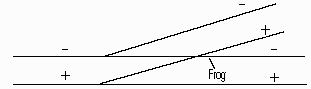
Notice that the two rails coming out of the frog are different polarities, one negative, one positive. If you place a locomotive on any of these tracks, the electrons flow from the negative track through the motor, where some becomes motion and heat, then into the positive track, returning to the power pack.
The motor offers some resistance to the flow of electricity. This is a good thing. Without it, you have a short circuit. Not good. This happens if you lay a screwdriver across the track. This can cause a fuse to burn out or trips a circuit breaker.
The basic thing to remember about the all-live turnout is that there is always negative on one rail and positive on the opposite rail, exactly as it should be. Hook up the wires and run the train.
Here is a diagram of the power-routing turnout; switched for straight-through running:
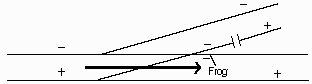
Notice that the polarity is negative on both tracks connected to the frog. If a locomotive was sitting on the track where both tracks are negative, it would go nowhere. There is no positive track to take electrons back to the power pack. Both tracks connect to one side of the power pack, the negative side. This would be an open circuit. No electricity flows. That piece of track is dead.
This is fine if this is a siding with a locomotive on it that you don't want to move. It will go nowhere.
Also notice if it connects to the rest of the layout through another turnout, there is now a negative and positive rail on the same side. This is not good. It would cause a short-circuit, with electricity returning to the power pack without passing through a motor, with therefore almost no resistance.
If you plugged two wires into a wall plug and touched the wires, you get the same thing, only more powerful; a blown fuse, circuit breaker, or fire. So, there is a need to cut a gap or use an insulated rail joiner here to prevent a short circuit.
Now what happens if this turnout routes the train onto the siding? Here's the diagram:
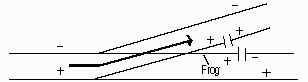
Now the frog is positive. The turnout has switched the polarity of it. Now a potential short circuit exists on the other side of the frog. Cut another gap or add an insulated rail joiner to prevent the short.
You don't want to run power leads directly to the frog, since its polarity flip-flops each time you change the turnout direction. That would do nasty things to your fuses or circuit breaker.
Despite the extra steps needed to use power-routing turnouts, they can be the best for the purposes of shutting power off to sidings, or if you scratch-build turnouts. One more advantage is more continuous power as the wheels of the loco roll over the all-metal frog.
Milton Friedman made an interesting contrast between democracy and the marketplace. In a democracy, 51% rules. If you are in the minority voting bloc, you don't get your way. You have to follow the rules made by the majority. In contrast, in the marketplace, everyone chooses for themselves.
If you want to model in a scale or historical period different from what most people are modeling, you can do it. You aren't required to conform to the majorities' vote. There are no perfect scales to always use. Each one has its advantages and disadvantages. None is right for everyone, or for every occasion. That's why there is no best scale. One size doesn't fit all. Same goes for cars, computers, houses, pets, clothes, etc.
Here are some characteristics of various scales:
HO (1:87). Pluses -- cheap rolling stock, sturdy enough for some kids to play with, easy to see what you are doing, easy coupling and uncoupling, huge variety of everything, digital control and onboard sound available. Minuses -- takes more space than similar type layout using a smaller scale.
N (1:160). Pluses -- great for a complex operational layout in a typical garage size space, big variety of everything, small enough for almost any apartment, digital control available. Minuses -- too small for some people's taste and for many children, locos and cars usually more expensive than HO.
Z (1:220). Pluses -- it's cute (76% the size of N, but looks half the size since it's smaller in all three dimensions), very small layouts possible or big layouts with expansive scenery, popular with collectors, good if you enjoy a challenge. Minuses -- No good quality ready made turnouts available (you will have to scratch-build them, Marklin's are expensive and worthless), limited variety, locos more expensive than in other scales (other freight cars about the same price as Micro-trains N-scale), too small for digital (so far).
G (1:24-1:28), O (1:48), S (1:64). Pluses -- sturdy enough for smaller children, good sizes for garden layout (especially G). Minus -- takes more space, although this could be an advantage if you want a big layout.
Narrow Gauge. HOn3, HOn2 1/2, Nn3, Sn3. The "n" stands for "narrow", and the number is the width of track in feet. This is for experienced modelers who want a challenge, like to scratch-build, and love mountain scenery. Although Narrow Gauge is currently a small segment of the modeling community, don't let that stop you if it appeals to you.
Almost all scales. Minus -- the need to change couplers.
Don't think you have to lock yourself into one scale. Any scale can offer challenges, especially if you scratch-build. Here are some of my experiences in various scales:
I put together an Athearn HO reefer car. It was astonishingly cheap, quite detailed and well painted. I've had one operating session in a one-car garage layout (Bob Anconetani's). The cars were very easy to work with. I understand now why this is the most popular scale.
I built a 2 1/2 feet square N scale layout. Since I love scenery, especially hills, mountains, lakes, and lots of trees, the smaller scales appeal to me. I've had two operating sessions on Bob Batson's N scale empire. Handling the cars is more of a challenge than HO, but not intolerable, especially if you have the attitude that it is not easy to uncouple the big trains either.
I'm currently working with Z, and since space is a consideration, its size is an advantage. I actually enjoy fine detail work, and plan on attempting some hand-laid track and scratch-built turnouts in Z. This is something you have to be crazy to contemplate, so I qualify. Z scale track-work must be precise and kept clean to operate properly. I've ordered a dial caliper accurate to .001", crude by Palomar standards.
Ever since seeing Dave Lambert's narrow-gauge layout, I've been infected with that bug, so I expect to slowly get into Nn3, which operates on Z scale track, with N scale structures. I love mountains, wood trestles, and the sometimes bizarre looking, but always cute, narrow gauge locos. If making a Z scale turnout proves to be too hard, I'll probably move up to N scale and/or HOn3, 2 1/2.
Jan.
3, 4 - Science Spectrum take-down
5 - Meeting 7:30pm
15 - Slide SIG 7:00
20 - Executive Committee 7:30
23 - Carillon setup
Feb.
21 - Railroad Day - TTU Museum
Mar.
16-20 - Godeke library setup
Back to LMRA home page