Making Your Own Bonsai Wire
Ok folks, the subject of wires for your bonsai trees has arisen several times lately, and some of you have requested that I share my techniques with you. So here it is.
First of, I make all of my own wire. Why? Because it’s cheaper that way! That’s the theme of this site. Plus, when you make a ton of your own annealed wire for next to nothing, you’re more apt to cut off a bad wiring job and start over. At least I am.
First of all, let me touch upon the basics. The size of wires is described as its gauge. The only thing you need to know about the gauge is the smaller the number, the larger the diameter of the wire. 8-gauge wire is pretty stout; you’d use it for thick trunks and only the thickest of branches. I keep everything from 8-gauge to 14-gauge on hand. I don’t think I have ever needed anything smaller than 14-gauge.
Before you run down to Radio Shack and start buying up speaker wire, let me say there is a difference in wires. Some wires, like speaker wire, is stranded, or made of many small strands of wire wrapped together. The type of wire you want to seek is called single strand, or sometimes Bell Wire. (Since it’s the type of wire the phone company uses.)
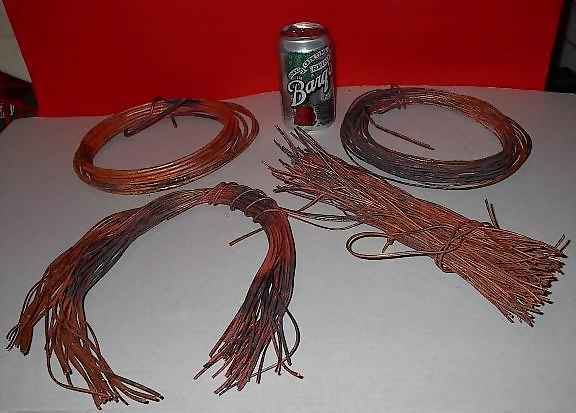
I found a great source for these wires. My local Home Depot had 14-gauge wire in spools, and huge 8 gauge grounding wire, but nothing in between. Then by chance I noticed some of their heavy-duty stranded wire. I saw that this wire was made of 14 pieces of wire stranded, approximately 10 or 12 gauge wire. I bought five 1-foot sections and two 2-foot sections of this wire. When I got it home, I stripped the insulation, and carefully untwisted the wire. It was a little wavy, but useable. And at $.68 per foot, VERY useable. But I figured I never use more than a foot at a time, and these are pre-cut. And all of the wire you see here cost me $20 and change.
Now for the hard part. You could just slap the wire on the tree. But as soon as you made a tough bend, it would bend right back. This is why you need to anneal the wire. Annealing is the process of heating the wire and quickly quenching it in water. This has the effect of making the wire very soft at first, but once it has been bent, it hardens to that shape.
Here is how I do it. First of all, I always do this at night. You’ll have to make sure the wire is glowing, and this is much easier at night.
I anneal in my barbeque grill. Before you start the fire, you have to prepare the wire. If you’re using heavy duty outdoor wire like I described above, strip off the insulation. Then I unwrap the wire from around itself. This gave me a bunch of loose wires, so I took two of the wires and wrapped them around the bundle at each end. This just makes it easier to handle.
If I am using the 14-gauge wire on a spool, I just let the fire burn the insulation off. But I do unwrap the wire off of the little spool and re-wrap it around a paint bucket. Remember, this is the final shape. Once it comes out of the fire, you can’t re-wrap it.
Then I fill a large bucket with water. This is where you’ll quench the wire.
Now for the
fire. I stack a large pyramid of charcoal briquettes and light them. While I’m
waiting for the fire to get going, I walk around the yard and gather all of the
sticks I was supposed to clean up last week. I also get the small lumber scraps
I saved from my last grow box project.
Once the edges are gray and the fire is going good, I spread the charcoal out evenly on the bottom of the grill. Then I set the wire on top of them. Then I cover the wire with the wood and sticks.
The wire is ready to be taken out when it glows orange. You may have to take it out and put it back a few times before it’s ready. Put the thickest diameter wire on the bottom. Use a VERY long set of tongs, and when the wire is ready, drop it directly into the water. Don’t worry; it’s supposed to sound like that. Ta-da, your wire is ready to use.
There will be some carbon residue on most of the wire, as well as small bits of burnt-off insulation. These shouldn’t hurt your trees. I hope this helps you save some money!