 That's
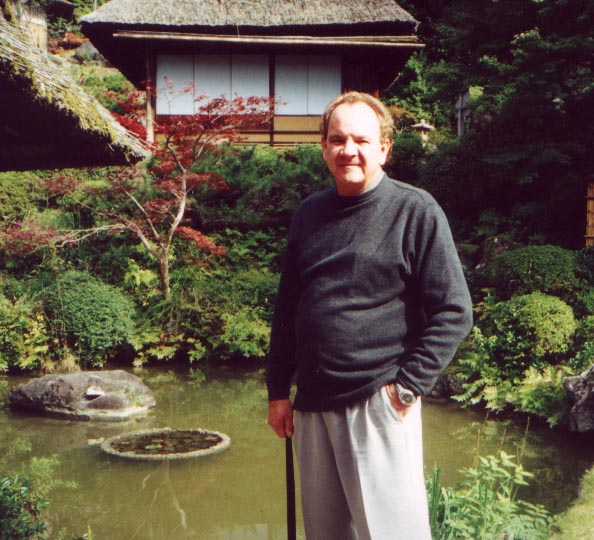
me, your "host" in beautiful Kyoto, November 1, 2000.
That's
me, your "host" in beautiful Kyoto, November 1, 2000.KONNICHI WA KARA NIPPON!
That's
me, your "host" in beautiful Kyoto, November 1, 2000.
 Miyajima,
near Hiroshima. The legend is that this beautiful and sacred island is
protected by a female god, who is very jealous, and that lovers, before marriage
should avoid visiting Miyajima as the jealous female god here will cause the
couple to argue and quarrel while there. Call it timing, coincidence, but when I
was here, it did seem to be the case with some couples! Fortunate for me, I was
with my Japanese "daughter" (musume) and we had a great time in a beautiful
place! Thanks Hisae-chan! The temples and main structures were
built around 1000 years ago at one of only two times in Japan's history that
there was a female Emperor. If you haven't seen Miyajima yet, make it a
must see on your trip to Japan. The 10 minute ferry boat ride is worth it!
Miyajima,
near Hiroshima. The legend is that this beautiful and sacred island is
protected by a female god, who is very jealous, and that lovers, before marriage
should avoid visiting Miyajima as the jealous female god here will cause the
couple to argue and quarrel while there. Call it timing, coincidence, but when I
was here, it did seem to be the case with some couples! Fortunate for me, I was
with my Japanese "daughter" (musume) and we had a great time in a beautiful
place! Thanks Hisae-chan! The temples and main structures were
built around 1000 years ago at one of only two times in Japan's history that
there was a female Emperor. If you haven't seen Miyajima yet, make it a
must see on your trip to Japan. The 10 minute ferry boat ride is worth it!
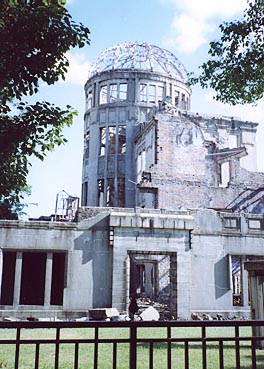 August 6, 1945, 8:15 A.M....let
us NEVER forget, let us NEVER allow this to happen again! The "A-Bomb
Dome" in Hiroshima. Left with a profound sense of sadness and
determination to let the world know of the horror here, and perhaps, more
importantly, the courage of the Japanese people who suffered through this
nightmare and rebuilt one of the most beautiful cities in Japan. Take the time
to visit the museum and park here. Also, this is where the memorial to the
young girl Sadako is and it's worth the time to learn her history. If you're not
moved by her story, then your heart is made of stone.
August 6, 1945, 8:15 A.M....let
us NEVER forget, let us NEVER allow this to happen again! The "A-Bomb
Dome" in Hiroshima. Left with a profound sense of sadness and
determination to let the world know of the horror here, and perhaps, more
importantly, the courage of the Japanese people who suffered through this
nightmare and rebuilt one of the most beautiful cities in Japan. Take the time
to visit the museum and park here. Also, this is where the memorial to the
young girl Sadako is and it's worth the time to learn her history. If you're not
moved by her story, then your heart is made of stone.
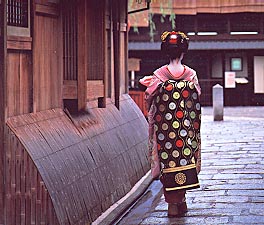 Kyoto. A
Maiko-san
on the street of Kyoto/Gion area. Often mistaken for a Geisha, Maiko can
be seen wearing their beautiful kimonos, geta shoes, white make-up and
beautifully adorned hair in Kyoto. They are very shy and reserved, however,
with courtesy and
respect, you may ask them for a photo. Please understand, they are NOT Geisha
"wanna-be's", rather they are going through the period of training and
education that will allow them to one day become a true Geisha. Actually,
the correct word for geisha is "geiko", although here in the
west we often refer to them as "geisha" which is a generic word. True Geiko
come from the Kyoto/Gion area. The word Geisha (or Geiko) means "Person of the Arts" and
she spends years in training, often starting
as early as age 5, to learn the many art forms she will need in her life as Geisha.
If you're stereo-type image of a Geiko (geisha) is that of a "high priced
prostitute"..then you "really don't get Japan" and should stop
watching so many movies and read "Memoirs of A Geisha"
by Arthur Golden. Geishas are the essence and "soul" of Japan
and will always have my highest regard and respect. This picture of the Maiko-san
was taken from behind to show the unique make-up markings on her neck.
Kyoto. A
Maiko-san
on the street of Kyoto/Gion area. Often mistaken for a Geisha, Maiko can
be seen wearing their beautiful kimonos, geta shoes, white make-up and
beautifully adorned hair in Kyoto. They are very shy and reserved, however,
with courtesy and
respect, you may ask them for a photo. Please understand, they are NOT Geisha
"wanna-be's", rather they are going through the period of training and
education that will allow them to one day become a true Geisha. Actually,
the correct word for geisha is "geiko", although here in the
west we often refer to them as "geisha" which is a generic word. True Geiko
come from the Kyoto/Gion area. The word Geisha (or Geiko) means "Person of the Arts" and
she spends years in training, often starting
as early as age 5, to learn the many art forms she will need in her life as Geisha.
If you're stereo-type image of a Geiko (geisha) is that of a "high priced
prostitute"..then you "really don't get Japan" and should stop
watching so many movies and read "Memoirs of A Geisha"
by Arthur Golden. Geishas are the essence and "soul" of Japan
and will always have my highest regard and respect. This picture of the Maiko-san
was taken from behind to show the unique make-up markings on her neck.
A photo of a true Geiko (geisha) can be found near the bottom of this page and at the beginning of this homepage. Her name is Kiriki Sama and I was very fortunate to spend some time with her at her shop on Hanami-koji Street in Gion. Kiriki sama is an instructor for young Maiko. A sensei. She was most lovely, gracious and as charming and mysterious as you might expect. I fell in love at once! I was indeed very fortunate and feel honored for her to spend time answering this "gaijin's" many questions. Please, if in Gion, do stop at her shop. Her English is very fluent and she is quite willing to share her life as geiko with you. Please, only the most respectful and sincere of visitors.
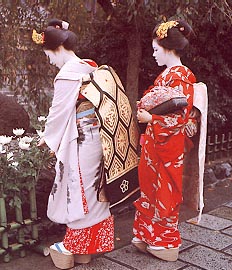 Kyoto/Gion. These
beautiful young women are Maiko. Maiko can be recognized by the elaborate
"obi" (belt/sash). Generally you don't see true Geisha "out and about" on the street. I
suspect they too are Maiko judging by the size of their obi (the
elaborately tied and colored sash around their waist, it is intentionally in
contrast to the kimono) and by the size of the sleeves in their kimono. Here too
is a good view of the geta shoe worn by Maiko and Geiko.
Kyoto/Gion. These
beautiful young women are Maiko. Maiko can be recognized by the elaborate
"obi" (belt/sash). Generally you don't see true Geisha "out and about" on the street. I
suspect they too are Maiko judging by the size of their obi (the
elaborately tied and colored sash around their waist, it is intentionally in
contrast to the kimono) and by the size of the sleeves in their kimono. Here too
is a good view of the geta shoe worn by Maiko and Geiko.
Special Rules in Gion (Text
from the Maiko Museum, Gion
http://www.meix-net.or.jp/~maiko/index.html )
You may not know that formal restaurants in Gion are available only for people
who are first introduced by their guest. If you don't know the guest, you need
to visit twice to enter these restaurants and you can't do anything on your
first visit. The Rule is called "Ichigen-San Okotowari" , and it's one
of the unique rules in Gion. However, we would like you to enjoy one of the
traditions of Kyoto and can provide you with the "basic rules" and can
introduce you to real traditional restaurants at a reasonable price after
you've learned these basic concepts from our restaurant.
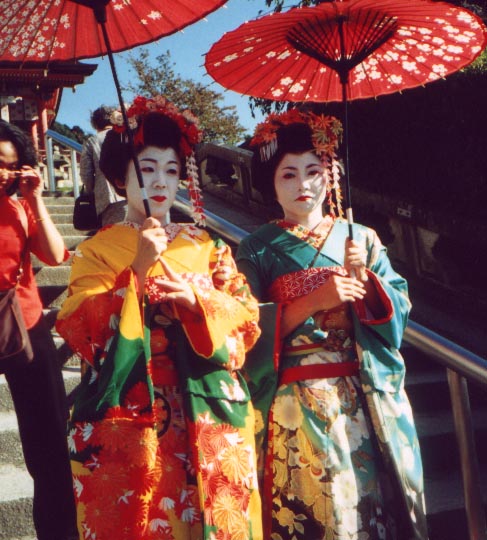 Lovely maiko in Kyoto...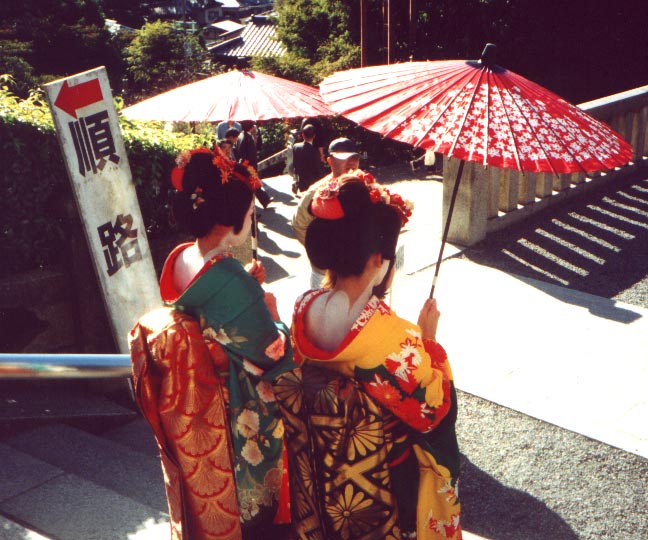
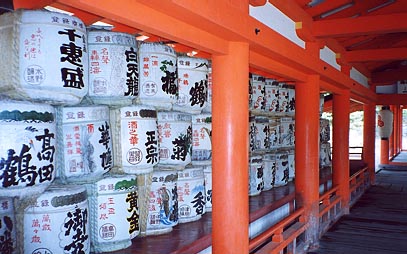 Sake
Barrels. What would Japan be without its native drink, sake. Made
from fermented rice, served either hot or cold (contrary to western belief) each
area in Japan competes at the many festivals (matsuri) throughout Japan for the
best sake. Of course, depending on where you are, who you ask, and, I may add,
how much sake you've had to drink, will determine the best sake! Kampai!
Sake
Barrels. What would Japan be without its native drink, sake. Made
from fermented rice, served either hot or cold (contrary to western belief) each
area in Japan competes at the many festivals (matsuri) throughout Japan for the
best sake. Of course, depending on where you are, who you ask, and, I may add,
how much sake you've had to drink, will determine the best sake! Kampai!
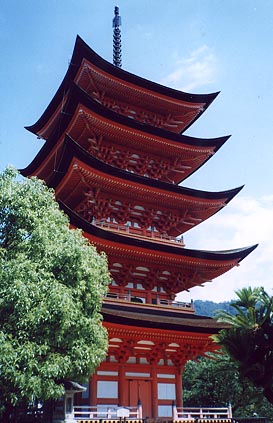 Beautiful temple.
This temple is found on Miyajima also. Its five (go) tiered roof is beautifully
adorned and built to withstand the ages. One never gets accustomed to the these
magnificent temples found throughout Japan. Take the time to visit one of these
serene temples whenever in Japan.
Beautiful temple.
This temple is found on Miyajima also. Its five (go) tiered roof is beautifully
adorned and built to withstand the ages. One never gets accustomed to the these
magnificent temples found throughout Japan. Take the time to visit one of these
serene temples whenever in Japan.
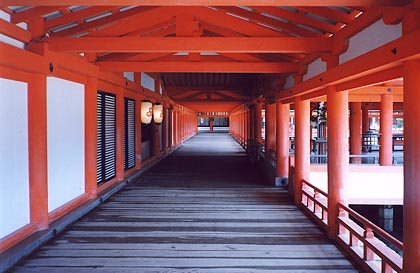 Original
wooden walkway at temple. This original walkway is located at Miyajima
but many just like it can be found throughout Japan. This Shinto
(Buddhist) country has some of the most beautiful temples in the world. This
particular walkway is nearly 1000 years old and is still in everyday use daily!
Many Japanese wonder what we put in our museums..:)
Original
wooden walkway at temple. This original walkway is located at Miyajima
but many just like it can be found throughout Japan. This Shinto
(Buddhist) country has some of the most beautiful temples in the world. This
particular walkway is nearly 1000 years old and is still in everyday use daily!
Many Japanese wonder what we put in our museums..:)
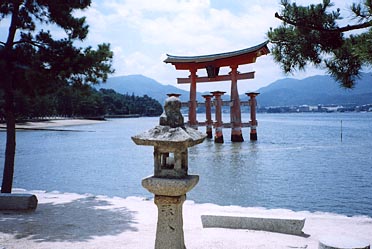
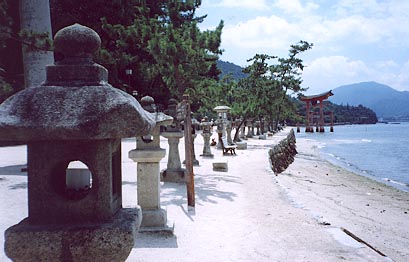 Another picture of Miyajima
Island. Looking down the beach and back to the mountains on the mainland.
The ishidoro (stone lanterns) in the foreground and torii visible
beyond give a striking feeling and sense "feeling" of Nippon.
Another picture of Miyajima
Island. Looking down the beach and back to the mountains on the mainland.
The ishidoro (stone lanterns) in the foreground and torii visible
beyond give a striking feeling and sense "feeling" of Nippon.
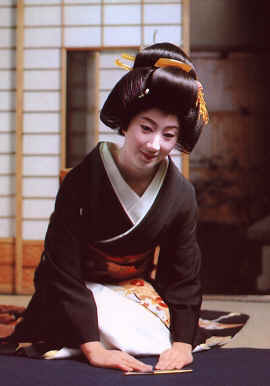 Geiko. Her
name is Kiriki- sama. My friend. Need I
say more. Beautiful, talented, quintessential pure Japanese art in the form of a
beautiful woman. Kind enough to spend a quiet, rainy afternoon in Kyoto
with me talking about her life, travels and experience as one of the last true
Geiko (geisha)....
Geiko. Her
name is Kiriki- sama. My friend. Need I
say more. Beautiful, talented, quintessential pure Japanese art in the form of a
beautiful woman. Kind enough to spend a quiet, rainy afternoon in Kyoto
with me talking about her life, travels and experience as one of the last true
Geiko (geisha)....
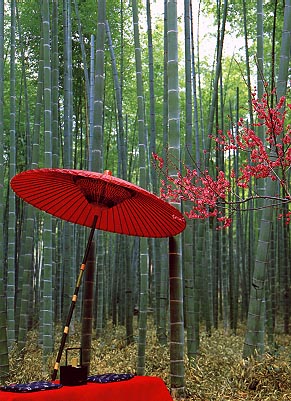 Lacquered
rice paper umbrella and bamboo stand. Other than the fact that this photo is
so very Japanese, I felt I just had to include it. It in some way, for me,
captures part of Japan that is so difficult to put into words.
Lacquered
rice paper umbrella and bamboo stand. Other than the fact that this photo is
so very Japanese, I felt I just had to include it. It in some way, for me,
captures part of Japan that is so difficult to put into words.
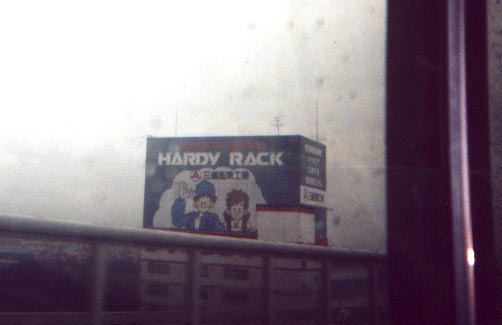 My beloved
Japan, I will always "Hurry Back" to you (Sign seen
on the Hanshin Highway leading to Kansai International Airport (KIX), Osaka)
My beloved
Japan, I will always "Hurry Back" to you (Sign seen
on the Hanshin Highway leading to Kansai International Airport (KIX), Osaka)