| Unti 2: Human Systems |
 |
| Urban Settlement: Factors in Settlement Patterns: - Near water for transportation, drinking water, Protection - Near urban centres for easier transportation - Warmer climate - Close to USA (trade) - Topography - can't develop steep slopes - Soil conditions (fertile near the river) |
|
| Location of Cities High Bluff - up on a cliff for protection Island Site - protection from land attack Confluence - where two or more rivers meet, more transportation routes Head of Navigation - change from water to land transport Bridge point - easier to build a bridge (where a river narrows) Harbour - deep water for large ships Resources - forests, minerals can be used by the city (trade) Low Order Services - a small population (example gas station) Middle Order Services - found in larger towns (example grocery store) High Order Services - requires a large population (example National Museum) |
 |
|
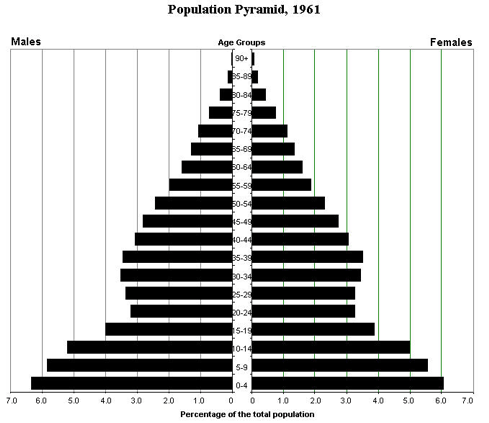
| Population Pyramids - is a bar graph that represents the age and gender of a population - males are represented in the left bar graph, and females the bar graph on the right - the shape of the pyramid may indicate what the future needs are: example an aging population may require more health care - bulges in the pyramid represent good economic conditions - narrow spots may indicate times of hardship 3 Shapes of Population Pyramids (increasing, decreasing, stable) An example of a Population Pyramid for Canada in 1961 |
|
| Population Distribution and Density Population distribution map shows where people live in an area (how they are scattered across a country). Distribution in Canada: - areas with no settlement in the north - agricultural (rural) areas with few people - urban (city) areas with many people Population Density is the number of people per unit of area; a big city has a high population densoty, whereas rural areas have a population density. population density = # of people/km2 |
|
| Migration Net Migration is calculated by subtracting the number of emigrants from the number of immigrants. A positive number would mean a net gain. Push factors are the negative conditions that cause people to leave an area (example, lack of employment, low standard of living, poor political situation...) Pull factors are the positive conditions that cause people to move into a town or anther region (example, many employment opportunities, more agreeable political practices, good educational programs) Canada's Immigration History - Immigration in the early 1900's from eastern Europe to settle the Prairies (free land and incentives) - Little immigration 1930-1945 due to the depression and WW2 Why do people come to Canada? Why do people leave Canada? Representing Migration patterns using flow line maps: Width of the arrow represents the number of people. |
 |
|
| Cities: Urban and Rural A rural area describes land used mostly for agriculture. The word "rural" may be used to describe the lifestyles and economic activity of the people. - less than 2500 people - single homes - homes are far apart - scattered or linear pattern of development - less development as people move to the cities An Urban area describes a built up area where most inhabitants have non-agricultural jobs. - more than 2500 people - multiple family homes (attached, apartment buildings) - homes are close together - clustered pattern of development - rapid growth Urbanization is the process in which a rural area changes to an urban centre. This results in an increase in the total urban population. This has occurred because of technological changes. Example better agricultural machinery--->less people needed on the farms--->they move to the city to look for jobs--->possibly in the factories that manufacture the machinery. Diversified urban centre= has a variety of urban functions Why are most manufacturing cities located in southern Ontario and Quebec? Trends that encourage people to move to the city! Trends that discourage people from living in the city! |
|
| Urban Land Use Residential - Where people live. Transportation - move people and goods; train stations, airports, highways, parking lots... Commercial - Where people shop and conduxt their business; convenience stores, plazas, malls, offices, banks, hotels...and the CBD (Central Business District) aka downtown. Industrial - downtown industries moving to the outskirts of cities. Industrial parks are designed away from residential; factories Recreational - are important because they enhance the quality of life; parks, beaches, arenas, community centres, golf courses... Institutional - churches, schools, libraries, government, hospitals Resource based - farming, mining, forestry... - Non-Basic vs Basic Service - As population increases the number of functions in a city increases. - Residential areas dominate further from the CBD because the land is cheaper, and businesses want ot be close to the city centre where population density is high - What are some desireable and undesirable characteristics of different land uses? |
|
| Transportation in Canada Transportation challenges in Canada 1. Freeze-thaw cycles (road damage) 2. Mountains 3. Frozen North 4. Population spread over a large area Unit trains - carry one type of cargo, usually bulk items such as coal, grain, and iron-ore; the items are also non-perishable goods. - Roadways are important in the movement of people (84%) - Road (44%) and rail (41%) -->movement of products - Streetcars are the most effiient way of moving people - Trains were important in the early part of the century because passenger planes were not yet developed. Many passenger trains now operate for tourists. - computer controlled traffic lights, TV cameras and transponders have been used to improve the flow of traffic |
|
| Urban Issues - Land Use - Little housing - Poverty - Teenagers (nothing to do) - Crime rate - Traffic problems |
|
| Industry Primary industries extract raw materials from the environment (examples are mining, forestry, fishing, and farming). The extractive industries are important to Canada's economy; however, only 8% of the workforce are employed in this industry--->partially due to mechanization Secondary industries use the raw materials, that are extracted in the primary industry, to produce a finish product. Examples: Timber manufactured into cabinets; Iron ore manufactured to produce steel. Tertiary industires porvide services to the primary, and secondary industries and to society. Examples: Police officers, Secretaries, Education, Health services... Factors in the Location of Industry |