:: Municipality of Tibiao ::
 Long before the Malays came,
the Negritoes and the descendants of the Dayaks, Ibaloys, Itnegs, etc. from New
Guinea who traveled west to Borneo passing through land bridges, inhabited
Tibiao. They had their primitive beliefs, ways and customs, some of which are
even practiced to this day. Later, it attracted other immigrants because of its
fertile land and favorable climate, which is good for fishing and agriculture.
Long before the Malays came,
the Negritoes and the descendants of the Dayaks, Ibaloys, Itnegs, etc. from New
Guinea who traveled west to Borneo passing through land bridges, inhabited
Tibiao. They had their primitive beliefs, ways and customs, some of which are
even practiced to this day. Later, it attracted other immigrants because of its
fertile land and favorable climate, which is good for fishing and agriculture.
One of these prominent immigrants
was Datu Oguid, who, together with his wife, children and faithful followers,
also decided to settle in Tibiao. They anchored at the mouth of Calaugan brook,
which is now a part of Poblacion Tibiao. At first, they happily settled along
the land by a brook until Oguid realized that the settlement is very vulnerable
to pirates and other armed adventurers because of its proximity to the sea.
Therefore, Oguid with his family and followers moved on to the foot of the
mountain which was at a safer distance besides being surrounded by a thick
forest. The natives were friendly with the new settlers and they readily
welcomed them to their place called Balanti-an. The settlement covered a large
area of lowlands and highlands. Oguid divided the whole barangay among his sons
and followers. The highlands were given to the natives while the plains and the
lowlands went to Oguid�s sons. Oguid chose the hillside of Olid, after his name,
to be the settlement as it was by a big river, now the Tibiao River.
After sometime, the relative of
Oguid from Bornay knew of his prosperous life in Tibiao, Antique. They agreed to
sail and meet Oguid. Oguid warmly welcomed them and the natives were entertained
with food, drinks and merrymaking.
During those times Moro pirates
usually robbed sailors and natives living near the shore. One day, they followed
the riverbanks to rob Oguid and his followers. Approaching the gateway to
Oguid�s Barangay, they were met by a giant who was Oguid�s faithful follower.
Trembling with fear, the pirates fled away.
With Datu Oguid leading, Balanti-an
was named barangay Oguid Pagsuguiron Amar. Being a converted Christian, Oguid
went to Barbaza and requested, Father Eslao, a parish priest of the town to hold
a mass in their barangay to thank God for their many blessings. Governor Barboza,
Father Eslao, and the choir members and band arrived in their town.
Governor Barboza explained to the
people present in the barangay that it was his policy to change the native names
to Spanish. The barangay was made a barrio and Oguid Pagsuguiron Amar being a
long word was changed into a short one. Datu Oguid and his followers planted a
cross at the top of the mountain near Paris; Oguid and his followers planted a
cross at the top of the mountain which was called �Cross� up to the present.
On November 6, 1815, Oguid
together with his family and followers transferred their residence closer to the
shore. They wanted to engage in trade and fishing to improve their livelihood. A
wide plain between Palaypay and Calaugan brooks was selected as a good place for
the people to build their homes. Juan Sarcino made a plan for the town. The land
was cleared of all trees and bushes. The church and the convent were built. The
plaza and the streets were laid out and the cemetery was completed. Oguid
conferred with his followers and they decided to ask Gov. Barboza and the parish
priest of Barbaza for a parish priest to be assigned permanently to their own
town. Juan Sarcino with eight strong men of the town went to Salog, Iloilo to
fetch Father Eulogio Cardones who was sent by the Bishop of Salog, now Jaro, to
be the parish priest of the new town.
Population increased in the new
settlements. Legend has it that one day, a group of roving Spaniards surprised a
group of natives who were fishing and picking up shells by the river. One of the
Spaniards asked a group of natives about the name of the place. The ignorant
natives saw that the Spaniards were pointing to the place where �tigbaw� was
abundant. Not comprehending the Spanish language, and thinking that he was
asking the name of the grass plant �tigbaw�, the native answered �TIGBAW�. The
equally uncomprehending Spaniards, thinking that the answer to their question
was the name of the place, accepted what they heard as a fact. Thus, with a
little help from a mispronounced word, the Spaniards listed the name of the
place as �TIBYAW� or �TIBIAO� as it is known today.
(Reprinted from the Binirayan 2000 Souvenir Magazine)
back to top
Barbaza <<
::Antique:: >>
Culasi
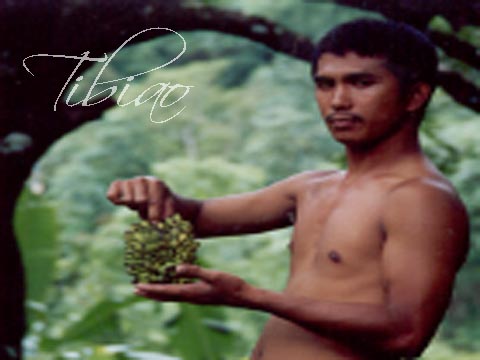 Long before the Malays came,
the Negritoes and the descendants of the Dayaks, Ibaloys, Itnegs, etc. from New
Guinea who traveled west to Borneo passing through land bridges, inhabited
Tibiao. They had their primitive beliefs, ways and customs, some of which are
even practiced to this day. Later, it attracted other immigrants because of its
fertile land and favorable climate, which is good for fishing and agriculture.
Long before the Malays came,
the Negritoes and the descendants of the Dayaks, Ibaloys, Itnegs, etc. from New
Guinea who traveled west to Borneo passing through land bridges, inhabited
Tibiao. They had their primitive beliefs, ways and customs, some of which are
even practiced to this day. Later, it attracted other immigrants because of its
fertile land and favorable climate, which is good for fishing and agriculture.