:: Municipality of Patnongon ::
Patno�gon grew out of the various settlements, which merged and fused into one, long before the arrival of the Spaniards. Its early settlers were the Maghats and the first settlement was in Catuayan. These settlers were a little bit cultured than the Aetas. They found Catuayan an ideal place to settle because food and building materials were readily available. The sea, rivers and plains were good sources of food. The swamps provided roofing materials. Aslom, which was a few yards away, was a good source of drinking water. Myth had it that vast treasures were buried in this place but were guarded by evil spirits.
Catuayan was strategically located since the Spaniards usually dock at this place. The Maghats, however, killed the crew of the Spanish boat that anchored in Catuayan.
Moro (Muslim pirates) predatory raids caused some settlers to move inland. Settlements were established as far East in places at the foot of the Magpungay Mountain. Other later settlements were found in Catmon, Carit�an, Badiangan, Baye, and Panacawon, a sitio of Tamayoc. Catmon became the religious center of religion, which included the early settlements in Patnongon.
The natives then had their supreme god �Bulalacao�and Ba�gotbanwa for their high priest. They had their own government and court. Though their laws were harsh and cruel, justice was meted out justly and impartially.
After the Spaniards had gained firmer and greater foothold in this place, visitas were established. The aim of the establishment of this visitas was to form a government with a set of rules and regulations. Domingo Diano was appointed as the first lieutenant, whose powers were the same and as absolute as those of the �Capitanes� and the �Gobernadorcillos�.
Formerly, the town of Belison was part of Patnongon. However during the term of Mayor Juan Esta�ol on March 10, 1961 through Executive Order No. 421, Belison and the outlying barrios became a separate entity.
It should be noted that the sitio of Belison was founded in 1810 during the term of Gobernadorcilbo Francisco Roque. In 1921, during the term of Fernando Cabiling, the sitio of Carit-an was established.
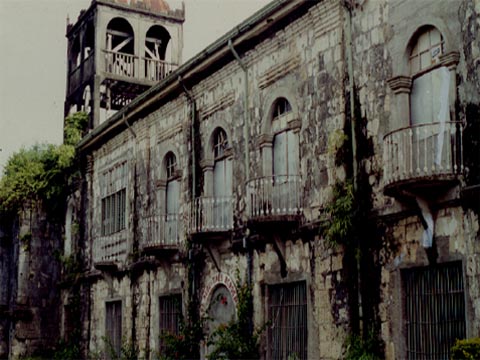
In 1762, the first gobernadorcillo was appointed. This made Patnongon a separate entity from that of Bugasong. The first gobernadorcillo was Don Pedro Tucoy. On January 15, 1873, the first Spanish priest, Padre lgnacio Clemente Panganiban, came to Patnongon. Six years later, during the term of Maximo Elio in 1879, the stone church was finished. It was also in this year when the municipal building was constructed. This was finished in 1895. During the Japanese occupation, this was razed and destroyed by fire. A new municipal building was constructed to replace the destroyed one.
The construction of the stone bridge spanning Patnongon River was one of the accomplishments in the administration of Ramon Manzanilla in 1887. On August 30,1896, the first mass was said by Padre Estaquio Heria in the newly finished stone church. Two years later, on November 25, 1898, the first election was held in all freed areas after the end of the Philippine revolutionary and Enrique Salvani was elected the first president of Patno�gon.
Legend of Patno�gon:
Patno�gon was named after �ongon� or torn which the Spanish priest from Bugasong unluckily stepped on when he went on foot along the bank of Catmon River (now-Patnongon River) on his visit to Catmon which was then the religious center of the early settlements. Catmon River came to be known by this name because its source is located from a big tree by that name.
Legend says that one early morning, numerous Moro Vintas (sailboats) were seen approaching from the horizons. Moro pirates came to plunder the villages and sacked the same for food, gold and treasures. The villagers saw an old man, bearded and with flowing rove and a wand in his hands, walking on the beach. The presence of this old man chilled the hearts of the Moros for they were not able to dock. They moved back instead. The inhabitants came to believe this old man was St. Augustine, then the patron saint of Sibalom. Thus Sta. Rita de Acacia became the patron saint of Sibalom and St. Augustine, the patron saint of Patnongon.
From the state when people were driven to idolatry and superstition to the present stage under the new Society, the history of Patno�gon is a glowing page on the inclined yardstick of progress in spite of the setbacks and the consequences brought about by the Philippine Revolution, the Spanish American War and the Pacific War (World War II).
The municipality is little by little moving progressively through the able, sound and commendable leadership of the local officials and cooperation from fine people of the town.
(Reprinted from the Binirayan 2000 Souvenir Magazine)
Belison << ::Antique:: >> Valderrama