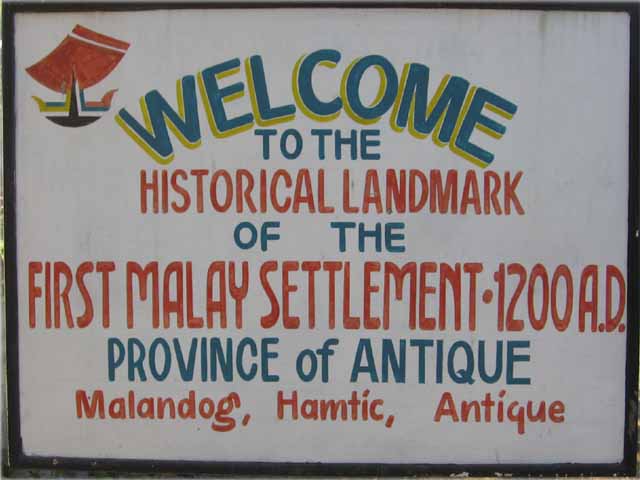
:: PARATANDAAN ::
:: WELCOME::
"Paratandaan" is a Visayan word which literally means marker.
To the Antique�os, however, "Paratandaan" connotes something deeper. It is often associated with history. The word "Paratandaan" is synonymous to the historical landmarks that are scattered al over the western shores of Panay, spanning across the mountains and sea, serving as reminders for the people of Antique of their rich cultural heritage.
:: INTRODUCTION ::
The name Antique came from �Hamtik� � black ants that abound in the area. Legend has it that when Datu Sumakwel and his men inspected the prospective village in Malandug, they found a huge colony of ants. They all shouted, �hamtik, hamtik,� and decided to name the place Hamtic. Among the sakops or villages set up in Panay, Hamtic was the first to prosper. Its population increased rapidly, and its inhabitants were the first to increase the number of livestock like carabaos, horses and cows, as well as to build wooden houses, plant cotton and weave cloth, and develop pottery.
The Augustinian missionaries who established the first church in 1581 wrote the name as Hantique, in the French manner, but since the Spaniards could not pronounce the letter �h�, the name later evolved into Antique.
Frequent moro raids aggravated by typhoons and floods threatened the dwellers in the coastal areas. They left their settlements and sought refuge in the mountains, while some turned nomads. Perhaps some of them deliberately fled the mountains to escape conversion into the new faith offered by the Spanish missionaries. The Spanish called them montescos or mundo.
It took the Spaniards more than two centuries to convert the mundo and convince them to build villages in the lowlands. Subsequently, parishes and towns were established. In 1796, by Royal Order, the province of Antique was created composed of the parishes and towns of Hantique (Hamtic), Nalupa (Barbaza), Bugasong, Cagayancillo (later separated from Hantique), Tubigon (San Jose), Sibalom, San Pedro, Bugan (Pandan), Patnongon, Laua-an, Dao, and Bacong (Culasi). Later the towns of Tibiao, Anini-y, San Remegio, Valderrama, Sebaste, Libertad, Belison and Caluya were created to complete the 18 municipalities of the province.
Copyright
Copyright � 2007.
Antique National School's Cyberfair 2007 Web Design Project.