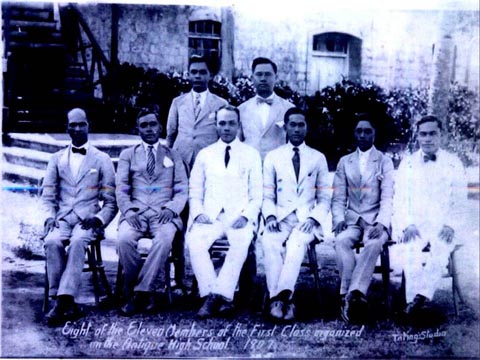
 Secondary education in the province of
Antique started in 1906 when eleven elementary school graduates petitioned to
the Secretary of Public Instructions for the opening of a high school in San
Jose, capital town of the province
Secondary education in the province of
Antique started in 1906 when eleven elementary school graduates petitioned to
the Secretary of Public Instructions for the opening of a high school in San
Jose, capital town of the province
AHS/ANS
Secondary education in the province of
Antique started in 1906 when eleven elementary school graduates petitioned to
the Secretary of Public Instructions for the opening of a high school in San
Jose, capital town of the province
All teachers were Americans. The subjects taught were Literature and Composition, Algebra, Geometry, Botany, Geology, Methods of Teaching, Philippine History and Gardening.
The second year was opened in 1908. The third year was added in 1918� and the school was changed to Antique High School. The following school year, the high school course was completed with the opening of the fourth year. Class 1920 was therefore the first graduating class of the AHS. The first graduating students were Paz Hiero (Valedictorian), Delfin Nava (Salutatorian), Junny Occe�a, Ambrosio Galera (President), Juan Tordesillas, Manuel Girado, Bonifacio Bangcaya, Sr., Santiago Dalumpines, Julian Huera, Perfecto Macanas, Basilio Pallon, Isidro Rubite, Manuel Tating, Benigno Vengano and Luis Palma.
Up until 1927, the high school site was in the lot where now stands the Delegate Angel Salazar, Jr. Memorial School (DASJMS). The AHS was transferred to its present site in 1927 and class 1928 was the first to graduate from this site.
World War II broke out and reached the Philippines in 1941. AHS was closed for more than three years and was reopened on August, 1945 when students came back to finish the curriculum year they left off when the war broke out.
The school underwent a major change in 1964 when, by virtue of Republic Act 3657, it was converted to a National School through the efforts of an alumnus, the late Hon. Tobias Fornier, Congressman of Antique.
Enrolment rose to more than 3,000 because no tuition fee was required. The number of teachers also increased.
ANS is the only educational institution in Antique that offers �Night Secondary Education�, catering to students who work in the daytime but wish to finish high school.
The school began implementing the Special Science Curriculum in 1973. It is an enhanced curriculum in the sense that it has more Science subjects and more units for Math as compared to the regular curriculum.
In 1976, the tertiary level was opened. It offered the following courses: Junior Secretarial, Associate in Agriculture and Associate in Arts. It was abolished in 2003 by virtue of a law requiring all post secondary courses to be under the Commission on Higher Education.
In the same year, ANS became a recipient of Secondary Education Development and Improvement Project (SEDIP). This largely accounts for new improvements in ANS in terms of upgrading teaching competencies and school facilities. Noteworthy among these changes is the anticipated P 12M cost of renovation of the Gabaldon Building. Likewise, a special feature of the project is the establishment of the Remedial Reading Program.
The Antique National School leadership through time has actively pursued an administrative policy of school and stakeholders� partnership. This policy allows ANS to draw a wide range of support from the alumni, the PTCA and the student body. Tremendous support too has come in the way of funding assistance from Congressman Exequiel B. Javier, Governor Salvacion Z. Perez, and Mayor Fernando C. Corvera.
Antique National School is looking forward to a lot more changes in physical and human resource improvements. Meantime, everyone is involved in response to these calls for continuing improvements in anticipation of the AHS/ANS 2006 Centennial Celebrations.
San Juan de Nepumuceno << :: :: >> The Story of Olayra