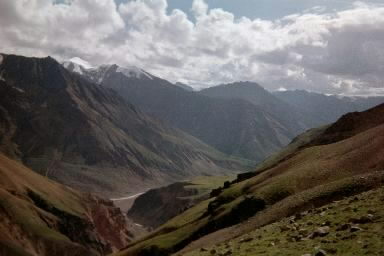
Across the Wrangell St. Elias Range
We blow up our backpack rafts where Glacier Cr. enters the Chitistone. Now I will finally be able to get off my feet after 130 miles of hiking on rocks and glaciers. My ankles are the size of grapefruits. My Curtis Raft weighs 18 oz. and feels like a light rain coat filled with air. I put on my dry suit and make sure my survival gear is around my neck. After putting my breakdown Werner paddle together and setting my pack between my legs I am ready. I love whitewater and this is my 29th year of running it so I am excited about the descent. Six of us start down the Class III run of flowing ice water in our toy boats. I try to run my boat like a kayak and immediately start taking on water. Robin Beebe, a petit 25 yr. old blond, is also having trouble. We have not seen her since the start of the race four days ago and she walks out of the woods here. She stayed in a cabin last night with John and Wendy. But then a bear stole Wendy's raft and bit 26 holes in it so Robin decided to push on. My raft continues to fill with water as I paddle around the edge of rapids. Finally my Thermarest which I am sitting on pops straight up as I fall into the water filled center of my tiny boat. I almost lose my backpack as well for it is slipping out.
Fortunately I run the boat up on a gravel bar and save my gear. Mike and Robin have had enough. They pack up their backpack rafts and start walking. Smart move. The four left jump in and try once again. My tiny raft again fills with water and I wash into a hole sideways which holds then flips me. I am crotch deep in ice water holding paddle, boat, pack and pad in my hands trying to stagger to shore. From behind I hear John yell before he runs into me as he is out of control. This causes my knee to bang into a rock and my gear is almost lost again. Even with survival gear around my neck under my dry suit it is very sobering. Mark Fineman lost both his boat and paddle on the Chitistone and had to be flown out. After dumping out my boat and paddling to where the others are I get in John's face about his river running skills. For some unknown reason we try again and again I come out of my boat, this time close to shore. Regardless, I have had it and decide to hike with Dick. I walk for an hour in my drysuit my ankle looking like an hourglass with the swelling.
The Wrangell's are a spectacular range and the rivers were very high, crossings dicey. The entire field of 30 racers took the wrong trail at the start. We raced off into Jack Cr. and did an extra three hour thrash through the brush to get to the Nebesna River. Dick started paddling a mile before Mike Sirofchuck and I. When he caught up he said: It is carnage back there. Kyle ripped his boat. Donna broke her paddle. Robin broke her paddle. I just left them.
We blew up our boats and paddled into the Nebesna in a high water. At the start of the race Gordy Vernon had said: Bob Jacobs, who knows this area better than anyone, said the rivers are as high as he has ever seen them. If someone flips in the Nebesna they will die. Let us go.
Bob later told me the Chitistone a week earlier was in flood and we would have lost racers. It was impressive. The Nabesna to McCarthy Classic Wilderness race was (to quote Muir): a grand page of mountain manuscript I was prepared to risk my life to be able to read.
The Nebesna took all my river running skills. Racers that couldn't read the river ended up on gravel bars. With the tight seals on the drysuit, freezing water and 40 F air temperature my feet were colder than they ever got traversing Denali or summiting at -40 F. We beached at the mouth of Cooper Cr. Dick Griffith threw himself on the gravel bar with his feet in his raft and just lay there gathering strength. The weather was so rainy and cold I hiked in my drysuit. We forded Cooper Cr. for several hours then built a fire to dry out gear. We continue to cross Cooper Cr. in glacier water up to our crotch. The first time the canyon narrows Dick goes left thinking it is the pass toward Blue Lake. Paul and Mike question the move but Dick says he is sure and we move on. There is music in my head as we climb the rocky riverbed in the fading light. Finally we make camp near Wendy and John. I repair my aluminum staff which was bent at a river crossing. Greg and Gabe decide to press on as they have not bags, tents or stove.
The next morning we are out of camp by 06:30 and climb for an hour before running into the returning hikers: Why are they coming down? That is not the pass. We spent all the daylight hours looking for it and curled up underneath a rock for a few hours last night.
We are stunned. That means seven hours of extra hiking. Dick is chagrined. He starts down the canyon immediately and we follow. We decide to check the maps closer in the future. After descending to Cooper Cr. we make quick time up to the left turn at a canyon that soon forks to the right. Climbing out we finally reach Blue Lake, a beautiful tarn nestled among the towering St. Elias range. We sit in the sun for just minutes to eat and drink before traversing the side of the lake and hiking up a glacial outwash plain to the pass. There is a beautiful gradual descent into Slayer Cr. which we follow until we come to a horse camp that Dick remembers from previous Classics. Here we find an old horse grain pan to haul water (with a finger stuck in the hole) and camp. Greg and Gabe are with us and we convince them to stay the night. They manage to keep warm by building up the fire and sleeping next to it.
We are hiking again at 06:30 moving across wide glacial plains with fresh snow on the mountains above the 6000 foot level. We cross one wide creek and then a island of trees before hitting the Chisana. Here John finds a horse bell which he carries for a while as the metallic ringing floats through the woods. Our group of six argues about the trail and finally we end up bushwhacking as we follow Dick in a general compass direction of south towards Chisana. We break out on the river flood plain and the views are spectacular with the snowy ramparts of the Wrangells rising into the clouds. Then we must cross the braided channel and we sink in the glacial till and struggle in the icy current up to our stomachs. Chisana is an interesting place. Passing by a horse corral the woman wrangler says: Your friends are just over there.
Others hardly look up. Like it is an everyday occurrence that someone passed through headed across the Wrangell St. Elias range to McCarthy. We hike past several airfields to the cabin of Mrs. McNutt. She tells us that Achim Jenke spent a cold night outside the generator building but:
He did not go inside and get warm because he could not find anyone to ask. He was wet and cold and should have gone in anyway.
Greg and Gabe decide to fly out of Chisana. They were just to light to make the entire traverse and have had little sleep. Traveling as light as Gordy Vernon and Nora Tobin only works if you can hike 20 hrs. a day, you donÕt get lost, and you are willing to push the edge.
Mrs. McNutt did not know where the trail was headed for Gohinda Cr. and waved
us off toward the Chisana River.We hiked in the warm sun up Gohinda Cr. and
through the timberline into the tundra. John was good at picking up horse trails
which were much better walking than the rubble strewn riverbed. Stream crossings
were frequent although not as high as we had previously done. By 21:00 I was
hammered and walked by leaning on my aluminum staff as we had been on the trail
since 06:30. We were halfway through the 150 mile course and my legs were like
jello. I started feeling a sharp pain in my right knee, an old smokejumper injury
that had bothered me only once before in 25 years- the last day of the Hope
to Homer. Finally Dick stopped and I limped around making dinner from brown
water that carried a maximum load of suspended glacier till. We arose at 05:30
and hiked over the pass to Solo Mt. cabin. From there we traversed to the White
River and dropped down to the wide glacial plain. There were magnificent panoramas
of the Wrangell's with clouds swirling by.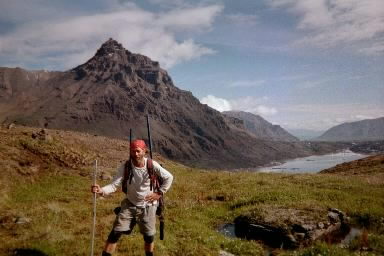
I had been in the upper White River only once before, flying in July of 1977 with my good friend Charlie Warbelow. We would get (lost) doing fire reconnaissance so I could scout rivers. It was so magnificent flying with my fishing partner and he is much missed. Charlie died when his helicopter had a massive tail rotor failure last November. When we arrive at Lime Cr. John fords it in water up to his chest. Dick said that if the four of us try that two would swim. We blew up our boats and paddled across. Hiking up the White River to where it gushes forth from the glacier was the only one of two times I remember hiking in the sunlight. My gear hung on my backpack to dry and we hiked right to the glacial source of the White. We camp on a patch of glacial till and cross Ford Cr. early when it is low. Several years ago a hiker tried to cross here and was swept into the White River and drowned. Then we climb to Skolai Pass and across gravel covered glaciers skirting a jokulhaup or glacial lake. Suddenly I sink up to my knees in a sink hole! I struggle out almost losing my shoes which would be very deleterious to my survival. My legs were covered in glacial muck up to my knees. It was a stark reminder that we were traversing an active glacier.
Then I almost got my feet crushed by a 200 lb. rock that rolled when I touched it. It was balanced so that when I touched it, the round boulder dropped and I was just able to push off and keep my feet from being crushed. Traversing the headwaters of the Nizana we crossed Chitistone pass and threaded our way down the goat trail above Chitistone Falls. We camped at the river below the glacier so we could cross early in the morning. We forded it at 06:30 and it was dicey. Others crossed the glacier above which I considered more dicey. Martin and Mailloux rafted and almost lost a raft. The Reifenstuhls swam it. Since I met Steve Reifenstuhl at Richard Nelson's place in Sitka in 1989 I have only seen him at the start of ultramarathons. As Michael Martin the race director said: What is it about this race that two men with young children are willing to swim the Chitistone and risk their lives to gain a few minutes of time?
We had one guy lost for three days and had to call his wife to tell her it was up to her and the Troopers to find him (he stumbled two days later after three flights to look for him). Five weeks later I still have swollen ankles and have just started walking without a limp (we are talking a marathon a day for a week with no trails,dicey fords and high water). Dick and I blow up our rafts and get into the Nizina River. Bob Jacobs said: A week earlier this river was in flood, somebody would have died in the Chitistone.
Almost immediately Dick's raft starts sinking. He bends over and inflates it as he floats. However, it is sinking almost as fast as he can blow it up. He asks me to paddle over to he can hang onto my boat while he inflates his. So I paddle over. He grabs on and sticking his head almost in the water blows his up. We run a section dodging gravel bars and he says: Its down again, come over so I can grab on.
We go through it again this time his glasses fog up so he takes them off. Which way? he yells.
Right Dick you've got to paddle right! I shout as he barely makes the cut.
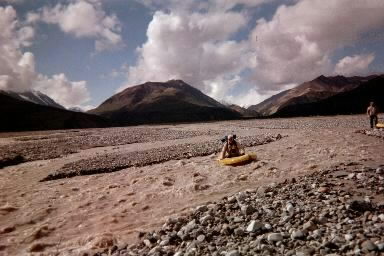
We pull over and stumble ashore. Then we build a fire and dry gear on a beached snag. It is almost warm and quite pleasant with just a hint of a breeze. The Wrangell St. Elias Range is spread out before us and the Nizina makes a great curve headed toward the Copper. Dick is able to find the holes he made in his raft bushwacking with the Sherpa packed on top. He is out of food except for a handful of jerky so I share the last of my Top Ramen with him. It seems fitting as on the Hope to Homer he gave me the last of his. As he repairs his raft two Trumpeter swans circle overhead and fly just above the river with the Wrangells as a backdrop. They must have a nest nearby because they circle numerous times this evening in wide sweeping arcs. Paul, Mike and John have gone ahead and will finish this evening. Robin, John and Wendy stop by to warm up by our fire before pressing on. For me it is a great way to spend the last evening of the race with my friend on an island in the Nizina encircled by mountains.
The last day of the race I am awake at 04:00 and spend an hour rubbing Vaseline into my feet and massaging them. In the last eight years that I have raced ultra marathons with Dick he has always managed to leave me the last day. This time I am determined to keep up. We are off by 06:00 and Dick vows he is not getting out of his boat. It is too hard when it is this cold. We run rapids I normally would not think of doing in such a small boat. By paddling hard you increase you float better. Got to paddle. Nonetheless, I still have to get out several times and empty the boat. Then the river starts to cut into the right bank and strain through the trees. I should have gotten out but instead followed Dick around a corner where a Cottonwood 50 feet long was jammed on an island. If your boat filled with water here, you would be pushed into the tree with dire consequences. I made a short prayer which I very rarely do on rivers, doing my best to stay out of conditions where pray becomes familiar. At the take out Dick motions me over. We pack our wet gear and I find two walking sticks that will help take the weight off my swollen ankles. Then we hike the last nine miles to McCarthy. It is a great stroll down a country lane and notice the size of the Aspen trees. Dick exclaims: I have never seen any that size. All those races here and this is the first time I have notice these groves.
Postscript: The celebration at McCarthy was memorable except for the fact that we were all concerned as to the fact of David Peters who was overdue. After two flights paid by AMWC Donna had to use my cell phone to call his wife and tell her it was now up to her and the Troopers to find out what happened to him. Fortunately he was find by another flight the next day. As Dick and I entered town a National Geographic photographer Mike Melford showed up taking pictures. When he recognized my he and remembered we had met at Denali base camp he said: Jerry Dixon, you must be have a good summer.
Best summer of my life!!