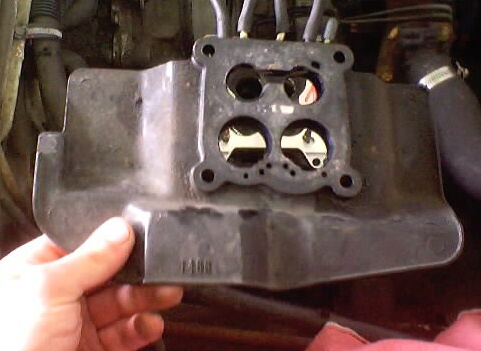
Ok guys, I have a little surprise here for you all. I made this out of a Daytona brand 4-barrel carb adapter. What it basically is, is an open-hole spacer for a Nikki carb. See, I'm too po' to afford sending out a carb to be modified, and I did a little math and discovered that a 12A, at 8400rpm, will require about 277cfm, assuming 80% volumetric efficiency. This is total, for both rotors. The problem is, each rotor doesn't take in air over the full 360 degrees of rotation. The column of air starts and stops. To draw an average of 139cfm per rotor, the flow will be much greater than that at its peak. The stock 300-325cfm carb cannot support this when in independent runner form.
My intake manifold was set up as a fully independent runner setup. The power would fall off early, it felt like due to air starvation.
With the spacer, well, let's just say I'm glad I have a rev limiter!
A side benefit is that the mixtures are no longer messed up. ( So I thought... see update below!) It's no longer way lean on the primaries and way rich at high RPM. Now that the flow is balanced out, the air moves through the carb in a more-or-less (less, right now) even manner.
Downside - less torque below 4k. So what.
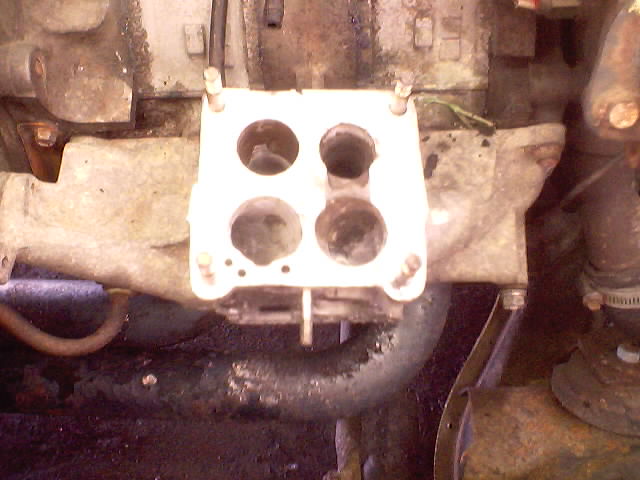
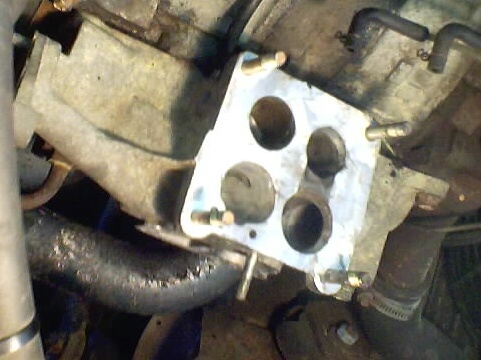
This is my manifold, as-modified by me. All of the throttle shaft bores are plugged, and is completely independent runner. (Seemed like a good idea at the time!) No, I don't have or need an ACV block-off plate, I plugged the air passage to the ACV area with JB Weld, and I drove sections of rod into the rotor housings to block off the air passages - now the center of the engine isn't heated by the exhaust!
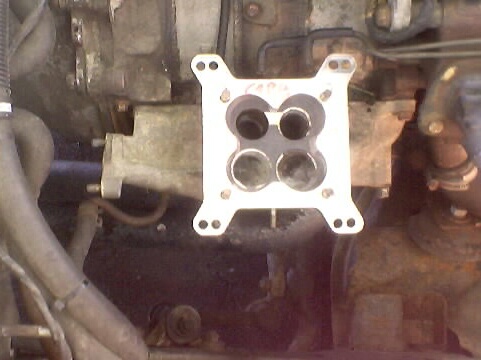
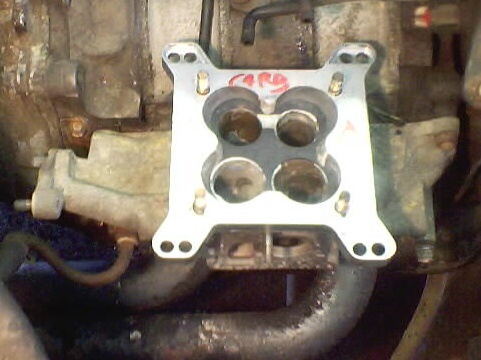
The new spacer. It is almost exactly the same thickness as the old spacer. If it works out well, I will clean up the manifold to match it better, as well as open up the center intake ports (now no longer primary/secondary!) to better match the ports in the intermediate housing. Notice that I didn't cut the carb mounting ears off - this is not laziness on my part. Theoretically a stock 390cfm Holley SHOULD work OK when the manifold has a plenum. People put 390's on Ford 2300 engines with no problem! For my purposes a Holley is more tuneable than a Nikki - you can't find Nikki parts anywhere, while every mom-n-pop speed shop will have an aisle or wall covered with Holley jets, pump squirters and cams, power valves, etc. Ok time to kill my rant for now...
 Just an image of the original phenolic spacer.
UPDATE: The car went a LITTLE faster - as i recall it went 16.0 as opposed to a best of 16.2. However, watching the O2 gauge showed why the car didn't pick up as much power as I'd wanted it to - the car was running very lean at the top end! This is because the carburetor is calibrated for the sharp vacuum signals you get when you separate each rotor. By putting a passage between the two rotors, the vacuum signal is smoother yet not as strong. This is acceptable at low RPM but I was watching the O2 readout steadily dropping to point zero volts as the engine went up the tach. I put the 4-holer back on. A fellow member of the Mazspeed forum was trying to run an Edelbrock carb on a 12A half-bridge and was having trouble with it running extremely rich. Armed with my experience with the open spacer, I advised him to cut a passage between #1 and #2 rotor. He did, and the carb ran great! Boinger carbs are designed to run with a plenum, Nikki's aren't, and both need a lot of work to go the other way. Oh well, at least we now know how to use an "off the shelf" carburetor - just cut a small plenum between the two rotors!
I had whittled my times down to a 15.616 with the 4-hole spacer, fuel pressure tuning, and a header dump. I obtained another Holley spacer, drilled the appropriate holes to fit over the Nikki studs, and modified it just for two holes, for a passage between primary and secondary but still keeping the rotors separate. (In other words, the same effect as a stock '80-earlier manifold) The car rewarded me with an instant 15.4, and I whittled that down to 15.1. With the stock tiny intake ports in the manifold you NEED a passage between primary and secondary, because the manifold is actually smaller than the primary bores. So, ah, don't fill in the primary-to-secondary passages!
Home
last updated Feb 15th 2001 at 2:31am eastern