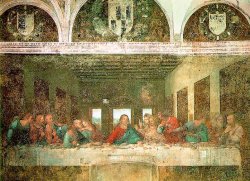
According to the Gospels, the Last Supper (also called Lord's Supper) was the last meal Jesus shared with his apostles before his death. The Last Supper has been the subject of many paintings, perhaps the most famous by Leonardo da Vinci. In the course of the Last Supper, and with specific reference to taking the bread and the wine, Jesus told his disciples, "Do this in remembrance of Me", (1 Cor 11:23-25). (The vessel which was used to serve the wine, the Holy Chalice, is considered by some to be the "Holy Grail"). Many Christians describe this as the institution of the Eucharist.
According to tradition, the Last Supper took place in what is called today The Room of the Last Supper on Mount Zion, just outside of the walls of the Old City of Jerusalem.
Chronology
The meal is considered to be by most scholars likely to have been a Passover Seder, celebrated on the Thursday night (Holy Thursday) before Jesus was crucified on Friday (Good Friday). This belief is based on the chronology of the Synoptic Gospels, but the chronology in the Gospel of John is regarded by many as placing the Last Supper on the evening before the Passover (John 13:1, 18:28). References in John's Gospel to the Day of Preparation of the Passover (John 19:14, 31, and 42), are also taken by many to indicate that Christ's death occurred at the time of the slaughter of the Passover lambs (this latter chronology is the one accepted by the Orthodox Church). However, those that place the Last Supper during a Thursday evening Passover Seder generally regard Mark 14:12 and Luke 22:7 as the only explicit references in the Gospels to the slaying of Passover lambs at the time of Christ's crucifixion, and take the Day of Preparation in the Gospel of John as a likely reference to the Passover Friday during which preparations were made for the weekly Sabbath rest. Additionally, several scholars have questioned these chronologies, and have rejected the assumption that the synoptics refer to the Passover Seder and held that they are harmonious with John.[1] Some Christians believe that a thorough examination of the Gospels indicates that the Last Supper was on a Tuesday, and that Jesus was crucified on a Wednesday.[2]
The meal is discussed at length in all four Gospels of the canonical Bible. The Synoptic Gospels state that it was the seder for the Passover, and are interpreted by some scholars to state that in the morning of the same day the Paschal lamb, for the meal, had been sacrificed. However, under the Jewish method of reckoning time, the day was considered to begin straight after dusk, and so the Passover feast would be regarded as occurring on the day after the lamb was sacrificed. This implies that either the synoptics are not written with an awareness of the Jewish method of time reckoning (Kilgallen 264), or that they used the literary technique of telescoping events that actually happened on different days into just happening on single ones (Brown et al. 625). Others interpret the language of the Synoptic Gospels as sufficiently broad to allow for an evening sacrifice of the Passover lambs.