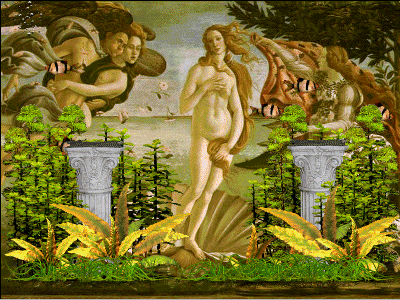
The Birth of Venus is a painting by Sandro Botticelli. It depicts the Goddess Venus, having emerged from the sea as a full grown woman, arriving at the sea-shore (Venus Anadyomene motif). The painting is currently in the Uffizi Gallery in Flore.
Origins
This large picture by Botticelli may have been, like the Primavera, painted for Lorenzo di Pierfrancesco de' Medici's Villa di Castello, around 1483, or even before. Some scholars suggest that the Venus painted for Lorenzo and mentioned by Giorgio Vasari may have been a different work, now lost. Some experts believe it to be a celebration of the love of Giuliano di Piero de' Medici (who died in the Pazzi conspiracy in 1478) for Simonetta Cattaneo Vespucci, who lived in Portovenere, a town by the sea with a local tradition of being the birthplace of Venus. Whatever inspired the artist, there are clear similarities to Ovid's Metamorphoses and Fasti, as well as to Poliziano's Verses. The classical Goddess Venus emerges from the water on a shell, blown towards shore by the Zephyrs, symbols of spiritual passions. She is joined by one of the Horae, goddesses of the seasons, who hands her a flowered cloak. According to some commentators[citation needed], the naked goddess is a symbol not of earthly, but spiritual love, in the manner of an ancient marble statue (which might have inspired the 18th century sculptor, Antonio Canova, by its candor), slim and long-limbed, with harmonious features. The modest pose is borrowed from the Venus Pudica type of ancient sculpture then being rediscovered.The effect, nonetheless, is distinctly pagan, considering it was made at a time and place when most artworks depicted Roman Catholic themes. It is somewhat surprising that this canvas escaped the flames of Savonarola's bonfires, where a number of Botticelli's other "pagan" influenced works perished. Botticelli was very close to Lorenzo de Medici. Because of their friendship and Lorenzo's power, this work was spared from Savonarola's fires and the disapproval of the Church.
The anatomy of Venus and various subsidiary details do not display the strict classical realism of Leonardo da Vinci or Raphael. Most obviously, Venus has an improbably long neck, and her left shoulder slopes at an anatomically unlikely angle. Such details only enhance the great beauty of the painting, and some have suggested it prefigures mannerism. [edit] Classical inspiration.