In 'Landscape with Diana and Callisto', Richard Wilson, the first successful British landscape painter, demonstrated not only his knowledge and experience of Italian sites but also his classical education. The site is Lake Nemi about twelve miles east of Rome with Mount Calvarone and the town of Nemi in the background. Lake Nemi was a popular destination among Grand Tour travellers and was also known as the mirror of the Roman goddess Diana (in Latin Speculum Dianae). Below the town of Nemi was believed to be a shrine to Diana, who for that shrine had the name Diana Nemorensis, i.e. Diana of the Woods. Wilson used his stay in Italy to sketch in front of ruins and famous Roman sites; two such drawings of Monte Cavo and Lake Nemi by Wilson exist suggesting that Wilson actually visited the lake.
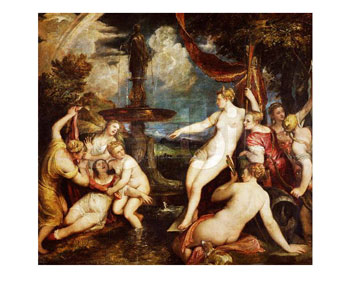
The mythological scene in the foreground serves as a visual link between the landscape and the goddess as described in Ovid's 'Metamorphoses'. Diana's companions were the nymphs, who where known for their chastity. One of these nymphs was Callisto, with whom the king of the gods Zeus fell in love. Callisto, pregnant with Zeus's child had disobeyed her vow, and Wilson depicts the moment when the goddess discovers the pregnancy of her nymph and is expelling her from her kingdom. One can just about discern Callisto, her miniature naked body a luminous spot in the overall composition. She is seated by a tree trunk covering her face with her hands and crying in despair while the standing goddess, in a position of authority and power, delivers the ban on Callisto with one condemning gesture. Callisto's companions seem to be desperately pleading to the goddess for mercy. Some other nymphs in the middle ground are bathing in the lake.