| A UNIQUE GENRE OF HONG KONG CINEMA: THE RISE AND DECLINE OF AMOY FILMS |
|
Amoy films occupied a special place in Hong Kong cinema. It was born after the war, with capitals from Chinese in the Philippines, Singapore, Malaysia, Indonesia, and Taiwan who wanted to expand on their root and culture on the screen. It soon grew into a glorious bloom and still lives in the memory of overseas Chinese in Southeast Asia. The Story began in 1947 when Xinguang Film Company of the Philippines went to Lujiang (now Xiamen) to sign up start Lu Hong and cabled the writer to come to Hong Kong. No time was wasted and the shooting of Too Late for Reunion (1950), a contemporary film starring Bai Yun and Lu Hong and directed by But Fu, immediately began in the Shiguang Studio in Ho Ka Yuen, Kowloon. The shooting of The Dumb Son-in-Law scripted by Wu Zongmu was underway at the same time. Too Late for Reunion was released to great success and created a sensation among overseas Chinese in Southeast Asia. Sensing the trend, Nanfeng Film Company, under the guardianship of Hu Tong, was established. Bai Yun and famous Amoy nanyin artist Jiang Fan were recruited to star in Tang Bohu's Seduction of Qiuxiang (1950), an even bigger success. At that time, there was a massive migration of Amoy natives to Hong Kong. Many viewed the cinema as a lucrative business and invested in filmmaking, and as a result, Amoy studios mushroomed. Xinguang boss Wu Hongbu saw the time ripe for expansion. Xinguang was renamed as Yizhong Film Company to raise capital. The writer was recruited to prepare new productions. The most successful production among them was The Romance of Lychee and Mirror (1954)1, an adaptation of the popular folktale 'Chen San and Fifth Madam'. Released in three parts, it starred Hu Tong (aka Hu Feng) as the male lead, Jiang Fan and Cai Xiaowen as the female leads, and Chen Huanwen the director. All the sets in Grandview Studios in Diamond Hill were taken up for the shooting of the film. The overseas distribution rights were all sold out in Southeast Asia even before the filming was called a wrap. Eager to share a piece of the pie, overseas investors teamed up with local partners to set up studios. Among them were Minsheng Film Company under the management of Wu Yuanxiang, Huaxia Film Company managed by Wu Baoxi2 and assisted by renowned producer Liu Zhiwei, Yicheng Film Company set up by Yicheng Trading Company which boasted Chen Yiqing as first director and Huang Zhenji as production manager, Liangyou Film Company managed by producer Zhang Guoliang, and Dehuang Company solely owned by the Singaporean investor He Youhuang. More rare to come by perhaps, was Shaws Film Company's Amoy film section, which was put under the management of Ku Wen-chung with Chen Lie acting as the principal adviser. Not to be left out, Ng Eng-wah, boss of Eng Wah & Company in Singapore, recruited Singaporean comedian Ye Feng and various singers to star in his contemporary Amoy films with Li Langguan acting as the talent scout. He also constructed theatres in Ipoh, Malaysia, exhibiting solely Amoy films. With his business savvy, cinema tycoon Yang Zhaoxing of the Philippines also sent his brother Yang Guoli to set up Golden City Film Company in Hong Kong to purchase Mandarin films, with a subsidiary focusing on the production of Amoy films. Taiwanese starlet Bai Lan was signed up to star in a string of contemporary Amoy films, such as The Jealous Woman (1959) and A Good Couple (1959). The late 1950s was the golden era of Amoy films, attracting quite a few famed directors to join its camp. Ma Xu Weibang directed Love's Crime (1957) for Minsheng Film Company; Wang Tianlin directed Miss Cuicui (1959), a joint production by Huaxia and Eng Wah, and the four-parted The Burning of the Red Lotus Temple (1957-1959) for Ji'nan Film Company; Yuan Qiufeng directed The Illegitimate Husband (1959) for Yizhong Film Company. Almost all the studios at that time were taken up by Amoy films. Amoy films had the niche in overseas markets such as Indonesia, Singapore, the Philippines and Taiwan. Cantonese films, though cornered the local market, were not wanted overseas. For mutual expansion of markets, Amoy and Cantonese filmmakers did collaborate at one time. A film was shot with two separate Amoy and Cantonese casts and every scene was shot twice with respective cast and released as separate Amoy and Cantonese versions. There were true collaborations such as The Eight Immortals in Jiangnan (1957) (its Amoy version was entitled The Eight Immortals Cross the Sea) starring Cheng Bik-ying, Wong Chin-sui, Xiao Juan (aka Ivy Ling Bo) and Huang Ying. In the Cantonese version, Amoy actors in the cast and song numbers were dubbed into Cantonese and vice versa in the Amoy version to cater to their respective markets. 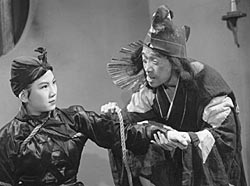 Wong Ching-ho collaborated with future star Xiao Juan (aka Ivy Ling Bo) in Monk Ji Gong (1957). As for distribution, because of the agreement between the Hong Kong and Kowloon Filmmakers Free General Association Ltd and Taiwan, only Amoy films featuring actors holding membership of the Association were allowed to be released in Taiwan. This restriction did not apply to other places. The biggest overseas markets were the Philippines and Penang in Malaysia. However, as Shaws expanded its Mandarin film empire, overseas markets were gradually taken over by Mandarin films, spelling the end for Amoy, Chaozhou and Cantonese films. This Amoy bloom, doomed by the time, faded away in the mid-1960s. (Translated by Teri Chan) Editor's notes: 1. Wong Ching-ho was the screenwriter, actor and assistant director in the film. 2. Ivy Ling Bo began her film career in 1955, acting under the alias Xiao Juan in Amoy films. Huaxia was managed by Ling's foster mother Wu Baoxi, and featured Xiao Juan in all its productions. Source: http://www.lcsd.gov.hk/CE/CulturalService/HKFA/english/newsletter02/nl23_5.html |