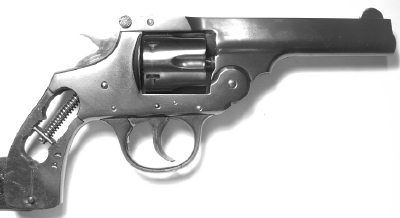
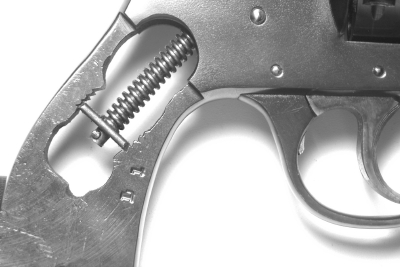
Until information comes to light as to what the factory might have named this pistol I will call it the 32 Supershot. The reasons are fairly evident; it is
built on a post WWII 22 Supershot frame with the prewar centerfire action. The 4
inch barrel shape is the same as late second model and the third model 844 22
Supershot Sealed Eight, while the caliber is 32 S&W Long and the ejection system
is the same that had been in use since 1909 when the Third Model Safety Automatic
Revolver was introduced. The frame is the same as found on all post WWII 22
Supershot Sealed Eight Second and Third Models, while the cylinder is identical
to those found on pre WWII Third Model Safety automatic revolvers in 32 S&W Long
Caliber. The serial number of this revolver is L1, this serial number dates it to
the post 1955 era. The explanation of this is; The serial numbers for the 22
Supershot Sealed Eight started in 1932 with L1 and had reach L26600 by the end on
1941. After World War II production of the 22 Supershot Sealed Eight was resumed
about 1946 and serial numbers started where they had left off in 1941 and continued
until L99,999 had been reached, about 1955 (the exact date is unknown). The third
model 22 Supershot Sealed Eight was introduced in 1954.
The Model 844 (or Third Model 22 Supershot Sealed Eight) will have very high L letter
code serial numbers or A letter code serial numbers. The model 844 Third Model 22
Supershot Sealed Eight was discontinued in 1957 and the new post was design Model 66
Trailsman was introduce in 1958, the Model 66 featured a new larger frame, manual ejection
and does not have the "Hammer the Hammer" action. The letter code used on the early
production of the Model 66 was K. The L letter code was not in use as early as 1955. The
conclusion I have drawn is this revolver could only have been made 1955 at the earliest
or 1957 at the latest.
The original finish on this revolver is unknown, when I got it had been refinished to a
polished blue similar to that found on a Third Model Safety Automatic Revolver. It is
a good refinish as the barrel, cylinder and frame are all the same, usually when a Iver
Johnson revolver of this era is refinished the frame will turn plum while the barrel and
cylinder will be blue. The plum colored frame is a very good indicator of a refinished
revolver. The type of original grips are unknown but there are very good indications
they were the same two piece the Third Model Safety Automatic Revolver.
This revolver is a mixture of pre and post war features manufactured when Iver Johnson was
in the process of designing a new top break revolver. I have not yet determined if this is
a new short-lived model or a one of a kind prototype.