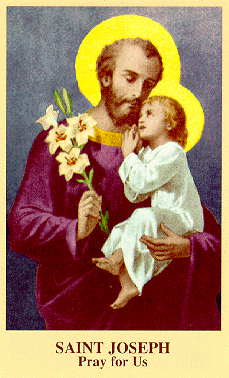
Patron of the Universal Church
Feastday: March 19, May 1,


Two days after the feast of St. Patrick comes the day of the carpenter of Nazareth, Saint Joseph, "the just man,"
of whom the Gospels say little but who is beloved by generations of Italians and Italian-Americans. The Feast of Saint Joseph is celebrated on March 19. Though often pictured as an aged man, bearded and bent with years, Joseph has more recently been seen as younger, more fitted to his role as protector of the young Mary and her Child.
Saint Joseph is patron of many places and many trades. He is the guardian of the spiritual home of Christians, the Church, and of the material home, too. The tradition of a St. Joseph's Day began when there was a severe drought in Sicily in the middle ages. In desperation, people asked St. Joseph, their patron, to intervene.
They promised, if rain came, they would prepare a big feast
in his honor. The tradition says these prayers were answered with rainy weather. In gratitude, huge banquet tables
were set-up in public and poor people were invited to come and eat as much as they wanted. Today, special foods, linens, flowers, and statuary adorn the St. Joseph's Altar which is built with three steps representing the Holy Trinity. Generosity marks this day, as it did the character of Joseph
himself. In many nations it's a day of sharing with the poor and needy, and nowhere is this better carried out than in the nation that perhaps loves San Giuseppe the most; Italy. In many Italian villages, especially in Sicily, everyone of any means contributes
to a table spread in the public square as an offering for favors received from prayers to this kindly saint. The bread made for this day is often shaped like a scepter or
a beard; villagers representing Jesus, Mary, and Joseph are guests of honor at the feast, and other guests are the orphans, widows, or beggars. After Mass, all go in procession to
this festive table. After the priest blesses the feast, everyone shouts, "Viva la tavola di San Giuse!" then eats. At the end of the meal every guest is given something to take home. For this feast, a unique minestrone is made; people add any vegetarian ingredients that happen to be handy to the soup. [This is the origin of a Sicilian expression minestra di San Giuse, i.e., confusion or chaos.] Although all kinds of lentils and dried beans are eaten on Saint Joseph's feast, cheese, usually a popular a part of the Italian diet, is not served; instead of grated Parmesan, this minestrone is served with dry toasted bread crumbs.
Everything we know about the husband of Mary and the foster father of Jesus comes from Scripture and that has seemed too little for those who made up legends about him. We know he was a carpenter, a working man, for the skeptical Nazarenes ask about Jesus, "Is this not the carpenter's son?" (Matthew 13:55). He wasn't rich for when he took Jesus to the Temple to be circumcised and Mary to be purified he offered the sacrifice of two turtledoves or a pair of pigeons, allowed only for those who could not afford a lamb (Luke 2:24). Despite his humble work and means, Joseph came from a royal lineage. Luke and Matthew disagree some about the details of Joseph's genealogy but they both mark his descent from David, the greatest king of Israel (Matthew 1:1-16 and Luke 3:23-38). Indeed the angel who first tells Joseph about Jesus greets him as "son of David," a royal title used also for Jesus. We know Joseph was a compassionate, caring man. When he discovered Mary was pregnant after they had been betrothed, he knew the child was not his but was as yet unaware that she was carrying the Son of God. He planned to divorce Mary according to the law but he was concerned for her suffering and safety. He knew that women accused to adultery could be stoned to death, so he decided to divorce her quietly and not expose her to shame or cruelty (Matthew 1:19-25). We know Joseph was man of faith, obedient to whatever God asked of him without knowing the outcome. When the angel came to Joseph in a dream and told him the truth about the child Mary was carrying, Joseph immediately and without question or concern for gossip, took Mary as his wife. When the angel came again to tell him that his family was in danger, he immediately left everything he owned, all his family and friends, and fled to a strange country with his young wife and the baby. He waited in Egypt without question until the angel told him it was safe to go back (Matthew 2:13-23). We know Joseph loved Jesus. His one concern was for the safety of this child entrusted to him. Not only did he leave his home to protect Jesus, but upon his return settled in the obscure town of Nazareth out of fear for his life. When Jesus stayed in the Temple we are told Joseph (along with Mary) searched with great anxiety for three days for him (Luke 2:48). We also know that Joseph treated Jesus as his own son for over and over the people of Nazareth say of Jesus, "Is this not the son of Joseph?" (Luke 4:22) We know Joseph respected God. He followed God's commands in handling the situation with Mary and going to Jerusalem to have Jesus circumcised and Mary purified after Jesus' birth. We are told that he took his family to Jerusalem every year for Passover, something that could not have been easy for a working man. Since Joseph does not appear in Jesus' public life, at his death, or resurrection, many historians believe Joseph probably had died before Jesus entered public ministry. Joseph is the patron of the dying because, assuming he died before Jesus' public life, he died with Jesus and Mary close to him, the way we all would like to leave this earth. Joseph is also patron of the universal Church, fathers, carpenters, and social justice. We celebrate two feast days for Joseph: March 19 for Joseph the Husband of Mary and May 1 for Joseph the Worker There is much we wish we could know about Joseph -- where and when he was born, how he spent his days, when and how he died. But Scripture has left us with the most important knowledge: who he was -- "a righteous man" (Matthew 1:18).
Joseph was foster father to Jesus. There are many children separated from families and parents who need foster parents. Please consider contacting your local Catholic Charities or Division of Family Services about becoming a foster parent.
Saint Joseph, patron of the universal Church, watch over the Church as carefully as you watched over Jesus, help protect it and guide it as you did with your adopted son. Amen
|
|

Copyright � 2001 Cassie All rights reserved. 
 ~cassie~ 
|


 Saint Isidore of Seville