
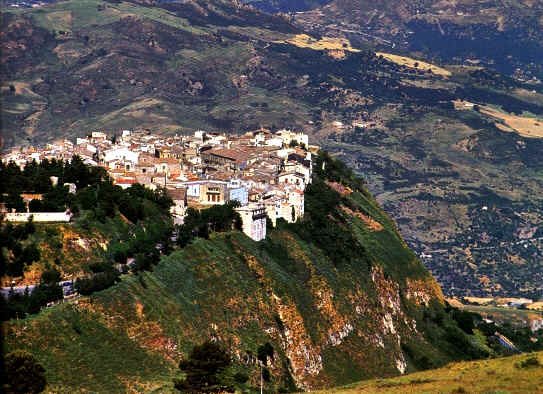
Village In The Sky
 |
|
Polizzi Generosa, like many Sicilan towns has an ancient origion. Its beginings have been discussed by historians for hundreds of years. Some have suggested that it would have been the Sicilian Athens mentioned by the 1st century Greek historian Diodoros Sikelianos. Still others believe that the City was founded by the survivors of Palica, the town destroyed by Ducezio and its name derived from the Palic Gods, the sons of the nimph Thalia. Thalia lent her name to 'spring', as "Naftolia". The discovery of a statue of Isis, also suggests that the name could have been of Egyptain origion meaning 'Town of Isis'. Archiologist have unearthed items of Punic and Roman origins dating from the 3rd and 4th century B.C., but the present Town is believed to have been founded in the Byzantine age when it was given the name of Basileapolis, City of the King. During the reign of the Normans, Earl Ruggero fortified the town and the Castle against the intruders. His niece, Countess Adelasia, Mistress of Polizzi, gave the City a great energy that attracted many visitors which included Monarchs, such as Queen Elisabetta D'Aragona, her son Ludovico, King of Trinacria, Queen Mary, wife of Martino the young, his wife the Queen of Navarra, Vicaress for the Sicily Kingdom and the Emperor Charles the 5th who was guest of Gian Bartolo la Farina in 1535. On that occasion the Senate of Polizzi was institued. Polizzi was never a State town, except for very short periods, and her independence was jealously defended. The town had her own government, laws and statutes.
Frederick the 2nd gave her the title of 'Generosa', meaning Generous, that even now is an integral part of the name and has always been admired for fairness. The presence of many noble families and the Law of Majorat created a presence of all the Holy Orders and enriched the city with Churches, Monasteries and works of Art. Polizzi's most magnificent period was the Renassaince. During that period she was distinguished for her great artistic flowering. The cultural life of the little city was particularly progressive and active. A public school was open in 1428, and in 1572 Jesuites inaugurated a schooi of 'Low Letters' that later was extended to 'Superior Studies'. A severe plague struck the town at the end of 16th century causing her decline. Still later social life of the comune was characterized by strong disputes among Nobles who held the power, and the representatives of the Bourgeosie, calied 'civilians' who had the right to take part in public offices. Polizzi Generosa means, Generous Policies. The community has always been known as a progressive community with regard to social works. Since the Middle Age there have been hospitals, schools, as well as artistsans and intellectuals. In 1901, when the large cities had only gas lamps Polizzi was the first town to have electric light. |
|

Copyright � 2001 Cassie All rights reserved. 
 ~cassie~ 
|

