As I noted in my presentation, I was tempted to apply the concept of Mary Wollstonecraft as a wholly modern woman to pop music, if only just to present a different side of her influence and as well to bring myself more into what I learned about her. While I spared the class during the presentation, I am adding this part of the site in it's place. I am going to steal bandwith from this site and upload one song a week until the end of this course, something from a female artist who I enjoy and find to be either groundbreaking, largely influential or unique. The songs on that site expire after one week. I will add any pertinent biographical information that will establish the artist as whichever of these things that apply. Here are some pieces of an article that I was planning to read -- it is from a literary magazine called Progression, the article is called "Hips and Makers -- Carl Homer on the New Deal for women in music". The entire article can be found here.
Female artists have always had a difficult time of it. In 1970, Germaine Greer wrote: "The female entertainer is so often exploiting her attractiveness as a sexual object that her situation is parallel to that of a [Playboy model]...She may be more than ever a valuable property for someone else, so that even her geniune talent may be obscured in the bally-hoo of the sexual object". (The Female Eunuch, p149) It would be untrue to say that women have less opportunity to succeed in the music business than men. It's woefully true, however, that the female artist is forced into particular roles more often than her male counterpart.
Now, female employees of record companies and so forth are increasingly rising through the ranks of management: the day of the mysogynistic svengali in the big office is drawing to a close. This isn't to say that the music biz isn't as model a patriarchy as the next industry, sociologically speaking. By and large, though, the waves of Mary Wollstonecraft and Emily Pankhurst are beginning to crash on the record company shores, and before long they'll have caught up with the rest of us.
Of course, there are still far too few female producers, DJs and A&R heads. Pop music culture is quintessential male teenage obsessiveness, and the opinionated boys will always shout louder than everyone else. Perhaps before the business side is equally open to women, the musical side could bear some scrutiny.
How many female artists are taken seriously on a political level? In Britain, Louise Wener (Sleeper) is constantly under fire from the music press for being lippy. Now, she's said some daft things, like arguing that there's no point voting in General Elections, and that feminists are congenitally humourless. I'm not saying that the flak she gets is because she's female, but the character of the criticism is certainly different.
[...] women are rarely inclined to adopt the masculine rhetorical discourse just to earn respect. Women like Madonna, who've proved they can succeed on patriarchal business terms, tend to adopt an egotistical and inward-looking masculine style to do it, and that means putting money before issues. Camille Paglia argues otherwise ("Madonna... exposes the puritanism and suffocating ideology of American feminism"); but for all her posturing and provocation, Madonna hasn't really fostered any cause but her own.
The demands on female artists are pretty constraining. They need to be glamorous, or kooky, or fetishistically scary (Siouxsie Sioux, for example). Personality is often reduced to the lowest common denominator by the establishment press: they don't want real people, they want either bimbo fantasy girls (take your pick), matriarchs (Aretha Franklin), or eccentrics (Bjork). Not politically minded, articulate or opinionated people. That's for the boys. Even Riot Grrrl will be viewed by history as part of the (male-dominated) grunge slacker scene.
It's the emphasis on appearance which really says it all. It seems to many young female artists as a fact of life that they'll need photos of themselves pouting, wearing ten times more make-up than usual, in some daft and undignified clothing. Being in a band affords more protection from this sort of thing than the solo singer gets, but most photographers (including women) will still shove the girl to the front whether she wants to be there or not. And no-one will ask them what their "message" for the kids is. Female agit-prop doesn't get far in the mainstream.
The message to the up and coming female artists of today, to adapt Margaret Atwood, has to be: nolite te bastardes carborundorum. Tell the photographer to fuck off. Get a woman to direct your video. Point out to the music press hacks they're treating you differently - once they realize, they'll be on your side. Refuse to sing other people's inane disco pap, it's not worth it just to be famous. Refuse to justify wearing a schoolgirl's uniform on Top Of The Pops (Echobelly): don't let the forty-year old journalists turn the conversation to sex all the time. Talk politics, or music, or bollocks, until they print it. And for god's sake don't accept the way things are as OK, just because it used to be worse. If everyone did that, we'd be stuck with the feudal system and the Catholic church.
Exceed the stated dose - one must be absolutely modern.
For the week of February 13th
Julie Doiron
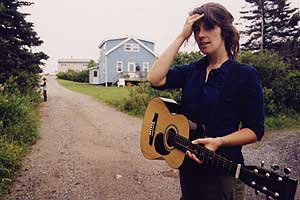
Julie Doiron has been involved in the Canadian independent music scene since she was 18 years old. She was a member of the acclaimed Canadian grunge rock band Eric's Trip before venturing out on her own. She is considered to be one of the most intimate, organic songwriters in indie music today -- and she has just moved back to this part of the country from Montreal and Ottawa. She has been nominated for an ECMA for alternative recording of the year. Here is a great interview with her. Note! I am going to be interviewing Julie on UNBSJ's campus radio station, CFMH 92.5FM this Wednesday at 2pm. We'll be talking about the state of women in music among other things. She is playing two shows at Sessions Cafe in Quispamsis this weekend and two tickets will be given away. Don't miss the boat.
Snow Falls in November
Faites de Beaux Reves
For the week of February 6th
Sue Tompkins (from Life Without Buildings)
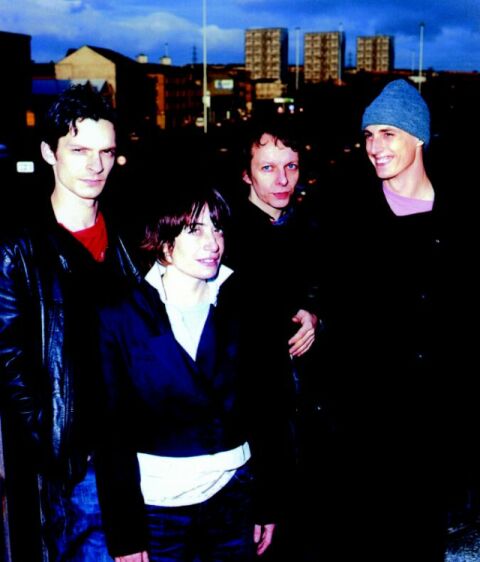
Life Without Buildings had one album. They released Any Other City in 2001 on Tugboat Records (a division of Rough Trade records) and promptly broke up. The members have promised other projects, but the only one I am particularly keeping an eye out for is Sue Tompkins, vocalist/lyricist and brains behind Life Without Buildings. On the merrit of this one album alone she is easily one of the coolest vocalists I have ever heard, and if you are into unique vocals please check this stuff out. This album took eleven months to get here in the mail -- if anyone is as taken with this stuff as I am let me know and I will make a copy, it's easier. Here is an interview, and here's the band's website. I'll let the music speak for itself here. See if you've heard anything more fresh than this for a while.
Life Without Buildings
The Leanover
For the week of January 30th
Pam Berry
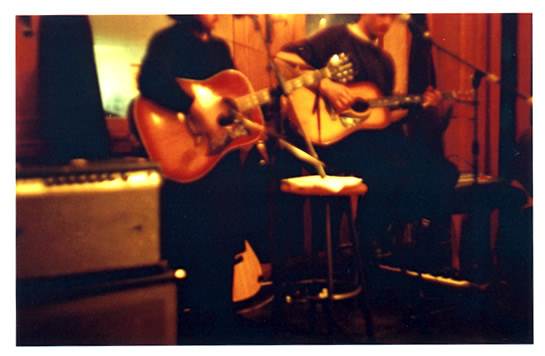
I am starting big here, this woman is my hero. She co-founded Chickfactor, a well known and well loved indie music zine in 1992 with Gail O'Hara. She has been in numerous bands, including Black Tambourine, The Shapiros, Glo-Worm, The Snowdrops, Castaway Stones, and her current project, The Pines. Read a neat interview with her here, that is also where I stole that picture from. It's not very clear but it is the only one I could find, which is something that interview also addresses. In the 80's and early 90's there was a indie pop explosion in the UK -- sparked by the NME's c86 mixtape and several small labels (creation, postcard, sarah). A lot of little pop bands were working hard to introduce a new sound to the world. Black Tambourine is the only American band that I have heard who was making music at the same time that was just as good (if not better in some cases) as the bands of that era in indiepop. While they only really achieved cult status in terms of following, they were hugely influential in the DC music scene and beyond; America's indiepop scene owes this band a lot. Anyhow, check out some songs fueled by the brilliance that is Pam Berry below.
The Shapiros (dream-pop/twee)
Do You Know
The Pines (folk-pop/twee)
Anita O'day
Glo-Worm (twee)
Downtown (Petula Clark cover)
Black Tambourine (shoegaze/twee)
Black Car