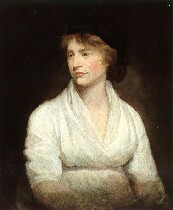
Mary Wollstonecraft is a woman much deserving of the respect she has been receiving in recent decades. Her most famous work is A Vindication of the Rights of Women, a work in which Wollstonecraft appeals for equal rights and opportunities for women. She argues that women must exercise their capacity for reason, and that the soft, delicate, and romantic characteristics that women exhibit are not inheret, but instead a learned, socially-imposed way by which males repress and enslave them. In her book Mary Wollstonecraft and the Feminist Imagination, Barbara Taylor tells us that Mary Wollstonecraft retains an enduring role:
[...] To represent women's hopes of a society free from misogyny and sexual injustice. However distant her ideas and imaginings may be from feminist thinking of the present -- very distant indeed in some cases [...] -- as a symbol of what remains to be achieved. Mary Wollstonecraft remains as vital and necessary a presense today as she was in the 1700's. (Taylor, 253)
To agree with the necessity of this eighteenth-century writer it is necessary to have a basic understanding of her life as well as her work. This section of the website will provide you with this.
Mary Wollstonecraft is an icon of modern feminism who "made her way into the world through the written word" (Lorch, 3). She was born on April 27, 1759 in Spitalfields, London. As a young girl growing up in various parts of England, she was an imaginative fantasist, a "compulsive manufacturer of 'Utopian dreams'" (Taylor, 1). When she was 16 she met Fanny Blood, a young woman several years older than herself who would have a great and lasting influence on her life. "Mary Wollstonecraft described her friend [...] as follows: 'She has a masculine understanding, and sound judgement, yet has every feminine virtue'. This androgynous notion of perfection was to remain an ideal for Mary Wollstonecraft for years to come" (Lorch, 15). In 1784 when Mary was aged twenty-four, she opened a school for girls with her two sisters and good friend Fanny. The school was forced to close two years later due to financial difficulties. Having been told on past occasions that she could earn a living by writing, Mary Woolstonecraft composed a 162-page pamphlet called Thoughts on the Education of Daughters -- an important work which early-on establishes Wollstonecraft as a woman well ahead of her time. This text is often considered her starting point for her writing of A Vindication of the Rights of Women, as she speaks of the absense of job opportunities for educated women. Eleanor Flexnor addresses the importance of this early writing, saying:
She argued that from the earliest age, every attempt should be made to develop children's intelligence: 'Whenever a child asks a question, it should always have a reasonable answer given to it.' Curiosity should be stimulated: 'Many things with respect to the animal and vegetable world may be examined in an amusing way; and this is an innocent source of pleasure within eevryone's reach.' No progressive teacher today could putthe case for learning how to reason more compellingly: 'Above all, teach them to combine their ideas. It is of more use than can be conceived, for a child to learn to compare things that are similar in some respects and different in others. I wish them to be taught to think.' 'I wish them to be taught to think.' In a book on the education of girls, this phrase alone showed how far ahead of her time the writer already stood. (Flexnor, 60)
This pamphlet earned ten pounds and led to the publication of Mary, a fiction and Original Stories which dealt largely with Mary's memory of her friend Fanny, who had passed away shortly before the closing of their school. She went on to publish other writing, a collection of childrens stories as well as writing for Joseph Johnson's Analytical review, but the brunt of her earnings went to her father and her sibbling's education.
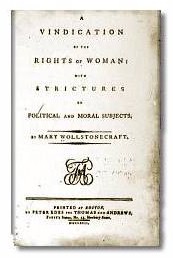
Mary Wollstonecraft is responsible for a number of texts which establish her as a woman far ahead of her time. Though much of her writing is considered to be highly subjective and fragmented, it is the ideas within these texts which prove her status as an original, modern woman, and a feminist-thinker. She is in many of the books written about her referred to as the "first feminist" and the "mother of feminism" -- Her most famous work is A Vindication of the rights of Women, which was published in 1792. This work is considered to be the first great written discourse of feminist thought. In this work Wollstonecraft works to "persuade women to endeavour to acquire strength, both of mind and body, and to convince them that the soft phrases, susceptibility of heart, delicacy of sentiment, and refinement of taste, are almost synonimous [sic] with epithets of weakness." As Eleanor Flexnor points out, Wollstonecraft was taking a big step in arguing the intellectual capacity of women: "[...] she was arguing without precedent, at a time when the mere existence of a woman's mind not only was in question, but was of no interest to anyone, women included" (Flexnor, 60). Wollstonecraft argued that a woman must be an "intellectual equal [to her husband], a mature and educated being", otherwise she is not fulfilling the role of a human being. Without this symmetry, a woman is "not [her husband's] companion, but his mistress" (Flexnor, 150). She argued that intellect and reason will always govern, and that women must become equal to their male counterparts by exercising theirs.
She looks forward to a day when both men and women will be active citizens. [...] She thinks that 'women ought to have representatives instead of being arbitrarily governed without having any direct share allowed them in the deliberations of government.' She states, 'The few employments open to women, so far, from being liberal, are menial', and, expanding on what she said in Thoughts on the Education of Daughters, she goes on to comment on those 'few employments'. Even in those, women are not treated equally with men; for instance, tutors and governesses do not have the same social status and are allocated different tasks. She then indicates what she thinks is appropriate work for women -- farm management, medecine, running a shop, the study of history and politics -- and criticizes government for not 'providing an honest, independent woman, by encouraging them to fill respectable stations'. (Lorch, 81).
She states again and again that the vast difference in status of men and women is keeping the improvement of society at a standstill. She stresses that "if women are not educated to enable them to be 'affectionate wives and rational mothers' and the 'companion of man', then there will be no progress" (Lorch, 84).
In 1795, Mary Wollstonecraft had her first daughter, named Fanny after her old friend Fanny Blood. Fanny's father was American Gilbert Imlay, a man with whom Mary shared a passionate relationship which eventually went tepid as the two grew apart. Gilbert was often kept away by his industry and Mary soon became miserable with her situation, aware that her career as a writer had come to a halt and that the independence which she had strived for since being a young girl was hidden from sight. She was at this time completely emotionally and financially dependent on him. On a particular occasion when she went to visit Gilbert she was so distraught with her situation that she attempted to take her own life. Months later while on a trip to Scandinavia, Mary discoverd that Imlay was living with a young actress and took a second attempt at suicide. Contact between the two was soon after abandoned. A relationship between herself and William Godwin, a radical political philopopher, developed within the next year. She told him that she had been "'existing in a living tomb'" (Lorch, 53) -- she became pregnant with her second child and the couple wed in March of 1797.

Old St. Pancras Church, St. Pancras Road, London. The church where William and Mary were wed in 1797.
Mary Wollstonecraft gave birth to her daughter Mary on August 30th, 1797 and she died ten days later on September 10th. The cause of death was septicaemia -- "the condition in which the bloodstream is invaded by bacteria giving rise to fever and hypotension" (http://mednet3.who.int/eml/disease_factsheet.asp?diseaseId=343). When she died, she left behind an unfinished book called The Wrongs of Women, or Maria. The sexuality expressed within this book was generally rejected by the public when it was released, and there was somewhat of a public outcry. As Barbara Taylor states in her book Mary Wollstonecraft and the Feminist Imagination, "the novel was inevitable seen as an exercise in sexual self-exoneration -- a 'direct vindication of adultery' [...] Sympathisers were taken aback; political enemies gloated" (Taylor, 246). This book, along with a biography that William Godwin lovingly put together, sharing private details of Mary Wollstonecraft's life including her despair and suicide attempts, worked to cast Wollstonecraft in a negative light and her reputation suffered a great blow. However writing several centuries later, Jennifer Lorch describes Wollstonecraft's final book as "the most sophisticated presentation of [Mary Wollstonecraft's] feminist thought [...] Its subtle analysis of the difficulties experienced by middle-class and working-class women , and their relations with men and with each other, is in many respects amazingly modern, presaging some of the late twentieth-century work in this area" (Lorch, 2). This book is important because it effectively displays the manner in which Mary Wollstonecraft progressed in her ideas throughout the course of her lifetime. A huge development in her feminist thought is apparent in this work -- this was likely due to her experiences with Imlay. Jennifer Lorch declares the text as a "combin[ation] [...] of the two Vindications", put together
to show how questions of class and survival cut across woman's loyalty to women, and how men's position of power links men to one another, while dividing women from each other [....] In the Vindication, Mary Wollstonecraft assumed as the basis of her arguments the similarities between men and woman and discounted sexual difference; in doing so she also discounted, or suppressed, sexuality itself. In the later work she draws on her relationship with Gilbert Imlay and addresses the issues of both sexual passion and sexual difference. In the relationship with Imlay, Mary Wollstonecraft experienced what some have seen as the very core of the feminist dilemma: how to love a man, live with a man, and retain feminist integrity and sisterly loyalty. (Lorch, 95, 98)
Lorch argues that it is this text, rather than Mary Wollstonecraft's famous Vindication of the Rights of Women, that ultimately establishes her as a key figure in history. "It is her last work, with its problematisation of romantic love and perception of the intricate interrelation of class, gender, and love, rather than the better known Vindication, that makes Mary Wollstonecraft relevant [...] two hundred years after her death" (Lorch, 99) .
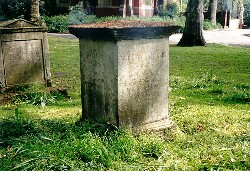
The grave monument for William Godwin and Mary Wollstonecraft at St. Pancras Old Churchyard, St. Pancras Road, London. Their remains were moved to Bournemouth following the death of Mary Shelley in 1851. source: here
When I asked Dr Jones what kind of information I should be looking for, she said to talk about who Mary Wollstonecraft is and why we should care about what she did. Who she is has been established -- she is a historic figure whose views earned her the lofty title of the 'mother of feminism' -- a completely modern woman in her time. Why we should care has also been established. She is not only the mother of an authour we are studying in this class, she is a fascinating woman whose revolutionary views and courage to express them is nothing short of inspiring. Her views have been taken and elaborated on through the centuries. As Sarah Lorch concludes in her book,
[Mary Wollstonecraft] was an unashamedly egocentric woman with enormous drive and determination, She was intelligent, [and] vivacious. [....] What distinguished Mary Wollstonecraft was the courage with which she attempted in her last years to create a synthesis of the personal and the political. Her search for solutions was not a detatched, academic one. Her experience with Gilbert Imlay and her suicide attempts were not disowned during her new life with Godwin, but integrated into a innovative analysis of what it is to be a woman living in a society controlled by the laws, customs and emotions of men. This is the integrity she sought and achieved in her last years and it is through this integrity that Mary Wollstonecraft can herself act as an inspiration for later generations of women. (Lorch, 111,112)