 |
|
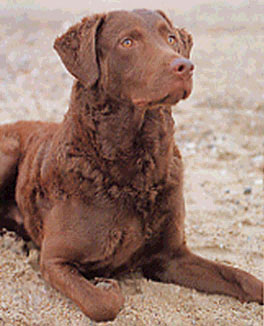
| Champion Chesrite's Turning Back Tyme, CD,CGC,TDI "Turner" a Chesapeake Bay Retriever. |
| Conformation is what dogs are judged on in the Breed Rings, whereas Performance is what Obedience is judged on. Each breed has its' own 'Standard of Perfection', a verbal desciption of the attributes of a perfect specimen. Judges are awarded licenses by Registries, (e.g. American Kennel Club, United Kennel Club, Canadian Kennel Club, etc), upon application and after demonstration of their knowledge of the Standards. Once licensed, a judge may award championship points. In order for a dog to earn the title of Champion it must have earned a specified total of points: AKC- 15 points earned from a minimum of 3 different judges with at least 2 majors, (3 - 5 points garnered at a single show. CKC- 10 points UKC- 100 points. The number of points to be won at a show are determined by the numbers of dogs in competition that day and for that region. While the numbers above appear to make one Championship easier to attain than another this is not the case. You could earn 40 - 50 points in a single U.K.C. show while the maximum number of points awarded at an A.K.C. show is 5. |
 |
| What does it take for a dog to be a 'Show dog'? It goes without saying that the dog should conform reasonably well to the 'Standard' and must be free of disqualifications. Structure and movement alone however, do not MAKE a show dog. Our definition includes the dogs attitude in the ring. They must be confident, enthusiastic, and have a 'PICK ME' personality. My ideal show dog is a dog who is on the edge of out of control. Intense, bold, vibrant should be the adjectives used to describe a winner. Most puppies are born with this attitude so why don't you see more dogs in the ring like this? In most cases a lackluster performance has been created through improper or ill-timed training methods. Setting strict rules for the puppy to perform by will virtually guarentee a 'burned-out' dog by the time it is physically mature enough to win. Puppies under one year of age should be entered into competition for one reason and one reason only, to learn to have fun! If they win then so much the better. If they don't??? Who cares if, they had a good experience. Wiggling and hopping and failing to stand for more than a few seconds are part of puppyhood! A critical part! As long as the puppy is well socialized and not fearful of an examination, most judges will overlook their baby antics and place them according to their conformation attributes and not their behavior. Those judges who will not 'put up' a puppy inspite of this are not worthy of an entry. An average show career could span 4-6 years. Is any one show worth ruining the young dog's frame of mind? I do not believe so! |
|
| How old should a puppy be before you begin training? Using It's Showtyme training methods we begin puppies as soon as possible. Those born in our home are started from day one. Students are accepted at 8 weeks of age. With the techniques that we use, an 8 week old can take a 1 hour class and a 1 hour private lesson the same day and LOVE to show for the rest of its' life! Most of the class work involves play and all of the private work is done off lead, allowing the puppy to CHOOSE to participate which they do willingly. Students are encouraged to follow the NO LEASH method of training for all of the 'homework'. |
|
| Coming soon.... More info on training techniques. |
 |
| ALL INFORMATION ON THIS PAGE IS COPYRIGHTED AND MAY NOT BE REPRODUCED BY ANY MEANS. |
| (c) Jan M. Thomas, It's Showtyme 2001 |
| (TM) |
 |