
Pay Per Click
In computing, an HTML element indicates structure in an HTML document and a way of hierarchically arranging content. More specifically, an HTML element is an SGML element that meets the requirements of one or more of the HTML Document Type Definitions (DTDs). These elements have properties: both attributes and content, as specified (both allowable and required) according to the appropriate HTML DTD (for example, the HTML 4.01 strict DTD). Elements may represent headings, paragraphs, hypertext links, lists, embedded media, and a variety of other structures.
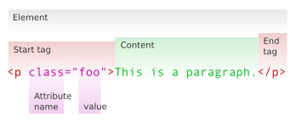
Syntactically HTML elements are constructed with: 1) a start tag marking the beginning of an element; 2) any number of attributes (and their associated values); 3) some amount of content (characters and other elements)'; and 4) an end tag. Many HTML elements include attributes in their start tags, defining desired behavior or indicating additional element properties. The end tag is optional for many elements; in a minimal case, an empty element has no content and requires no end tag. There are a few elements that are not part of any official DTDs, yet are supported by some browsers and used by some web pages. Such elements may be ignored or displayed improperly on browsers not supporting them. Informally, HTML elements are sometimes referred to as "tags" (an example of synecdoche), though many prefer the term tag strictly in reference to the semantic structures delimiting the start and end of an element. XHTML is the successor to HTML 4.01; XHTML 1.0 supports the same elements as HTML 4 and in most cases valid XHTML 1.0 documents will be valid or nearly valid HTML 4 documents. XHTML 1.0 migrates HTML from its SGML underpinnings to an XML foundation. Accordingly, the discussion of elements within this article focuses on the final SGML based HTML, version 4.01 (unless noted otherwise). However, to the extent that XHTML 1.0 elements remain identical to the HTML 4.01 elements, the discussion remains applicable (see HTML for a discussion of the minor differences in content between XHTML 1.0 and HTML 4.01).