|
Basilica of Mary Major |
||
|
to Previous Page: St. Lawrence |
to Next Page: St. Peter's |
|
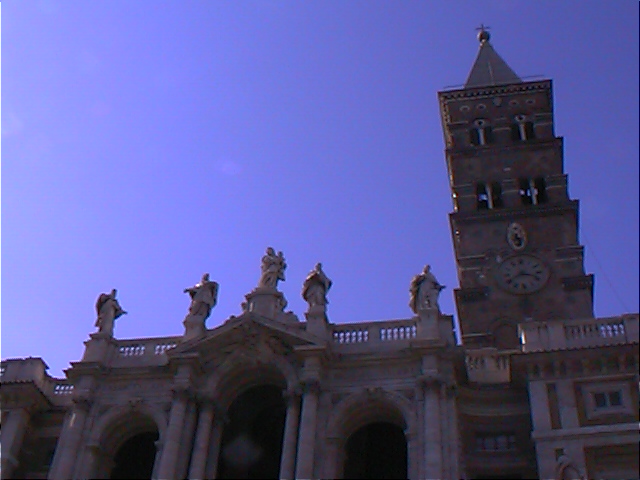
The facade and bell tower of Santa Maria Maggiore
The view from the Holy Door entry showing the columns, the nave, the apse and the Alter.
One of the chapel alters at the entrance
|
This church has the most
interesting origins of any of the other churches in the seven church
walk. It is said the Pope Liberius (353-366) and a local
influential man called Giovanni, both had a series of dreams in which
the Virgin Mary was indicating to them that they should build a church
in her honor. On August 5, the Feast of Our Lady of Snows, there
was a snow fall in the form of a church. The pope took this as a
sign that his dreams were true and thus had a church built. In
431, Pope Sixtus III (432-440) built the present church in honor
of Our Lady after the Ecumenical Council of Ephesus (431) declared the
the mother of Jesus, the Virgin Mary, is indeed to be known as the
Mother of God. It was dedicated to the Holy Mother of God, but was
soon referred to as St. Mary Major, since it was the oldest church in
the west dedicated to the honor of the Mother of God.
Much of the present structure is work from the fifth century original church. Fifth century frescoes can be seen through the facade and a series of mosaics line the upper part of the nave which have also survived from the fifth century. The altar piece in the chapel to the left of the main altar depicts the miracle of the snows. The confessio has a large statue of Pope Pius IX kneeling in adoration. Among the relics kept there are pieces of wood from the crib of Jesus and remains of St. Jerome, St Matthew, St. Lawrence and St. Stephen. The Blessed Sacrament Chapel to the right of the main altar has a large church suspended above the tabernacle by four bronze angels. In the apse is a 13th century mosaic showing Jesus placing a crown on the head of Mary his Mother. The ceiling is said to be guilding with gold brought to Europe from the new world, a gift from King Ferdinand and Queen Isabella. The columns lining the nave came from the pagan temple dedicated to Juno on the Esquiline Hill. |
|
| to Previous Page: St. Lawrence | to Next Page: St. Peter's | |


