Many of the
qualities of OK Computer - particularly the amazing guitar sounds and the
masterful use of dynamics - are absent from Kid A. Also absent from some
of the songs are certain members of Radiohead themselves. It was an album
made in an entirely unfamiliar fashion: no time-constraints; very little
pre-written materiall; a great deal of bewilderment and fear. "In terms
of the relationship between the five of use, everything was up for grabs
last year," Selway reckons. "it was a case of trying to see what different
musical approaches there were - whether they were appropriate, whether
we could find something that we all agreed on." The final member of Radiohead
to meet Q is Thom Yorke, who walks into the pub in a rather foul mood and
orders a pint of bitter. With Blue Note jazz and Django Reinhardt playing
in the background, he slowly unwinds over the course of three or four ales
and ends up staying till closing time. By then the pub has filled with
young drinkers, but none give Yorke so much as a glance. "No, they're all
much too cool," he says, adding icily, "Right now everyone's off my back
- and I'd like it to stay that way."
Yorke seemingly
had an awful time making Kid A. All the same, O'Brien insists that its
musical leaps-in-the-dark and discoveries of new frontiers were made possible
only by Yorke's doggedness.
"Thom drove
the album, more so than any other album," says O'Brien. "It was an eye-opener
for me. He has a great art-school ethic. He did art at university and he
has that kind of drive: OK, I've done that. Now I'm going to move on. I
think I can be vaguely objective about this, and I think Thom is in the
line of the John Lennons, the David Bowies, part of that heritage. He has
an incredible gift."
Yorke is not
the leader of Radiohead as such, but he is credited as being their prime
motivator and ideas man. O'Brien: "You look at Thom - he's always moving,
he's very fast. He's got incredible physique and brain." In a Radiohead
dispute, Yorke will often win. ("We operate like the UN," he suggests,
"and I'm America.") From day one, he has written nearly all of Radiohead's
material. Even on OK Computer, which sounded like a democracy in action,
what was actually happening was well-rehearsed band playing Yorke-written
songs until they arrived at the optimum performance.
When Radiohead
started recording the new album in Paris in January 1999, however, it was
clear that Yorke had virtually nothing prepared. He had, in fact, been
hit by a grave attack of writer's block.
"New Year's
Eve '98 was one of the the lowest points of my life," he recalls. "I felt
like I was going fucking crazy. Every time I picked up a guitar I just
got the horrors. I would start writing a song, stop after 16 bars, hide
it away in a drawer, look at it again, tear it up, destroy it... I was
sinking down and down."
Among the things
eating into Yorke's confidence was his worry that Radiohead were not the
pioneering band they were cracked up to be. As a student in Exeter in the
early '90s, he loved the risk-taking techno of the Sheffield-based Warp
label. Trying to find his bearings on returning home from the OK Computer
tour, Yorke listened back to the Warp artists Autrechre and the Aphix Twin[s],
and grew convinced that they had pushed music forward while Radiohead had
only nudged it sideways.
"I thought
we had missed the point," he says sadly. "The first thing I did after the
tour was buy the whole Warp back catalogue. I started listening to John
Peel and ordering records off the Net. It was refreshing because the music
was all stuctures and had no human voices in it. But I felt just as emotional
about it as I'd ever felt about guitar music."
During rehearsals
at the end of 1998, Ed O'Brien had had a brainwave about the new Radiohead
album. He felt it should be full of concise, three-minute guitar songs,
each one skillfully arranged and packed with wonderfully melodies. "I was
fed up with all the prog-rock analogies," he comments, "particularly because
I hate all that music anyway. I thought the only way that we could do the
antithesis to OK Computer was to get rid of all the effects, have really
nice-sounding guitars and do something really snappy."
It says somethng
the internal workings of Radiohead that not only did Yorke not share O'Brien's
vision of the album, he didn't even know about it until a few seconds ago.
"That explains
a lot," Yorke laughs. "Fucking hell, there was no chance of the album sounding
like that. I'd completely had it with melody. I just wanted rhythm. All
melodies to me were pure embarrassment."
Electing to
downplay some of his uncertainties with such an important record at stake,
Yorke felt it better not to tell the others that he had no desire to sing
either...
After listening
to Yorke's Autrechre and Aphex Twin records for a while, Radiohead started
the Paris sessions with a song that had emerged in a soundcheck in New
York the previous April. Its working title was rather apt: Lost At Sea.
"We soon became gridlocked," remembers Phil Selway. "Paris was very much
a case of tripping ourselves up." Lost At Sea was duly put to one side
and forgotten.
In March, the
band moved to a studio in Copenhagen and started recording whatever fradments
of songs were available. "Copenhagen was two weeks of us having a pretty
horrendous time," says O'Brien with a wince. "At the end of it we had about
50 reels of two-inch tape, and on each of those tapes was 15 minutes of
music. And nothing was finished."
Partly because
Yorke was unable to complete any songs, and partly because he'd had a Warp
revival, he would sometimes bring demos to the studio that contained only
a programmed drum sequence or an interesting sound. Perfectly legitimate
procedure if you happen to be Massive Attack, but a bit of a head-scratcher
for a three-guitar band like Radiohead. And since few of the songs that
evolved from Yorke's demos had distinct verses or choruses, it was hard
to work out basic arrangements, hard to see where the guitars should go,
and hard for the musicians to know whether they were making headway or
wasting their time.
Yorke: "It
was about generating bits of work that may be incomplete and may not be
going anywhere. And by the time you finish it, it may be unrecognisable.
But it might be far better than what you started with. That's what I hoped
we were trying to do - regardless of where the music was coming from, and
regardless of which members of the band were involved."
The logic of
this approach percolated gradually down to everyone else. O'Brien, who
admits to being bamboozled by the recording practices for the best aprt
of the year, can just about see the wisdom of them now.
"If you're
going to make a different-sounding record," he says, "you have to change
the methodology. And it's scary - everyone feels insecure. I'm a guitarist
and suddenly it's like, well, there are no guitars on this track, or no
drums. Jonny, me, Coz, and Phil had to get our heads round that. It was
a test of the band, I think. Would we survive with our egos intact?"
For O'Brien,
it meant a complete rethink: he would hardly touch a guitar in 1999. Selway,
too, wondered if he had a valid contribution to make to Radiohead's music
any more. Colin Greenwood concedes the album didn't start to take shape
for him until earlier this year. As for Greenwood's brother Jonny, the
lead guitarist once described as "a chronic upstager", he is thoroughly
low-key on Kid A and plays guitar on only a couple of tracks.
"I think, if
this doesn't sound too corporate, that Radiohead is a big badge that we
hide behind," says Jonny over a tea-time beer in the same pub that Yorke
will later spend the evening. "Radiohead is something that we push forward
instead of ourselves...And also I sometimes feel like there's a sixth member
of the band sitting listening to what we're doing, and every time we've
done something he shouts, Bored now!"
Or perhaps
it's the 28-year-old Greenwood himself who shouts it. The band's youngest
member, Jonny is also by his own admission the most impatient. He laments
the amount of time Kid A took to make, guessing that Radiohead would release
four albums a year if he were in charge. Happy to adapt to the new methodology
- although far from in tune with Yorkee's Warp fixation - Greenwood had
none of O'Brien's reservations about making a largely guitar-free album,
but had definite concerns that the album might appear too gratuitous a
move towards electronica and random digital experimentation.
In the event,
the instrument that Greenwood plays most on Kid A predates the digital
computer. A combination of keyboard, a ribbon and a ring, the Ondes Martenot
is featured in the work of the French composer Messiaen, and can also be
heard in the Star Trek theme, where it sounds like a woman singing. Greenwood
has been obsessed with the possibilities of the instrument since studying
Messiaen as a schoolboy.
But Radiohead's
new methodology wasn't simply a case of pointing Greenwood at his Ondes
Martnot and hoping for the best. "Paris and Copenhagen were pretty much
wash-outs," he feels. "We did quite a lot of stuff and then spent a year
hating it. And then ended up using bits of it, or even quite a lot of it.
It was typical of us." Dozens of tracks were started and abandoned, only
to be reassessed and polished off anything up to six months later. One
song, Knives Out, took 373 days to complete and still doesn't appear on
the album.
When the band
moved their equipment into an empty Gloucestershire mansion, Barsford Park,
in April 1999, nobody - least of all Yorke - had any concept of a schedule
or plan of action. "When we went into Barsford, there was board," recalls
O'Brien, "and I think Thom enjoyed the perverse delight of writing up the
titles of 50 or 60-odd songs. Some of them were just doodles. Others were
song ideas that he hadn't played us. You kept on looking at this board..."
Selway remembers being "frightened" by it.
The lack of
a deadline from label Parlophone was beginning to look like a double-edge
sword. O'Brien: "It was almost like brain overload. Human beings need a
sense of order to what we can handle. If there are too many unfinished
things, where do you focus? If you've got 30 or 40 things started and you've
made no decisions on any of them, it causes you to kneejerk and panic at
times. We had several crisis meetings."
And out of
those meetings came an understanding that if Radiohead couldn't record
an album worth releasing, they would admit defeat and go their separate
ways.
As Yorke found
confidence, only to lose it straight away, he half-hoped that another member
of the band, or their co-producer Nigel Godrich, might seize the reigns.
All eyes, however, were looking to Yorke. "It was a learning curve for
everybody," he says. "It wasn't like I was standing there waiting for everybody
to catch up."
The reason
why Radiohead had recorded in Paris, Copenhagen and Gloucestershire was
because their own studio, which they had expected to be ready by the start
of 1999, was still being fitted out and would not be fully operational
until September. Yorke imagined Radiohead using their studio much as Can
had used their Cologne fortress in the '70s: to record every minute of
music played, editing the best stuff down to album length. But Can had
been geniuses at improvising. Were Radiohead?
That summer,
much to the interest of the music papers, O'Brien began posting a diary
of the album on the band's website. Soon his progress updates and descriptions
of songs started to appear as news stories in the press. This was not viewed
by Radiohead as an irritation, nor as a threat to their ??, but as a splendid
means of letting the outside world see in. Bow that the public had seen
what they were doing, the album seemed [less like a?] secretive science-lab
Project X and [more like an?] accountable endeavour given to [?oles] and
human error.
"There was
very little played but a lot of talk," reads the early O'Brien entry. "The
problem is that we are essentially in limbo. For the first time... we have
nothing to get ready for, except 'an album', but we've been working on
that since January and nothing substantial has come of it, except maybe
a few harsh lessons in how not to do things... Are we going down Stone
Roses territory?"
But as they
groped for consensus, an important consideration came into play. Although
Radiohead were only three albums into their career, the musicians had been
playing together for almost 15 years - and had know each other for nearly
20. Yorke was not the only one to worry that they might have reached the
end of the line. "We had a lot of growing up to do," he mutters.
The critical
moment, as Yorke sees it, was when everyone accepted that they wouldn't
appear on every song. "It got to the point where it was like, Now we've
really
got to sort this out," he says. "It was so that everybody felt comfortable,
including myself. But it took a long time to sort it." The upshot was that
some members of Radiohead had to learn, as O'Brien puts it, "how to be
a participant in a song without playing a note."
In one of his
diary entries earlier this year, O'Brien urged Radiohead fans to buy No
Logo, a book by the Canadian journalist Naomi Klein. A brilliant analysis
of the branding of planet Earth by Nike, McDonald's, Starbucks, MTV and
others - and of the activists around the world who are trying to throw
spanners in the works - No Logo was read by three members of the band and
was even rumoured to be a potential title for the new album.
"No Logo gave
one real hope," says O'Brien. "It certainly made me feel less alone. I
must admit I'm deeply pessimistic about humanity, and she writing everything
that I was trying to make sense of in my head. It was very uplifting."
O'Brien had
visited India a few years ago and been thrilled to see the children of
a tiny village gathered around a television watching the video of Radiohead's
Lucky on MTV. His heart sank, however, when it was followed by an ad for
Nike, and he realised that Radiohead's video was just another pixel on
the display screen of worldwide product placement. Whilst Thom Yorke is
Radiohead's most visibly politicised member, supporting Free Tibet, Drop
The Debt and a host of other movements besides, O'Brien is the one who
found himself on the recent anti-World Trade Organisation march in Whitehall
- his first demo since his student dayys - and who confesses to wishing
the band could be more "useful".
But here's
the dichotomy. Logo-free tents or not, Radiohead are bound by contract
to the vast global entertainment conglomerate EMI/Time Warner/AOL, and
their records do battle with Britney Spears and her fellow synergised icons
in the market-place. Yorke had some petulant fun with this dichotomy in
the sleeve copy for OK Computer ("All songs are published by Warner Chappell
Ltd. Lyrics used by kind permission even though we wrote them"), but No
Logo presents many an example of a cutting-edge musician being sarcastic
about the big machine, and is scathing about all of them. "Where do you
have the guts to draw the borders around your brand?" Naomi Klein writes.
And is that what Radiohead are now starting to do?
But if O'Brien,
a paradoxically laidback worrier whose favorite band is Asian Dub Foundation,
would like to see a more political Radiohead, the fact is that Yorke is
anything but a polemicist. Neither especially media-friendly nor comfortable
in the spotlight, Yorke personifies the angry intelligence and awkwardness
of Radiohead's music. Intensely wary of being patronised or co-opted, he
bats away Q's questions about No Logo and shrugs that the book didn't teach
him anything he didn't already know. While it's tempting to see Radiohead's
determination to break the cycle as an ethical decision - a willingness
to undersell their brand by removing the enormous promotional opportunities
that attend long-awaited masterpieces and year-long supertours - none of
this cuts any ice with Yorke, who refuses to be drawn on Radiohead's long-term
plans and is elliptical about the themes in his lyrics on Kid A.
For all that,
there is one song on the album, Optimistic, which appears to go hand in
hand with No Logo. In Optimistic, Yorke piles on violent images of "dinosaurs
roaming the earth" and big fish eating little fish, offering the weary
hand of friendship in the lines "you can try the best you can, you can
try the best you can... the best you can is good enough". Sung without
a hint of cynicism, it turns out to be a favourite saying of his girlfriend.
"I can see the dinosaurs stepping over the mountains every time I sing
that song," he says with a faraway look. "Monsters... out of control monsters
roaming the earth. All-powerful, utterly invisible [invincible?], wreaking
destruction... Kalashnikovs... faceless, nameless... "
According to
O'Brien, Yorke has changed his lyric-writing style on Kid A. For the first
time, he has not explained the songs to the rest of the band - and won't
be including the lyrics in the album's packaging. They sound more disconnected
than ever, like the circular shorthand of David Bowie's Low or the menacing
reiterations of early Mark E. Smith.
In September
1999 Radiohead finally moved into their own studio, still uncertain whether
the previous nine months had been productive or not. By November, the song
Kid A (whose title comes from a computer programme of children's voices)
had been mixed and a list had been made of new songs to work on. When they
broke for Christmas on 13 December, O'Brien's website diary calculated
that six tracks were now finished.
Not that the
end was necessarily in sight. Indeed they remained fearful about completing
the album and suspected other methods of working might be worth exploring.
On 10 January, following a suggestion by Nigel Godrich, the band split
into two groups. One group worked in the studio's programming room, the
other in the main room, and the only rule was to avoid using any acoustic
instruments such as guitars or drums. One group began by creating a basic
sequence or loop or noise, handing it over for the others to expand on.
Yorke thought the experiment might bring it home to Radiohead that "accidental"
pieces were just as worthwhile as "proper" songs.
And with that,
the new methodology suddenly made sense for Ed O'Brien. "You find yourself
playing a Moog," he marvels, "or operating machinery that you've never
used before. You're literally like a kid. 'I don't know [how?] this works,
but God it makes a great noise!' It was so fantastic to realise that that's
as valid as playing a really great riff on a guitar."
Although no
music from that speculative session made it on to the album, O'Brien feels
that Radiohead's foreseeable musical future was illuminated there and then.
"Thom was encouraging us and saying, Look - this stuff is easy,"
he recalls. "And he's right. With all the technology and software now available,
you can take things and manipulate them in ways that you've never been
able to do before. That's definitely something that we're going to get
more and more into: taking guitars and cutting them up, making sounds that
have never been made... Everything is wide open with the technology now.
The permutations are endless. Completely and utterly endless."
The Greenwood
brothers, however, are rather less upbeat on this subject. Jonny remembers
the two-groups experiment as a crushing bore, while Colin seems to feel
Radiohead are not out of the woods yet.
"The trick
to try and carry on doing things that interest you," he says, "but not
turn into some awful art-rock nonsense just for its own sake so that it
looks loike you're cutting your nose off to spite your face. For me, what
I'd hope we end up being is like a West Coast group that does a record
every year, or somebody like The Beta Band where the work is of very high
quality and you have a bedrock of support and respect."
As for the
other members of the group, Phil Selway, who became a father last year,
inevitably has a mature outlook on how Radiohead's activities will need
to change to accommodate their personal lives. Yorke has his own motives
for hoping that the hysteria that followed him from continent to continent
in 1997-98 will never be repeated. Only O'Brien is anything like excited
about Radiohead's projects to come.
"What we're
going through at the moment - what we have to keep telling ourselves -
is that we're embarking on a new route," he says. "We couldn't have carried
on like the way it was before. There was absolutely no point. It's a cliche,
but what we've done is split the band up and reform it with the same five
members... You know, I think one of the most important ethics of Radiohead
is that we're not nostalgic. We never talk about school. We were all at
school together, but we never look back. We never talk about what we've
done in the past."
On August 6
1999, O'Brien stood back from the troubled album and wrote in his diary:
"It's taken us seven years to get this sort of freedom, and it's what we
always wanted. But it could be so easy to fuck it all up." The fact that
they have given birth to the exquisite Kid A after such a confusing and
harrowing pregnancy suggests that few Radiohead crises are insurmountable.
And by using the strong bargaining position to reappraise the way they
make and promote their music, they are unquestionably well-placed to break
the hated cycle. But the pressures that come with being the Best Band In
The World are surely not theirs to turn off with a flick of a switch. When
Q reminds O'Brien that R.E.M., too, thought their career would calm down
after Out Of Time, and look what was round the corner, he laughs his off
and gives it no further thought.
But in a year
when a Radiohead-influenced band like Coldplay enter the album charts at
Number 1 and are talked of by some as the Second Coming, what price the
First Caused? How can Radiohead be sure that the 4.5 million OK Computer
fans will fall into step with the band's new decelerated pace?
"It's all about
what kind of signals you send out," argues Colin Greenwood. "If you send
out signals that you're not interested in the conventional trappings of
the world that you inhabit, people don't intrude on you."
Thom Yorke
might beg to differ. One line of the song Morning Bell was inspired by
a letter delivered to Yorke's home saying that it was pity Jeff Buckley
had died and not him.
In time, Radiohead
will be among the first bands of their stature to figure out the exact
measurements of releasing music via the Net. Contracted to make six albums
for terrestial Parlophone, they are talking of releasing the fifth as early
as next year. (If they do, it may comprise many or all of the 14 songs
omitted from Kid A). After that, the widely predicted protocol for trickling
songs onto the Net in batches of two, three and four will no doubt be the
answer to some of Radiohead's prayers. There will be no more of what Colin
sardonically calls "aesthetic statements or manifestos". Not more greatest-albums-of-all-time.
But if Radiohead
are really to find the peace of mind they're looking for, the solution
is a simple one. And until such as they are able to implement it - by driving
people away in the multitudes with disappointing records and insipid gigs;
by deteriorating as a creative force - it's likely that Radiohead will
continue to be the band that everyone wants to crown with a garland of
superlatives.
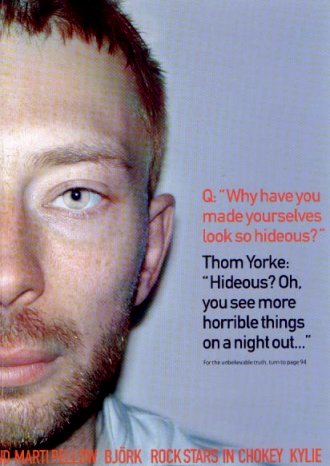
"WHAT ON EARTH
ARE THOSE PICTURES ABOUT?: Thom Yorke explains Radiohead's self-image issue",
last page (104) of article
band
. mutant .
cover
.
cover
(inside)
What are you
trying to achieve with these photographs?
It's me and
my mate Dan, basically. We've been messing about with this software for
ages, making paintings in a sort of American hyper-realist style. Then
it occurred to us - durrrr! - that the software was made for treating photographs
and that we could be really having fun with pictures of ourselves. Initially,
we were mirror imaging one side of our faces onto the other, but that looked
a bit weird...
Why make yourselves
look like this?
I'm fed up
of seeing my face everywhere. It got to the point where it didn't feel
like I owned it. We're not interesting in being celebrities, and others
seemed to have different plans for us. I'd like to see them try to put
these pictures on poster [giggles].
What if "they"
did put them on a poster?
[Taken aback]
Well, I wouldn't mind. It would be quite amusing.
So, in order
to sabotage the Kid A marketing push, you've deliberately made yourself
look hideous...
[Surprised]
Hideous? Do you think so? I think they're... interesting. Maybe I've stared
at them for too long. They seem quite normal. Maybe my beard isn't very
nice, but, on the whole, I think you see more horrible things on a night
out. I certainly have.
Maybe we should
go on more nights out with Radiohead...
Maybe you should.
Hee hee hee!
We showed the
picture of Colin to an old friend of his and he jumped out of his skin.
Really? Hee.
hee. hee! Great.
You're doing
no magazine photo shoots. What's so bad about them?
They're just
so time consuming. We could so easily be somewhere else, doing something
else more pleasant than making money for IPC...
EMAP, actually.
We're the marginally less evil ones.
Marginally!
Hee, hee, hee! I quite like the idea of someone scanning the magazing shelves
and seeing these pictures in between the tits and bits of electronic gadgetry.
This should freak them out.
What are your
plans for the presentation of the band in the future?
We'd like to
present ourselves in software form. You know, so you could take 3-D versions
of the band and place us in a variety of contexts and environments. That
would be fun. We wouldn't have to do anything the...
What about
this weird composite Radiohead member?
That's Phil's
head, obviously, Jonny's eyebrows, my nose and mouth. It's like a human
mutation, not a comment on the GM thing as such, though you can't really
ignore the GM issue. It's everywhere, innit?
So, are you
taking the piss? Out of us? Our of the fans? Is if unreason-able for them
to want to see you as you are?
Oh no, it's
not like that at all. We're just... being creative.
10/2000
 IL
FAN CLUB ITALIANO DEI RADIOHEAD
IL
FAN CLUB ITALIANO DEI RADIOHEAD
 Per
favore sostieni
Per
favore sostieni








 [Copyright
© 2000]
[Copyright
© 2000]