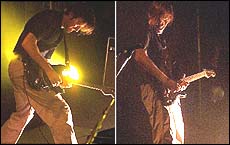
 Ed
O'Brien: Turning up, Tuning in Ed
O'Brien: Turning up, Tuning in
Radiohead guitarist
Ed O'Brien tells RUSSELL BAILLIE about playing right-hand man to Neil Finn
- and life in the greatest band in the wworld.
You are a guitarist
in what many consider the greatest band in the world. You are between your
difficult fourth album and the release of your fifth, which you effusively
describe as the best thing your band has done.
You have an
invitation to play on the other side of the world with a chap whose songs
you have long admired. You take up the invite and drag another member of
your band along for company and rhythm-keeping duties.
You rehearse
12 hours a day for four days in a barn by a beach on Auckland's west coast.
Also in the band is another chap from England who helped to turn you on
to guitar in the first place.
The shows are
momentous from the first night, and the five nights turn into An Event.
You go back
Up Over to the greatest band in the world and start rehearsals on Monday.
And so, Ed O'Brien of Radiohead, what do you tell the folks at home about
your time playing right-hand man to Neil Finn?
"I am going
to try really hard not to bore people about what a great time I've had,"
laughs the tall, chisel-jawed musician. "You know, there was that time
when we were doing Weather With You and Johnny Marr, who was one of the
reasons I started playing guitar, comes over and says 'why don't you take
this?'
"It's been
really, really, really hard work, like learning all these songs. It's kind
of reassuring when people like Johnny come up and say - because he's guested
loads - 'when you guest again, you won't do anything as hard as this."'
It's the morning
after the third show of the Finn and friends season. Before sitting down
with O'Brien we've briefly encountered Radiohead drummer Phil Selway in
the hotel lobby, who pronounces the excursion to Finn-land has been "really
intense."
Upstairs, O'Brien
looks like a well-to-do young British tourist as he politely requests a
herbal tea from his local record company minders. He could gush for England
about playing with Finn and how much of a challenge it's been.
It has been
an interesting musical exercise for him, too, considering Radiohead's recent
experimental moves, which have meant he hasn't been playing as much conventional
guitar.
"Yeah I know.
That's right. It's really weird to be playing chords again. Haven't played
chords for a long time. I realised I haven't played chord changes since
OK Computer and stuff like that. I've learned a lot musically in this week
and it's kind of made me go back and work even harder as a musician."
But there is
something else to talk about apart from playing the best Split Enz/Crowded
House tribute band, ever. Radiohead have a new album, Amnesiac, on the
way in early June, less than a year after than their perplexing fourth
album Kid A, which followed 1997's OK Computer, an album which, with the
touring that followed, reportedly caused the band much internal anguish,
was praised to the heavens and sold by the millions.
The harsh,
electronically distressed sound of Kid A, says O'Brien, was an intentional
spanner in the works after OK Computerhad elevated them to a place they
weren't sure they wanted to be.
"One of the
brilliant things about Kid A was that we kind of dispelled any notion of
Radiohead being ready to take on the mantle U2 were going to hand us, the
baton of stadium rockery, and we were going to embrace it and it was never
us.
"At the end
of OK Computer we were playing big, big arenas and it wasn't right. You
can do those things occasionally but at the time it didn't feel right.
"It did get
quite big around OK Computer, it was suddenly really 'hang on a sec, this
hasn't solved any of my problems. In fact it's made them worse.'
"The thing
you worry about is that the rock'n'roll business can turn you and wants
to turn you into one of these really sad old musicians.
"What is so
refreshing playing with Neil Finn and all his friends is these people think
exactly the same - regular people doing their thing and separating the
music from the business."
A listen to
a four-track preview of Amnesiac, which was recorded during the same sessions
for the previous album, indicates the songs are more inviting. While Kid
A was a fractured affair, electric buzz and static, the next instalment
turns down the experimental factor in favour of melody and, on the likes
of the brooding Pyramid Song, something majestic.
"Kid A was
such an unemotional record. When we came out it was such a relief and we
were kind of instilling our art. It was trip, it was a headspace. I love
Kid A. I think it's really great but it's not warm. [Amnesiac] is warm.
"Stanley, who
does the artwork with Thom [Yorke], his analogy was Kid A was a bit like
you are phoning someone and you get the answerphone at the other end and
hear their voice, and Amnesiac is like a conversation on the phone. It
engages you."
But if it was
recorded at the same time as the previous effort, couldn't this be seen
as the second half of a double album?
"Well, it was
a matter of tracklisting the first one and seeing what we got left. We
tracklist really hard these days, I think it's a real art. For a band like
us tracklisting is a massive, massive task. It's the only time we seriously
ever think, 'right that's it, I've [expletive] had enough of this'."
So what's it
like being in Radiohead, a band often perceived these days as tortured
singer Yorke and four relatively normal young men from Oxford?
"I don't know
where we are at the moment because we're not touring as much. That's a
bit confusing. There aren't as many neuroses. It's not like Meeting People
is Easy [the Radiohead tour film of the band on the rockbiz treadmill]
any more, which is really cool.
"I think we
might have lost a little momentum and we might need to regain it. We had
loads of momentum five years ago, but the trouble with that momentum was
it was coupled with a band imploding, and now our knee-jerk reaction is,
if you do a few more tours, the band will start to go that way again. It
won't, it's not like that, times have changed and things have moved on.
I think we are in a good space.
"We are a weird
bunch, we are very disparate. We are different people - you get a different
take on the band whoever you speak to. Somehow, at the end of it, it goes
through the filtering process and out comes the Radiohead thing.
"It makes me
realise we are all really different and that is the kind of thing that
might have got on our tits a few years ago, but now it's kind of something
to be embraced."
|
 IL
FAN CLUB ITALIANO DEI RADIOHEAD
IL
FAN CLUB ITALIANO DEI RADIOHEAD
 Per
favore sostieni
Per
favore sostieni





 [Copyright
© 2000]
[Copyright
© 2000]