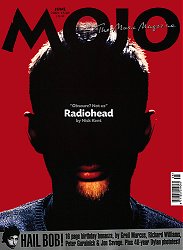
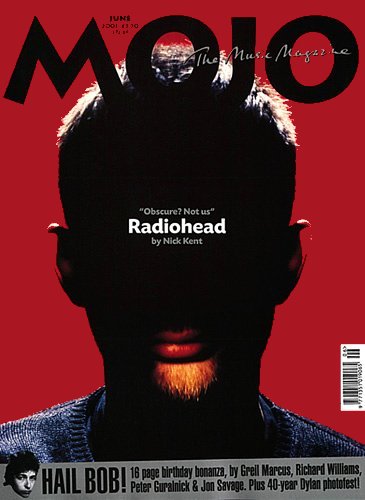
Happy now?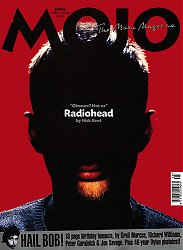
Songs are
coming easily, confidence has returned. After the paranoia and angst, Radiohead
talk to Nick Kent about Amnesiac, love of music and a way out of the woods.
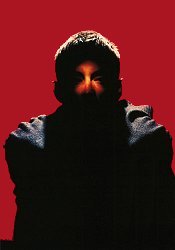
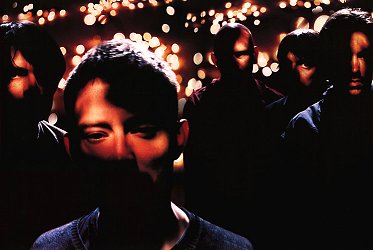
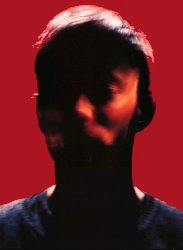
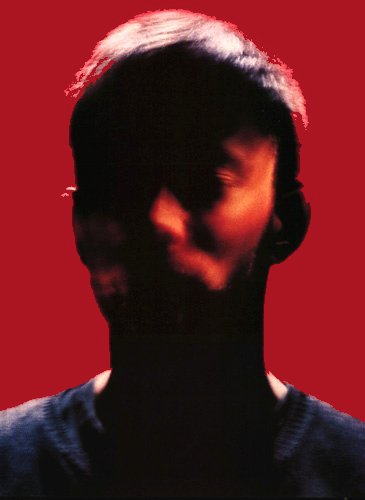
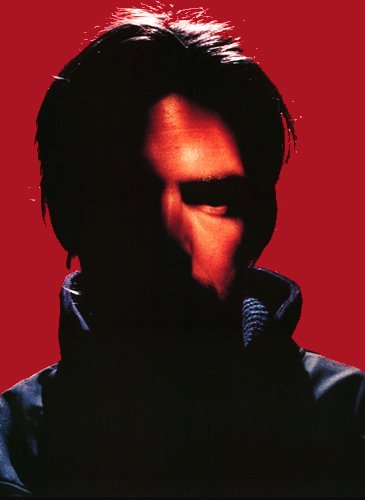
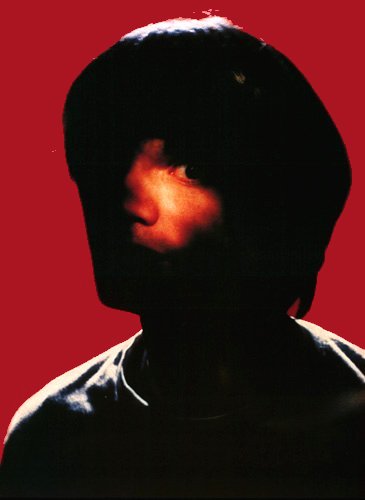
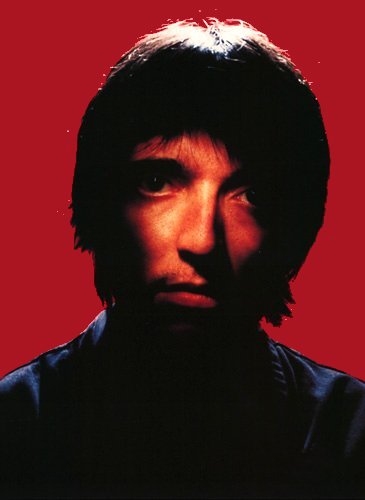
Photography
by Kevin Westenberg.
The 43rd Annual
Grammys ceremony - held in February in Los Angeles' gargantuan Staples
Centre - once again lived up to its ritzy reputation as contemporary music's
most glamorous and prestigious night of nights. Millions around the world
watching the event via satellite television were left with inflamed retinas
after staring too long at the fruity pink-and-green polka-dot ensemble
Elton John chose to sport during his 'controversial' duet with 'homophobic'
rapper Eminem. The petite soul singer Toni Braxton started an international
style scandal with her virtually non-existent dress, while hot R&B
girl trio Destiny's Child caused widespread outbreaks of temporary blindness
the world over with their eye-poppingly erotic attire. Everyone in the
audience had stepped out in their best, brightest togs and kept flashing
toothy "we're all winners here" smiles whenever a camera would swoop down
on them. However, there were three noticeable abstainers on the "be-of-good
cheer" front: Phil, Colin and Ed of Radiohead, who sat immediately behind
the greying domes of Donald Fagen and Waiter Becker of Steely Dan (who
ended up going home with two statuettes). Like the song that first brought
them fame says, the just didn't belong there. Every time their uncertain
faces appeared on screen they looked so spectacularly out of place, it
seemed as if they were expecting an usher to toss them out of the nearest
exit.
"Did you see
what happened to us" asks Jonny Greenwood a month after the event. The
guitarist - like singer Thom Yorke - managed to blag his way out of actually
having to attend and ended up watching his fellow members squirming under
the spotlight on a television set at home. "Phil, Colin and Ed were asked
to stand at the front of the stage for photographs [Radiohead won a Best
Alternative Rock Grammy for Kid A] - and the three of them looked so awkward
the audience all started laughing. All the other acts had done this big
performance - "Thank you, America" and all that - but Radiohead were so
visibly uncomfortable at just being there that everyone went into a state
of complete hysterics."
"It felt like
any minute we'd be ejected by the organisers screaming, "What are you doing
there in the same room as all these Playboy bunnies?" remembers Colin Greenwood.
"There was an entertainment area on the fourth floor - open-air for smokers
- and you could look down on this Woodyy Alien Sleeperesque landscape of
black and white stretch limes belonging to the rich and famous and the
media moguls coming down from their mansions. It was such an antiseptic,
controlled environment. They closed down all the liquor-serving facilities
at five in the afternoon."
The absence
of bevy didn't unduly concern Ed O' Brien, however: "I actually took some
mushrooms that night. It was the best thing to do; going around the parties
afterwards - there were fires everywhere and swimming pools and 'the beautiful
people' - it was like being on a film set."
Radiohead's
self-conscious predicament was truly brought home to all members when they
saw Bono and U2 sweep onto the stage to receive no less than three awards
that night. The globe-straddling Irish quartet have seen off a lot of stiff
competition over the years - Nirvana, the Stone Roses, Oasis - and Bono
wasted no time in theatrically declaring, "We're re-applying for the job
of greatest rock'n'roll band in the world" to tumultuous applause. "U2
walked out to collect their awards very, very slowly," recalls Jonny Greenwood.
"They looked just like gunslingers, didn't they! Bono does that sort of
thing so well."
Still, the
three unlucky Radiohead members stuck in the Grammy audience staring at
the back of Becker-and-Fagen's heads for five hours were less impressed
by the speech and overall spectacle. "Bono's a very positive guy," reckons
Ed, still piecing together the fractured images of his night at the awards.
"And he recognises that to be in the arena that U2 are in, you have to
put up with a lot of crap so that his music can get on the radio and spread
a feeling of general well-being everywhere it's played. The thing about
Thom - and this extends to all of us - is that we just don't think it's
worth it. To get to that stage, you have to go through so much crap. And
along the way, you're bound to fall prey to the system. They'll get you
somehow. We kind of dipped into that situation with OK Computer and it
was all too much. You come out at the end and you're half a person."
The year that
OK Computer came out - 1997 - was the year that Radiohead officially got
the nod that they'd become the most important rock band in the world. Most
would have openly rejoiced at being spoken of so highly but such talk only
made Radiohead feel queasy. "We just felt dwarfed by that title," reckons
drummer Phil Selway. "It's an awful lot to live up to.." For Colin Greenwood,
"It's like having an appointment at Savile Row to have a suit fitted. You
don't turn up but still they end up cutting you this huge flamboyant outfit
that Bono wore previously and which he passed on to Michael Stipe. And
then you finally turn up and collect a pair of pyjamas instead." Selway
is more down-to-earth in his evaluation of Radiohead's reticent essence.
"We started off as a school band so there's always been a slight insecurity
generated by that. Part of it is us saying over and over again to ourselves,
'Who are we trying to kid?"
In the wake
of OK Computer, Radiohead's refusal to assume the mantle of gunslingers
seemed at odds with the size of the following they'd attracted. Subsequently,
Kid A was seen as a drastic attempt to downsize that following. Yet people's
preconceptions about their behaviour blithely overlooked the fact that,
as Selway points out, Radiohead had always been a geeky university band
out of spin with the rest of the world. The quintet began in 1987 under
the name of On A Friday playing around their home town of Oxford. Yorke,
Colin Greenwood and Ed O'Brien soon all moved on to attend various English
universities but the five members would still religiously relocate in Oxford
once every three weeks to rehearse. "The important thing for me," maintains
Colin Greenwood (who studied Raymond Carver, John Cheever and other writers
"dealing with the tensions of post-war American society" at Cambridge's
oldest college, Peterhouse, between 1988 and 1991) "apart from the friendship,
was the quality of Thom's songs. I remember an acoustic version of Creep
he sent me a cassette of from Exeter University in 1987. I listened to
it and said, This is what I want to do. This is my destiny: to help disseminate
this music and propel it directly into contemporary popular culture because
it's so important."
For Greenwood's
younger brother, who was accepted into the group when he was only 14, "at
first it wasn't any big deal. I just thought, Oh Thom's doing songs that
sound as good as Elvis Costello and R.E.M. That's why it held my interest.
I don't remember thinking anything would come of it. It was just music
that was really good to make."
Having graduated
from university, all members recommitted to the group, connected with sympathetic
managers, and by the end of 1991 had signed a lucrative deal with EMI who
quickly persuaded the group to find a new name. They chose Radiohead partly
because it had been a song-title of Talking Heads. (According to O'Brien,
"We always felt this massive affinity with them because they were white
folks grooving in a 'college geeky' way and still making records as good
as Al Green.") Over a period of two-and-a-half to three weeks, they recorded
their debut album, Pablo Honey. Only Colin still has good words to say
about its contents. The album, of course, contained Creep, Yorke's plaintive
hymn to low self-worth, and its sudden success in America in 1993 meant
that the group were often besieged by hordes of "Whoa, dudes" types whenever
they performed there. In Britain, though, they had problems connecting
to any kind of sizeable demographic. According to Jonny Greenwood, "We
kept missing out on all the so-called movements - like 'shoe-gazing', Britpop
and all that. We were so annoyed; it was like we'd arrived too late for
everything.
1995's The
Bends is where all members of Radiohead are agreed that they started to
create something uniquely their own. Recording Street Spirit is unanimously
denoted as the key moment when the group first availed themselves of the
potential to take their music into a truly magical dimension of sound and
feeling. The combination of strangely alluring songs, inspired sonics and
Them Yorke's "unhappy child watching a fireworks display" vocal style proved
too potent for the world to ignore. Even though Radiohead were still viewed
as 'outsiders' with regard to the burgeoning Britpop scene, their record
sales began edging ever closer to those of Oasis and Blur - the media-ordained
top dogs of the era. "When Oasis and Blur were having their battle, remembers
Colin Greenwood, "it felt like Radiohead were on the sidelines, holding
everyone's coat. Then when we released OK Computer, it was like we gave
them their coats back, all patched up (laughs). I loved Blur's Parklife
and Oasis's first two records were amazing but that battle they waged was
depressing and belittling to both parties. Both groups were too naive;
they were functioning at a primary-school level of media manipulation.
No one could
have forgotten how the release of Radiohead's third album OK Computer
impacted on popular culture four years ago. Critics struggled to maintain
the flood of giddy superlatives whenever they addressed the record, but
more crucially it cast a complicated spell over millions, who found something
deeply illuminating in the record's insinuated struggle to find a humane
set of values amid the numbing paraphernalia of the lap-top mind-set. However,
the group - and particularly Thom Yorke - found all the acclaim unpleasantly
disorientating. In one of the final scenes of Meeting People Is Easy, a
gloomy documentary of the OK Computer promotional world tour released on
video in 1998, Thom Yorke is seated at a dinner table, looking wild-eyed
and hollow-cheeked - like a state prisoner on hunger strike - as he berates
Jonny Greenwood and Ed O'Brien who are facing him: "Jonny, last year we
were the most hyped band. We were Number 1 in all the polls. And it's all
bollocks! Everything's changed and it's just a complete mind-fuck... I'm
really, really worried. We've been running too long on bravado."
In order to
revitalise the group musically, Yorke stipulated that the sessions for
OK Computer's successor take a more radical direction, incorporating the
introduction of programmed music into Radiohead's creative arsenal. Jonny
found the challenge exciting from the outset, "even though I find a lot
of electronica really pretentious", but his brother was not without his
misgivings. "I was principally a soul boy and didn't know much about programmed
music at the time. A lot of the stuff I'd heard on Warp I didn't like at
all. It was really cold. But that was exactly why Thom liked it: there
was no emotional baggage attached to it."
Ed O'Brien
was even more worried: "I honestly didn't feel I had a role to play. My
suggestion for OK Computer's follow-up had been to say, Let's go back to
the well-crafted three-and-a-half minute song. I came from idolising The
Smiths in the '80s and I thought that would be the shocking thing to do.
It was really difficult because, as a musician, I express myself more emotionally
than cerebrally.
"The other
problem was the lyrics. Whenever we'd done a record before, Thom's lyrics
were evolving. He'd give you sheets and once you see the words to, say,
No Surprises, you immediately think, Ah yes, we need a guitar for this
that sounds like a child's musical box. This time, there were no lyrics
and therefore no reference points. Phil, Colin and I went through some
major dilemmas at various stages. How could we contribute to this new music?
We all wondered if it wasn't better to just walk away. It was a very scary
thing at first."
Last September,
the first fruits of Yorke and Radiohead's long, protracted struggle against
following a formula were made available to the general public. Entitled
Kid A, the record managed to make Radiohead deeply cool with the 'experimental
dance' set but turned off a number of their older guitar-loving listeners,
who felt the group were selling themselves short by immersing themselves
too readily in computerised sonic doodles. Now comes the release of Amnesiac,
Radiohead's fifth album and Kid A's sister: all the tracks to both albums
were begun and finished during the same sessions. The word is already out
that it's more 'accessible' than its predecessor but that's not strictly
true. Lyrics are still hard to grasp. Melodies keep taking unexpected turns.
Packt Like Sardines In A Crushed Tin Box, the opening track, is more Underworld
than OK Computer. Dollars & Cents has a creepy 'driving-through-inner
city-slums at three in the morning' vibe going for it, further heightened
by eerie samples of Alice Coltrane that Colin urged be mixed onto the track.
Hunting Bears, a Thom Yorke solo guitar instrumental, sounds like a gentler,
less abrasive Trout Mask Replica outtake. And Life In A Glasshouse, the
album's finale, can be very hard going indeed, at least to begin with.
Imagine Thom Yorke singing at a New Orleans funeral serenaded by Humphrey
Lyttelton and a similarly grizzled-looking horn-playing chum of his who
- according to Jonny Greenwood - had beeen let out of hospital, after undergoing
open-heart surgery, the day before the session. Once your ears get used
to the provocative blend of Yorke's plaintive caterwauling and the melancholy
honking of Humph and co, it all starts to make sense, but before that you
tend to endure it with a heavy heart thinking, Oh shit! The Acker Bilk
revival is just around the corner.
But Amnesiac
also contains many examples of Radiohead's best work to date. Pyramid Song
is a shimmeringly beautiful dreamscape of a piece based on Charlie Mingus'
Freedom, featuring a truly spine-tingling string arrangement from Jonny
and probably the most transcendent vocal performance Yorke has ever delivered
in a studio. Knives Out is a haunting group performance with jangly guitars
that pays homage to Radiohead's teenage infatuation with The Smiths. You
And Whose Army is a fascinating song based around melancholy jazz chords
with Yorke spouting invective at Tony Blair in the voice of a sleep-walking
drunk. The song then opens up into a churning OK Computer-like extended
bridge. But best of all is I Might Be Wrong: basically just a Thom Yorke
home demo with a drum machine that Jonny Greenwood personally built and
an exquisitely serpentine bass line from his brother who "had it in mind
that I was Bernard Edwards that night". Over an eerie, trance-like metallic
beat and a venomous-sounding guitar riff, Yorke sings in a chillingly sweet
falsetto as though his voice is a soprano saxophone.
On April 12,
2001 Yorke finally sat down with me to discuss the struggles and successes
of the past years. He'd only recently become a father for the first time
(his girlfriend Rachel had given birth to a son, Noah, late last year)
and wasn't getting much sleep as a result, but nonetheless looked exhilarated
by his new responsibilities. Small, with cropped red hair and a vague beard,
he always chose his words carefully but nonetheless addressed every topic
thrown at him with admirable candour. He has no problem referring to himself
as a deeply messed-up individual - he just doesn't like other people doing
it, that's all.
Are you
happy with this record?
Thom:
I don't know. I'm really not the person to ask. When we were on tour with
Kid A we had the tapes with us and we were trying to work out a running
order and what was to go on and what wasn't, so I was listening to it a
lot then. And it was kind of nice, because it was "the secret record".
It felt like it was our secret weapon against all the weirdness going on
- the fact that we had another one thatt nobody else had (smirks). But now
I've heard it too much and I really don't know any more. It was all finished
at the some time as Kid A. That's why it was quite hard. We had like a
board of sketches, a list of about 60 sketches - some of which were songs,
others just sequences or ideas for sounds. Then it got narrowed down and
narrowed down until we had a block of stuff which felt like it fitted together.
And then Kid A pulled itself together very easily and really obviously.
But Amnesiac didn't.
What's the
essential difference between the two records for you personally?
Thom:
What were we looking for! Fuck knows! (Pause) Kid A was kind of like on
electric shock. Amnesiac is more about being in the woods (laughs), in
the countryside. I think the artwork is the best way of explaining it.
The artwork to Kid A was all in the distance. The fires were all going
on on the other side of the hill. With Amnesiac, you're actually in the
forest while the fire's happening. With Kid A when you sequenced certain
tracks together, this play started appearing. Amnesiac was much more difficult
to put together, but that could equally be because we concentrated so much
on the first one.
Pyramid
Song and Everything In Its Right Place seem close?
Thom:
They were both written in the same week - the week I bought a piano (laughs).
The chords I'm playing involve lots of black notes. You think you're being
really clever playing them but they're really simple. For Everything I
programmed my piano playing into a lap-top but Pyramid sounded better untreated.
Pyramid Song is me being totally obsessed by a Charlie Mingus song called
Freedom and I was just trying to duplicate that, really. Our first version
of Pyramid even had all the claps that you hear on Freedom. Unfortunately,
our claps sounded really naff, so I quickly erased them.
The words
this time around: you don't hear so many of them.
Thom:
Oh really! Fuck! I thought I was being really clear.
Certain
lines are clear, others aren't. It gives the music an added mystery.
Thom:
That's funny because the mystery is not intended. On Life In A Glasshouse
I'm desperate for people to understand all the words because they're really
important. It began after I read this interview with the wife of a very
famous actor who the tabloids completely hounded for three months like
dogs from hell. She got the copies of the papers with her picture and she
posted them up all over the house, over all the windows so that all the
cameras that were outside on her lawn only had their own images to photograph.
I thought that was brilliant, and that's where the song started from. It
was just a really sad, awful story about her desperately trying to cope
while he's off filming, and the only reason she was being hounded was because
it was rumoured he was having an affair with his leading actress. I just
thought, "Nobody deserves this." Especially when they're a completely innocent
party. From there, it developed into a complete rant about tabloid journalism
destroying people at will, tying people to the stake and watching them
burn - an activity that seems to be particularly rife in this country.
It's funny.... This is the longest we've actually spent in Britain since
we were all about 21. For the past three years, we've been here most of
the time. To be honest, it's all been a bit of a shock (bursts out laughing).
Do you still
feel tied to British culture? You've all chosen to remain here, after all.
Thom:
Yeah, but that's due to inertia as much as anything else. Staying around
here is just us saying, "Well, we can't all move." If we all moved too
for away, we'd just end up never doing anything together. I'm in no way
proud to be British at all, really. I'm just not interested in the place.
When Blair first came to power I got heavily involved in reading all about
what was going on, about his 'third way' and how he was going to develop
a relationship with business which was going to be of benefit to this country.
That obviously was never going to work. And it didn't. Politics was quite
a big issue with me when we were doing this record.
You And
Whose Army is about Blair, isn't it?
Thom:
Originally, it was about the voices in my head that were driving me round
the bend - to be honest (bursts out laughing). And then, once I came up
with that You And Whose Army phrase, I was able to stick other ideas on
there and Blair emerged as the song's real subject matter. The song's ultimately
about someone who is elected into power by people and who then blatantly
betrays them - just like Blair did. At the same time, I think he couldn't
help betraying this country. I think the man's a fool. He's just a product
of his time, like any important public figure. I've become slightly more
charitable towards him of late. Anyone who's put into that position just
immediately becomes like all the people surrounding him. He can't help
it - that's just who he is. So it's never been a personal thing. When we
put that image of Blair in the Kid A booklet, it was just us saying, "He's
just a public figure. He's fallen from grace and he's useless like everybody
else." The problem with Blair is that he's surrounded by all this other
stuff that will end up destroying anything worthwhile he as a human being
might want to achieve. That's why I call him "a fool", because a fool is
just someone who plays to the court; he's a court jester, in other words,
and that's all he is. But that's basically the same with most presidents
these days. I'm not saying things here that most people don't already recognise
themselves, I'm sure.
Don't you
feel that Rupert Murdoch is even more to blame for the way Britain has
become such a diminished cultural power?
Thom:
Oh, absolutely. Murdoch has achieved this mind control trick by getting
his papers to work in a spectrum where it's very easy to dismiss any art
that skirts towards Planet Politics. Because clearly he feels that's not
where artists should be. So his papers instantly negate anything you do,
and make you look ridiculous when you try to go anywhere beyond Geri Halliwell-land.
Were you
surprised by the media reaction that greeted the release of Kid A?
Thom:
I actually went into quite a deep state of shock when Kid A came out. I
was really, really amazed at how badly it was being viewed. People were
calling it "commercial suicide", blah-blah-blah, and saying that we were
being "intentionally difficult". That just blew me away because the music's
not that hard to grasp. We're not trying to be difficult.. We're actually
trying to communicate but somewhere along the line, we just seemed to piss
off a lot of people.
I think
the people you pissed off are mostly the older generation who aren't comfortable
listening to electronica and dance influenced music...
Thom:
But surely they remember Kraftwerk! (Laughs) What we're doing isn't that
radical. While we were cooped up for three years recording and driving
ourselves potty - as usual - [managers] Chris [Hufford] and Bryce [Edge]
would come in occasionally to have meetings and see where everybody was
at and they used to say, "Y'know, things are changing. The music's all
getting fuckin' weird and we're not sure what's going to happen." They
were really pretty worried because they just didn't know what the hell
would happen when we did finally release something. And we didn't make
things any easier because we didn't do any videos. We did these commercials
because we felt videos were just commerciaIs anyway - why lie about it!
But then, of course, they didn't get played as commercials because we couldn't
afford to get them on TV because we didn't have a product to sell that
was ultimately worth that much (smirks). We weren't playing the magazine
game properly. We just felt at the time, "We've earned a licence to do
this. Let's just do it. But the media responded by suddenly thinking, "Oh,
so they're not going to play ball. We're going to go after them." I just
felt, "What the hell's going on'" We're only making music here. Come on.
Bono's become
a friend of yours. How do you react when he tells you you're too talented
to recede into the margins, that Radiohead need to embrace the mainstream
more?
Thom:
I would have to reply that it's not my fucking fault.We just can't play
the game any more. By the end of OK Computer - personally - I had so many
ghosts in my closet that I couldn't even go in my closet! (Laughs) I certainly
couldn't fuckin' talk to anybody else about how I felt about anything.
Every time I decide to release a new record, it's an incredibly nightmarish,
stressful scenario for me because I have to deal with all this stuff that's
in the closet.
U2 used
Passengers as their experimental alter-ego. You don't.
Thom:
We did talk at one time about doing certain things under our name and certain
things under a different name, because it seemed to make things easier.
But I've always been massively 'anti' that because what you're doing then
is just a bunch of compartmentalising bollocks. It's just putting music
into pointless little boxes and pretending it should be viewed in different
ways. Why not put it all out under the same name? I was really, really
surprised at the criticism, though. Maybe I'm just being a bit naive but
I really didn't expect that to happen. But as I didn't specifically reed
what people wrote, maybe I'm just projecting as much as anything else.
It was very much something that was happening in Britain anyway.
You told
Q last year that you'd become tired of melody. On Amnesic you stretch your
songs aImost purposely so that they never fall into a conventional classic
rock chord progression mode.
Thom:
Yeah, there are no obvious "here comes the chorus" moments throughout the
record. None of the music that I was listening to at the time had melodies
like that going for them. So-called commercial melodies make me flinch.
So often when I hear a song, the melody's just trying too fuckin' hard
to grasp my attention. It's like being besieged by a wasp: you just wont
it to go away.
Knives Out
and In Limbo have tricky little riffs and time signatures, strange chords.
Are you trying to disorientate the listener!
Thom:
In a way, yes.
But at the
same time, the music for In Limbo is a perfect musical metaphor for the
state of flux you're singing about.
Thom:
The words themselves on Kid A are kind of empty because they're leaving
room for the music. That's all to do with my reaction against OK Computer
where the music bashed away behind the words. Whatever emotions I was going
through, I just found it incredibly difficult to write down lyrically.
I was listening to us playing and became obsessed with looking for accidents..
It was so much about finding accidents - waiting for them to happen. Because
that spoke to me more than words. I just had this terrible trouble writing
words.
Were you
in effect suffering from a form of writer's block?
Thom:
It wasn't really a writer's block because words were coming out like diarrhoea
but they were all awful! And I couldn't tell the difference - which was
much worse. But that was because, personally speaking, I'd lost all confidence.
When and
how did it come back?
Thom:
It came back when we recorded The National Anthem. I really, really love
that track. Everything In Its Right Place I really, really love as well.
And In Limbo I'm still proud of just for the disorientating, floaty feel
we managed to capture. It comes from this really peculiar place. On the
new one - even though I've heard it too much - Pyramid Song is still a
really good one. In terms of trying to get somewhere new, I think Spinning
Plates is the best of all the record for me. When I listen to it in my
car, it makes the doors shake (laughs). Knives Out, though - for the longest
time
I really, really hated that song.
It took
the longest time to record, apparently...
Thom:
Yeah,'cos I hated it so much (laughs).
313 hours
- is that accurate?
Thom:
Possibly, I wasn't counting. A lot of time anyway. A lot of time.
How did
[producer] Nigel Godrich adjust to your new direction?
Thom:
It was a very strange push-and-pull thing going on between us. There were
days when he was completely in charge of what was going on and then there
were days when I would just go into a massive tirade and wouldn't let anybody
else do anything except me. Then there were days when he was purely like
the adjudicator at a trial.
Was there
the feeling coming from other members that you were losing the plot?
Thom:
(Ardently) Oh yeah! Big style. Massively. There were lots of depressingly
frank exchanges of opinion late into the night. But the sad thing about
it is that very few of our arguments were to do with music: it was just
'fall-out'. Really sad. Personally speaking, during that time I was just
a total fuckin' mess. No one could say anything to me without me turning
round and launching a vicious tirade at them. It got really, really bad.
It was your
personal quest not to repeat OK Computer?
Thom:
I don't think it was just me - it was everybody, really. What was happening
was everyone was saying, "Well, we've got to start somewhere.." But I was
standing, going "Yeah, but not here." Then they'd say, "So where, then?"
And I'd reply, "I don't know." And the dialogue would just go round and
round in circles like that. So we'd launch ideas off and about halfway
through them I'd suddenly start screaming, "This is bollocks! Stop the
tape." And I'd pull the tape off and start something else. Things seemed
to be constantly faIling apart at that point. Then we'd go back and listen
to them a few months later and suddenly we'd realise, "That's fucking amazing,
why the hell did we stop working on that" That happened with loads of stuff
like Morning Bell and Spinning Plates. Basically we'd lost all confidence
in what we were trying to do; we didn't have the ability to see anything
through. But gradually, as things got back to normal again, it became clear
what was good and what wasn't.
Haven't
Radiohead always approached recording with a lot of intense brow-beating
and constant pulling of hair? You don't take things casually, do you?
Thom:
Yeah (laughs). Nigel used to say to us a lot, "You're behaving like a bunch
of fuckin' method actors. Get it together. It ain't that important." I
think I'm as guilty as anyone for creating a climate of fear for too long.
Actually I'm much more guilty. I was just so absolutely fucked-up.
You must
be aware that a number of your early fans are saying, "This experimenting
is all very well..."
Thom:
...lt's all very well but they'll get back to the good stuff later (laughs).
But why
isn't Jonny Greenwood - probably the most exciting electric guitar player
currently alive - being allowed to play more of what he does best?
Thom:
Electric guitar is great. I love it when Jonny plays guitar. But none of
us really wanted to make a rock record. He's got all this mad shit that's
got nothing to do with the electric guitar. He joined the band when he
was 14 and he was already a multi-instrumentalist even then. He can play
keyboards and write string arrangements. He can even read music. Actually
they all can now, except for me. Bit scary, that. Everything he picks up
he can make music on. It's totally logical that he should be trying other
things.
In contrast
to Britain, over in America they seem to embrace whatever you do with open
arms.
Thom:
That was what we call "smoke and mirrors". We only spent two weeks there
but we really liked it. The press was really nice, which made a change.
There's much less questioning in America. The highlight of the whole Kid
A thing was our Saturday Night Live performance. I was so proud of that.
I was walking on water for a week after that - I felt so good. That was
a real achievement. SNL is notoriously intimidating. We heard all these
terrible horror stories from Michael [Stipe] about it.
The rumoured
Oscars duet with Biork: What happened?
Thom:
I was briefly on the cards for being A-list - which was great. But only
briefly. Because they messed her around quite a lot. In the end, it was
probably good I didn't go over to join her there.
Was it your
choice not to perform then?
Thom:
No, it was her decision. Hopefully, we'll do it somewhere else - like a
better place. Working with her was funny, though, because I went and did
that session literally the day we'd finished putting Kid A together so
I was going, "Yes! I'm out! I'm in someone else's studio and it's not my
session and I'm not under any kind of pressure.
Your voices
blend well together...
Thom:
Yeah, but it took quite a while to find that blend (laughs). My whole tip
at the time was, "Well, if this is a duet, then we really need to record
this together." And stylistically we sing quite differently. I sing quite
softly while she really belts it out. And the key was incredibly low for
me. So we had to work at it but when our voices finally fitted together,
it was just the best. Great fun. I haven't seen the film, though.
You sang
on P.J. Harvey's last album. Did you contribute in anyway to Horses In
My Dreams?
Thom:
No, but I wish I had. Isn't that song amazing!
It sounds
like Polly saying to Patti Smith, "Listen up, sister. You may have done
this first but I'm doing it better."
Thom:
Yeah, I guess. The Patti Smith thing was going on quite a lot during Polly's
sessions. She was very aware of the likeness to the point where she was
becoming worried about it. I just told her everything sounded great anyway
so she had no need to worry about anything.
When you
were first presented with the lyrics of your main duet This Mess We're
In, were you ever concerned the media would jump on the words and start
publicly speculating that you and Polly were "an item"?
Thom:
No, no, no. Anyway if they had, I think it would have been kind of amusing.
(He bursts out laughing.) That would have been great fun.
Have you
sung live with her?
Thom:
No, I was supposed to do a gig with her in London last year, and my girlfriend
had just come out of hospital with our little boy Noah. I was halfway to
London when I thought I'd better ring home. And she'd had a really bad
'turn'. Her complexion had suddenly turned yellow. It was really quite
an emergency so I had to go back and take care of her. Actually, that morning
there'd been water pouring through the ceiling in our kitchen. One of those
days you never forget.
You're rehearsing
now. Would you consider doing anything from Pablo Honey or is that too
far in the past?
Thom:
Maybe. I don't know. We can still do Creep. I don't care.
I listened
to Pablo Honey a couple of days ago. It still stands up as a great first
record.
Thom:
Ooo-h! I don't know about that. (Pulls face and bursts out laughing.) When
I hear the singing I just don't recognise myself at all.
Would you
have preferred different producer?
Thom:
Oh no, that was great. They [Sean Slade, Chris Hufford, Paul Kolderie]
were rock'n'roll. They were brilliant.
The recording
of The Bends - was that the first time you felt you'd actually hit upon
Radiohead's ideal sound?
Thom:
No, it was more the usual "No, I'm hitting a brick wall" scenario all the
way through the recording (laughs).
But there
must have been cathartic moments when all the struggles finally made sense?
Thom:
Oh yes, definitely. I'II never forget the moment we captured Street Spirit.
That stands out for me. The whole reason to be doing this is to arrive
at those moments. It makes it worth all the scratching around for months
on end in note-books and all the hundreds of thousands of ideas you compile
on endless tapes. It's the sole reason you spend your entire life in your
bedroom playing to yourself. If I ever forget why I started this as a career,
than that's why I started. I do remember the magic moments from The Bends..
The Street Spirit moment I remember very, very well. We spent a day going
round in circles until I was thinking, "This is never going to happen."
Then suddenly something happened and I was transported to a place that
I'd been willing myself to be in for months on end. I'd finally made the
transition. Now you might only be in that place for three minutes and for
ever more life'll never be quite as good. But that's fine by me.
You enjoyed
a good relationship with The Bends' producer John Leckie?
Thom:
Yeah, really good actually, even though I think he thought we were all
stark raving mad. He was so cool - he was amazingly able to deal with all
sorts of stuff. He was getting "concerned but polite" phone cells from
the record company and had to deal with that. We wouldn't take calls from
them but, because of his vast experience in the studio, he viewed everything
with a lack of importance. And thank God he did! He's been doing it for
so long he realised sometimes a producer is simply someone who just creates
the right atmosphere for things to happen. In a way, he was like a caring
uncle. He might see you as his little nephew who's in a right fucking mess
- but he still lets you get on with it.. If he hadn't been like that, I
honestly think the records would never have been made because of the circumstances
surrounding it.
The great
OK Computer hoopla seemed to make you intensely jittery. Yet surely a part
of you must have enjoyed being feted as "the most important band in the
world" after so many years on the outside? Surely OK being voted the most
important record of all time by a significant number of people stands as
a great personal victory for you?
Thom:
I was most proud of the fact we were able to get things slipped through
[into the mainstream]. One of the proudest moments for me was getting Paranoid
Android on Radio 1. The reaction it got was just fucking wicked. Just amazing.
You couldn't listen to it a lot on Radio 1. Each time I'd hear it, I'd
keep thinking about people doing intricate jobs in factories - working
on industrial lathes - getting injured from the shock of being exposed
to it (laughs). Otherwise, as regards that whole period... I think we just
toured too long.
Can you
physically handle a lot of touring?
Thom:
Yeah, anybody can. You can find a way through it. It's not the physical
stuff that's the problem, it's the mental stuff. It's cool if you're 'sorted'.
But if you're just someone who's actually been a mess for quite a while...
To me, all I was since leaving college was in this band. That's all I did.
And everything else was utterly irrelevant or else just a pain in the arse.
To the point where I sort of lost connection with everything and ended
up driving myself a bit round the bend. It just went on too long.
If the other
band members had refused to join you in your 'new direction', would you
have made Kid A as a solo album?
Thom:
No. Because I wouldn't have had the confidence.
When you
were struggling with your writing, were there certain records from your
past you referred back to for inspiration? Did you pull out your old Elvis
Costello and Smiths records?
Thom:
A little bit of the Smiths, yeah! I did stop listening to 'bands' almost
completely, though. If I needed to feel better about music, I'd listen
to Mingus. I also really liked the [Aphex Twin] Richard D. James album.
There was a tape of Bud Powell, the jazz pianist - that I subsequently
lost - that I played a lot for inspiration.
The music
you're releasing now, both Kid A and Amnesiac: you must be aware that it's
not going to sell Bon Jovi-like quantities of records. What you're doing
isn't so different from what Bowie did when he released Low - it's a complete
left-field "fuck you" to the mainstream.
Thom:
I guess. But I'd argue that with Low there was not a conscious decision
to say "fuck everybody". To me, Bowie was just saying, "I'm going off in
this direction now. Come with me if you want." If it's just going to be
a "fuck everybody" thing, then you'd know about it instantly. I just don't
think you can even make music with that attitude, quite frankly. The whole
point of making music is to get something across.. Unless you're Atari
Teenage Riot (laughs).
What about
something like Scott Walker's Tilt?
Thom:
Oh God, I don't know what to make of that record (laughs). It's hardcore.
Do you know Tilt was being made at the same time as The Bends in the same
studio? We'd been in when he was out. Nigel was on both sessions. We finally
met him at the Meltdown festival. He's a top geezer - a really nice bloke.
We did that gig for him basically. I was on-stage the whole time thinking,
"Scott Walker's in the audience. I don't give a shit who else is here."
Still, you've
got to accept that parts of both Kid A and Amnesiac are extremely challenging
when first confronted. I couldn't make any sense of Dollars & Cents,
for example...
Thom:
Well, that started out as a IO-minute piece of us mucking around, trying
to do the Can thing. It just came out spontaneously. Lyrically, I like
doing things like that - where whatever happens in the first take is what
stays. When we did OK Computer all the vocals were first takes because
(a) I couldn't do it again afterwards and (b) it was about being in the
moment. The lyrics are gibberish but they come out of ideas I've been fighting
with for ages about how people are basically just pixels on a screen, unknowingly
serving this higher power which is manipulative and destructive, but we're
powerless because we can't name it. At the time, the whole global marketplace
thing was a major preoccupation of mine. I was reading a lot of stuff about
it and it really become a massive part of my writer's block. It sounds
daft now, but I couldn't see the point in writing about personal feelings
when there were other, far more fundamentally important things to talk
about.
It was strange
seeing you last year campaigning to drop the Third World debt. You looked
more than slightly uncomfortable next to Bono and Bob Geldof...
Thom:
I don't think anybody was comfortable. I was sprawling on a pin, I'II tell
you (laughs). Half the stuff that was going on, I was going, "l'm not so
sure about this." It took a lot of effort just to understand what the issue
was. Having to do interviews - the amount of information I'd have to swallow
and then spit out was just nightmarish. A lot of what gets called politics
now is just fuckin' cowboys and indians and doesn't amount to anything.
The really important issues in politics are the Third World debt and the
relationship between the First World and the Third World, and trade laws,
and NAFTA and GATT and none of this stuff is ever discussed as a political
issue. It's all in the realm of the economists and that is fucked up. Jubilee
2000 took a purely humanitarian angle on something that had always been
considered out of the jurisdiction of the 'charity' arena. Yet it's interesting
because, in order to get the Jubilee 2000 message across, we had to basically
not get into any of the surrounding issues. I'd start going off onto my
rants about pixels on a screen and being a powerless political pawn and
they'd all sort getting really twitchy behind the cameras (laughs). But
I'm really proud I got involved. It was an incredibly privileged place
to be in - to go to Cologne and see the realities of political manoeuvring,
and to see that basically what gets fed to the press has absolutely no
relationship to what goes on behind the scenes.
You must
be thrilled by George W. Bush's recent election?
Thom:
I was chuffed to bits. I think it's actually great, to be honest, because
it's going to radicalise people. People who've never been into politics
are going to suddenly wake up and realise that they actually have to fuckin'
do something about it.
Any thoughts
on Oasis' current predicament and the inevitable cost of keeping up a rock'n'roll
lifestyle?
Thom:
Well, that's something you do in your early twenties. Then you're supposed
to grow up. Either that or you just keep growing older and trying to screw
20-year-olds. Rock's fundamentally about on energy, isn't it. But it's
on energy that anyone can connect with, irrespective of their lifestyle.
Good music is like fucking. It's always been like fucking. Even if it's
classical music. And it doesn't really matter what people are like: it's
good sex or it isn't. And everybody's capable of having good sex. It's
either good music or bad music, isn't it? There's the stuff that comes
from the other side, and then there's the stuff that comes from someone's
personal marketing campaign. And there isn't any in-betweens.
All members
of Radiohead - apart from Jonny - are particularly sensitive to accusations
that their music is a kind of new-fangled prog rock. But yet the golden
age of progressive rock had as much to do with Can, Soft Machine and Captain
Beefheart as it did with Yes and Gentle Giant. Being associated with that
is not something to be ashamed of, surely?
Thom:
No, I guess not. (Pause) But I don't really see us as "progressing". You
walk down one particular path - that's what you choose to do. You're in
the woods and you take a path and you just keep taking it. Sometimes you'll
get lost and sometimes you won't. But if the music is in you, you're able
to carry on down your path and not go mad. I think a lot of the times it's
that people just get driven mad by it, or they get sent off or they get
too involved in the peripheral lifestyle" aspects. The thing that's damaged
rock'n'roll so much - it's choosing the idea that it's this lifestyle"
and that's all it is. Everybody has problems. John Coltrane got addicted
to heroin and hot chocolate (laughs). Everyone's got problems and people
get pulled sideways. But if you really love music, you don't want to repeat
yourself. That's all it is. And also, if you hear other people's music,
you're influenced by it. The things you love really inspire you and make
you go off and do something else. And if that's what "progressive" is -
then yeah, that's us. But trying to be clever, trying to be difficult or
bloody-minded is not what we're about at all.
Amnesiac
is your fifth album for EMI. After your sixth, you're free. Are you planning
for future internet distribution?
Thom:
No. We still want an excuse to print all the packaging. For me, it's an
integral part of what's going on with the record itself. I know this sounds
wanky but it's true: if the music's not inspiring the pictures, then I'm
not comfortable. Amnesiac is packaged like a closed book.
Could you
be more precise?
Thom:
No, that's it (bursts out laughing). We had this whole thing about Amnesiac
being like getting into someone's attic, opening the chest and finding
their notes from a journey that they'd been on. There's a story but no
literal plot, so you have to keep picking out fragments. You know something
really important has happened to this person that's ended up completely
changing them but you're never told exactly what it is.
I Might
Be Wrong really conveys that feeling well, Something life-changing is obviously
going on but you don't tell us exactly what it is.
Thom:
(Half-sings) "I used to think there was nothing left at all." It's a document
of a complete crisis point, basically. I live on a beach and one night
I went out on my own and looked back at the house and even though I knew
there was nobody there, I could see a figure walking about inside. Then
I went back to the house and recorded that track with this presence still
there.
This was
some sort of stalker?
Thom:
No, it was all in my mind, as usual (laughs). The song really comes as
much from what my long-term partner Rachel was saying to me, like she does
all the time, "Be proud of what you've done. Don't look back and just carry
on like nothing's happened. Just let the bad stuff go." When someone's
constantly trying to help you out and you're trying to express something
really awful, you're desperately trying to sort yourself out and you can't
- you just can't. And then one day you finally hear them - you finally
understand, after months and months of utter fucking torment: that's what
that song is about.
Finally,
fatherhood. How has it changed your life?
Thom:
I'm not taking things so seriously any more - which has to be a good thing.
And also when I get let out, it's big news. I want to get things done now
because I have to be back in four hours. It's very good for me because
if I'm left to my own devices, I'II just work all the time. If I was left
in the house on my own, all I'd do is work; I'd never, never stop. So it's
good that now I've got something for more beautiful to focus on.
Spring has
finally sprung among the flora and fauna of sleepy Didcot, the quiet little
town set between the dreaming spires of Oxford and the rolling hills of
Wiltshire that serves as the location for Radiohead's management offices,
rehearsal room and personal studio. The long winter of discontent is over
- at least for the moment. Birds are a--singing. New-born babies are a-gurgling.
And electric guitars have been taken out of flight-cases and plugged into
large amplifiers festooned with effect pedals. "It's weird to be rehearsing
now," reckons Thom Yorke with barely concealed enthusiasm. "We're supposed
to be going over the parts of Amnesiac that we haven't learnt yet. But
we're just using the time to write new stuff. It's great. The songs are
coming easily. It's just really nice. We've all got our confidence back."
"We were rehearsing
yesterday," adds Jonny Greenwood. "And Thom just stopped everybody and
started complimenting us on what we were doing. He kept saying, This is
really working again. It's fantastic what each of you is bringing to the
piece."
But how do
these new songs sound? "It's all loud and it's all guitars. It's exciting
to make loud music again. It's sounding good and fresh. We're even doing
a Neil Young song - Cinnamon Girl - for the first time ever, and those
loud minor chords just sound wonderful; it's just got such a swagger to
it. In two days of rehearsal, we've played it between 10 and 15 times.
Loud minor chords. Distortion. Fantastic"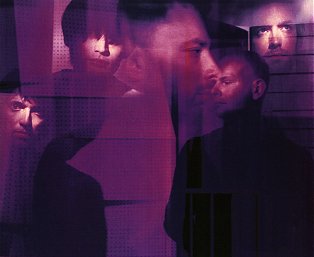
For old-school
Radiohead fans, this all sounds probably too good to be true.. One still
instinctively senses Yorke will have to go through some more championship-level
bouts of self-questioning and inner torment before Radiohead's sixth album
is in the racks. It might end up sounding like a conventional rock record,
but it could just as easily end up sounding like Penderecki. Yorke and
his cohorts are on a journey. "And if we choose to go off in a new direction
and do something different, it's OK if you don't want to come along this
time. But we'll probably be returning your way sometime anyway. We'll be
getting our guitars out just when everyone else is doing German techno.
So don't worry about us!".
Di
Nick Kent, Mojo
06/2001
|
 IL
FAN CLUB ITALIANO DEI RADIOHEAD
IL
FAN CLUB ITALIANO DEI RADIOHEAD
 Per
favore sostieni
Per
favore sostieni





 [Copyright
© 2000]
[Copyright
© 2000]