Operating
on His Own Frequency
Radiohead's
Thom Yorke didn't take a detour into electronica. He headed down a new
path in the name of self-preservation.
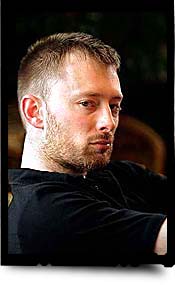
"I
function by dwelling on things that aren't normally discussed at the dinner
table. They are the things I find stimulating." —THOM YORKE
GRAHAM
BARCLAY / For The Times |
OXFORD, England—There's something exhilarating about walking in the footsteps
of history, which is why the streets of this historic university town are
usually crowded with tourists. Oscar Wilde, Graham Greene, Lewis Carroll,
Roger Bacon and Shelley are among the hundreds of famous figures who studied
here.
As a teen, Radiohead's Thom Yorke was fascinated by the class differences
he observed—the students who came here to prepare for positions of power
and wealth, and the ordinary residents who most likely would never have
a chance at either.
"There was a massive gap between those inside the high walls and those
outside," Yorke, 32, says now. "I knew some people who went to university
and it was an incredible life of privilege. If they drank too much, someone
would come behind them and wipe their vomit from the floor.
"To the tourists, it looks like an idyllic little town, but there is so
much resentment that students are always getting beaten up. The class thing
has always been a bit of an agonizing point for me, and it is something
that has come out quite a lot on the last two records. The disheartening
thing is the gap seems to be growing."
Don't, however, expect political diatribes on Radiohead's albums. Yorke's
concerns are presented in lonely, haunting soundscapes that depend more
on delicate mood than words to express disillusionment and helplessness.
At its most fragile, the music approximates the beeps and squeaks of an
intensive care unit's monitoring devices.
The quintet's 1997 album, "OK Computer," was such a strikingly original
work that taste-makers began talking of Radiohead as the group that would
finally wrest the title of best rock band in the world away from U2.
But since "OK Computer," the only thing this stylish and demanding group
has generated more than acclaim is confusion.
Most commonly, bands are willing to do anything for maximum sales—from
sticking with a successful musical formula to putting so much pressure
on themselves by constant touring and promotional activities that they
self-destruct. That's the story shown night after night on VH1's "Behind
the Music."
But Radiohead's story is one of self-preservation. By focusing on the music
rather than sales, Radiohead not only has won respect, but Yorke—the band's
de facto leader— has also come out of the process with a renewed optimism
about the band's future. Yorke summarizes his position of power in the
group colorfully—and accurately—when he says, "We operate like the U.N.
and I'm America."
Rather than continue in the accessible path of "OK Computer," which sold
nearly 5 million copies worldwide, Radiohead shifted direction dramatically
on its follow-up album, last year's "Kid A."
Gone were traditional verse-chorus-verse song structures and the band's
guitar-dominated sound. Lyrics were mostly disjointed references. The album
relied chiefly on esoteric sounds from computers and other devices employed
by the electronica movement.
When the band didn't tour extensively or release videos in support of the
album, the assumption in the rock world was that "Kid A" was a deliberate
career sidestep, part of a cooling-off process to bring things back to
normal after the pressures and expectations generated by "OK Computer."
That's what Bruce Springsteen did in the '80s by releasing the stark, brooding
"Nebraska" after the commercial explosion of "The River," and it's what
U2 did to a lesser degree with "Achtung Baby!" in the '90s after the superstardom
of "The Joshua Tree."
Respect for Radiohead was so great that "Kid A" entered the U.S. chart
at No. 1, but the word of mouth (and lack of radio airplay) soon slowed
sales. Its U.S. total was about 840,000, compared with 1.4 million for
"OK Computer." Critics, however, mostly continued to talk about Radiohead
in glowing terms. Spin named "Kid A" album of the year, declaring it "the
most emotive down tempo electronica ever."
Those Radiohead fans who found "Kid A" too distant turned their thoughts
to the group's next album, hoping for a return to a more commercial and
accessible path—just as Springsteen followed "Nebraska" with "Born in the
U.S.A" and U2 returned to its familiar sound with last year's "All That
You Can't Leave Behind."
The surprise in the new Radiohead album, "Amnesiac," which arrives in stores
Tuesday, is that it's as esoteric and electronica-driven as "Kid A."
To outsiders ready to anoint Radiohead, the question is: Don't they want
to be No. 1?
The answer is no—at least, not at any cost.
"The big fright after 'OK Computer' was that I didn't feel love for what
we were doing anymore musically," he finally says. "If we had kept on the
path of 'OK Computer,' it would have just been to satisfy others. I was
totally burned out. I couldn't have done it. I went around for over a year
with this creative block that was so bad I felt like I was dead.
"I think a lot of people think the last two albums were a sort of tokenism
that we were just dabbling in a new style or trying to piss everybody off.
But these records are the result of a desperate attempt to keep the band
together—and we've done that. Everybody wants to be loved, but there are
lots of things more important than being No. 1—starting with your sanity."
The Oxford tourist information center tempts you with all sorts of walking
and bus tours, but there isn't any rock 'n' roll itinerary—yet.
On a recent weekday morning, young fans at the Virgin Records store in
the center of town said people are always asking about Radiohead, whose
other members are brothers Colin and Jonny Greenwood (bass and guitar,
respectively), Ed O'Brien (guitar) and Phil Selway (drums). They all grew
up here and maintain ties.
A few lucky fans might even spot various band members ducking into stores
on the town's busy pedestrian shopping street.
One favorite stop for visitors is the Jericho Tavern, where the band—then
known as On a Friday—played its earliest shows in the late '80s. Although
the building still stands, it is under new ownership and has little of
the feel of the old days.
The most likely place to find Radiohead—named after a Talking Heads song—is
the band's management company, located in a nondescript office complex
in a village on the edge of town—not that anyone thinks they'd be lucky
enough to find Yorke.
The band's lead singer and primary songwriter has evolved into one of rock's
most celebrated recluses.
In the sarcastically titled "Meeting People Is Easy," a documentary about
Radiohead made during the "OK Computer" concert tour, Yorke was shown as
a shell-shocked musician whose life had been sucked from him by the endless
interviews and other demands on the group.
He was still so fragile by the time of the "Kid A" release that he left
the interviews to other band members. When he did comment, he frequently
did so by e-mail.
"It was horrible for a while watching the misery that he was going through,"
the band's co-manager, Chris Hufford, says. "It was a misery that was self-inflicted,
part of the classic English disease. At the same time you are enjoying
all the praise and attention, you feel you don't deserve it and that you
should be doing a million times better."
Even on the 50-minute train ride here from London, you half expect to confront
a last-minute change of plans when you arrive. But Yorke not only shows
up at the management office on time, but also suggests taking some chairs
outside so he can sit in a public courtyard. It's a rare sunny day in Oxford,
and his disposition matches the weather.
For all the brooding intensity of his music, Yorke is down to earth and
agreeable. He dresses casually and goes into the office to refill his teacup
rather than asking a staff member to bring it to him. Like his friend Michael
Stipe of R.E.M., he has a winning smile and is quick to make fun of his
own obsessiveness. He is proud of Radiohead's accomplishments but seems
to view all the acclaim with genuine suspicion.
One reason for his good cheer these days is that Yorke's first child, Noah,
was born in February. The youngster has helped make his dad less obsessive.
"It's a joy," Yorke says, sipping his tea. "There was a time when I was
working all the time and I thought it was all worthless, just endless tapes
and computers filled with crap. My partner, Rachel, would say, 'Do something
else. . . . Paint, go for a walk, anything that's not work for a day.'
"But it was hard to break my habits until now. Since Noah has come along,
it's like, 'I've got 20 minutes to do a drum edit. Let's get it done.'
"
When asked about the changes in Yorke, co-manager Hufford responds, "Having
a son definitely helped, but making the last two records also helped .
. . .To go through so many self-doubts and come out with music he loved
and realizing the band has a future."
No one will ever mistake Thomas E. Yorke for Alfred E. Neuman, the "What,
me worry?" cover boy of Mad magazine.
For as long as Yorke can remember, he has worried.
"I function by dwelling on things that aren't normally discussed at the
dinner table," Yorke says. "They are the things I find stimulating."
Over the course of two hours, Yorke frets about everything from human cruelty
(born with his left eye paralyzed, he was teased mercilessly at various
times during his early school years) to the dangers of airplanes (not fear
of a crash, but of the harmful effects of recycled air).
That's not to say he's a whiner or a malcontent rocker who is fashionably
unhappy about the way life has treated him. Yorke comes from a solidly
middle-class family, studied English literature and art at Exeter College
(he's not one of the Oxford elite), and is an avid reader. (The other four
members of Radiohead also went to colleges outside of Oxford.)
When he talks about social injustice, he is liable to quote linguist and
political theorist Noam Chomsky. Yorke was part of the rock contingent
supporting the Jubilee 2000 crusade to encourage Western powers to forgive
billions of dollars in debt owed by the world's poorest countries.
Given his interest in international politics, it doesn't take him long
to zero in on President Bush.
"I wonder if most Americans know that the rest of the world is laughing
at them over electing Bush—or maybe I should say, they would be laughing
if it wasn't so serious," he says. "I think the people in Britain will
stop laughing if [Prime Minister] Tony Blair actually agrees to this Star
Wars thing.
"Bush reminds me of the character from the film 'Being There,' Chauncy
Gardner, the guy who had no real opinions but seemed to be giving people
what they wanted. That's the man we have leading the free world—and you
wonder why I worry?"
Mostly, though, Yorke worries about his music.
In the early days of Radiohead he worried that no one outside Oxford would
pay attention to his group. A few bands, notably Ride, came out of this
area, but none developed a global following.
After the band did have an international hit in 1993 with the single "Creep,"
he worried that Radiohead would be dismissed as a one-hit wonder.
Yorke wrote the song one night during his college days when he was drunk
and feeling sorry for himself. He meant such self-deprecating lines as
"I wish I was special/But I'm a creep, I'm a weirdo" to be melodramatic
and a bit humorous.
When recording "Creep," however, he identified with the underlying issue
of low self-esteem and he sang with fierce conviction. The song became
huge in America, though it was widely ridiculed by critics who felt it
was a blatant attempt to come up with a slacker anthem.
Intent on proving his worth, Yorke and Radiohead fought back with "The
Bends," a 1995 album that began to eat away at the skepticism in England.
But it was "OK Computer" that turned the band into a sensation.
Stipe and U2's Bono became the band's champions. Radiohead, suddenly fashionable,
was now a celebrity favorite. For what it's worth, Brad Pitt has described
Radiohead as "the Kafka and the Beckett of our generation."
In a readers' poll last year by Q magazine, roughly the English equivalent
of Rolling Stone, "OK Computer" was voted the second-best British rock
album ever, behind only the Beatles' "Revolver." Describing the impact
of "OK Computer," Q wrote, "Aside from being a tremendously stimulating
and evocative listen, [the album] was an encapsulation of what it's like
to feel terrified by the times . . . .A work of infinite anguish . . .
[that ranks with] all the apocalyptic classics in the rock 'n' roll pantheon."
The 'OK Computer" experience was exhilarating at first, but all this praise—and
the looming expectations for the next album—troubled Yorke, who worried
that the music wasn't as groundbreaking or profound as critics claimed.
He also feared he would become a parody of himself if the band stayed on
the same musical path.
He had seen U2 change directions dramatically in "Achtung Baby!' and 1993's
"Zooropa," and he wanted to explore his own interests. One private passion
was electronic music that relied on exotic, unusual sounds—experimental
rock bands such as Can, a German band best known for the work it did in
the '70s, and such British dance-world innovators as Aphex Twin and Autechre.
Yorke felt dance music was where the real creativity was taking place in
pop. He and other band members also listened to such innovative jazz figures
as Charles Mingus and Miles Davis.
"I know bands do [repeat themselves] and they sell loads of records, but
we couldn't do it," he says when asked about the band's musical shift.
"To me, it seems a little bit sad and pathetic to just rely on a guitar
and a voice forever more, which is the easiest way to connect with an audience."
The difficulty was getting others in the group to share his vision.
After several months off following the "OK Computer" tour, Radiohead regrouped
near the end of 1998 to begin thinking about the new album.
There was some sentiment in the band to move toward a more classic pop-rock
sound, one that took advantage of Greenwood and O'Brien's guitar wizardry
and the group's feel for melody. But Yorke wanted to head in the opposite
direction. Rather than rely on melody, he wanted rhythm—the more exotic
the better.
"To me, electronic music is the new folk music 'cause it's that easy to
use and generate," he explains. "I find the noises I can get out of my
laptop and all the gear that we've got in the studio far more stimulating
than [conventional] rock instrumentation."
But the transition wasn't easy. They spent several months moving among
four studios, trying to put together music relying on synthesizers and
other tools of the electronica movement.
Radiohead ended up with some two dozen tracks. Yorke says the "Kid A" material
"chose itself quite easily and 'Amnesiac' was kind of what was left. I
know that sounds bizarre because a lot of people say the new album is more
coherent or more conceptualized than 'Kid A.'
"But I do think they have their own identities. Something [traumatic] is
happening in 'Kid A' and this is looking back at it, trying to piece together
what has happened. Go back and listen to 'Kid A' after listening to 'Amnesiac'
and I think you'll hear it."
There are lines in some "Amnesia" songs including the "Get off my case"
chant in "Packt Like Sardines in a Crushd Tin Box"—that could be taken
as a reaction against all the scrutiny of the band, but Yorke warns against
such an interpretation.
"Most of the lyrics are taken from things I saw on television or from conversations
I overhear on buses," he says. "That was far more interesting and personal
to me than trying to mine my own experiences.
"I think that is one of the reasons people get into electronic music. It
takes some of the emphasis off personalities and linear thinking. But there
is a side of me that enjoys being at a microphone, so we are trying to
find a midpoint between the worlds of rock and electronica."
Andrew Slater, new president and CEO of Capitol Records, is thrilled with
"Amnesiac," but he acknowledges that it will present a marketing challenge.
Capitol does have some tools. This time the band will do videos and is
planning an extensive U.S. tour, which starts June 18 in Houston. The four-week
trek includes stops June 29-30 at the Santa Barbara Bowl and a still unannounced
Los Angeles show to follow.
And the album has some tracks that might be more easily accepted by radio
than the "Kid A" material. Chief among them: "I Might Be Wrong," a tense,
bluesy exercise that carries a sense of danger and uncertainty, and the
lovely, ethereal "Pyramid Song," which has a trace of "OK Computer's" melodic
feel. But the music still may be considered distant by fans who prefer
a strong sense of melody and a clear message.
"There is such respect for the band that I feel there is the same kind
of excitement around a new Radiohead record that there was a Prince or
a Bob Dylan or a U2 record," Slater said. "That means there will be a large
audience that will find this record."
Whatever happens in the music marketplace, Radiohead will probably walk
away from the last three years of musical examination with its future bright.
The U.S. shows announced so far have been instant sellouts.
But the fervor of the pop world seems far away in the relative quiet of
Oxford, which is one reason Yorke continues to live here.
It's late afternoon and the sun has been chased away by clouds and a light
shower. But Yorke's mood remains bright. "I haven't felt this good since
I was 16 and we were first getting on stage at the Jericho Tavern," he
says.
Finally though, he looks at his watch and brings the interview to a close.
He's due home—something apparently to do with Noah—and he excuses himself.
He's worried about being late.
Radiohead
plays June 29-30 at the Santa Barbara Bowl, 1122 N. Milpas St., Santa Barbara,
6:30 p.m. Sold out. (805) 962-7411.
Di
Robert Hilburn
03/06/2001
|
 IL
FAN CLUB ITALIANO DEI RADIOHEAD
IL
FAN CLUB ITALIANO DEI RADIOHEAD
 Per
favore sostieni
Per
favore sostieni





 [Copyright
© 2000]
[Copyright
© 2000]