Radiohead:
Making Records Is Easy
Thom
Yorke talks! Radiohead's elusive founder discusses his band's twin record
releases, its many imitators, and the best advice Bono ever gave him.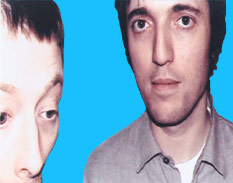
In
the aftermath of the critical and commercial success enjoyed by Radiohead's
1997 album, OK Computer, the landscape for mainstream rock changed.
Major labels went hunting for the "new Radiohead," and mainstream figureheads
like R.E.M.'s Michael Stipe and U2's Bono figuratively passed the torch
by praising the British quintet's innovations: a bold merger of anthemic
arena rock, skewed tunefulness, thoughtful introspection, and luminous
atmosphere.
Then
a funny thing happened on the way to their coronation. Radiohead had twins:
Kid
A, released last fall, and the just-released Amnesiac. Together,
they represent a full-blown detour into the avant-garde side of the rock
spectrum from a band supposedly on the brink of mainstream superstardom.
Instead of anthems, Kid A and Amnesiac offer disquieting
lullabies. Instead of Thom Yorke in full roar, they present Yorke sounding
adrift in space, if not muted entirely. And instead of ringing guitars,
they brim with computer-generated sounds.
These
are entrancing, otherworldly albums that find Radiohead expanding on the
most radical elements of OK Computer rather than the most instantly
accessible. Think these albums represent just a blip in Radiohead's development,
rather than a blueprint for its future? Guess again, says singer Thom Yorke
in an e-mail interview.
CDNOW:
Some of your bandmates say you initially wanted to release the material
that eventually ended up as Kid A and Amnesiac as a double
album. What persuaded you to change your mind? Do you feel in retrospect
this was the correct decision?
Thom
Yorke: Do you? Imagine the shit we would have got. They are separate
because they cannot run in a straight line with each other. They cancel
each other out as overall finished things. Originally we thought about
making them EPs, but that would have been a cop-out. They come from two
different places, I think. And I don't worry about things in retrospect
much anymore. You can listen to them together, but they are separate, although
they do fit very well on either side of a C100 cassette. In some weird
way I think Amnesiac gives another take on Kid A, a form
of explanation.
You
have guitarists in the band not playing guitar on these two albums. You
have members of the band not playing anything at all on certain tracks.
How well did the band adapt to this way of working? Are you all on one
page in terms of how far to push the envelope, what kind of band Radiohead
is, and what it should sound like?
There
is a restriction about people defending their own musical patch, which
just gets a bit daft after a while. It wasn't really the point. I think
everybody was surprisingly cool with not being involved necessarily directly
in certain tracks. It was a bit boring at points, however -- staring at
laptops all day is only so rewarding. But it was quite liberating to get
used to the idea of music on a screen.
Being
in a band is also about having/sharing ideas, especially now that there
is so much instrument changing going. If everybody is into it, if everybody
likes what's happening musically, then they don't give a shit. The trick
is letting someone pursue an idea without stepping over it too early --
that's the hard bit. I felt very strongly that if we wanted to pick up
different styles, go completely electronic, whatever, that it is all still
us, otherwise you are pandering to the nice little stylistic boxes, to
this tribe or that tribe.
Bono
says U2 has "reapplied for the job of the greatest rock band in the world."
For U2, being a rock band and being part of the rock tradition is important.
How important is that to Radiohead? Do you still consider Radiohead part
of the family of rock bands, past and present? And if so, is it important
for Radiohead to be part of a larger dialogue with other bands -- raising
the stakes, pushing the art form, and, in turn, being pushed by each other
to outdo yourself with each album?
All
of that stuff is not interesting to us. Bono said to me, I'll be on the
corner of the bar singing quietly into the mike, while he's belting it
out demanding your attention -- that's right I think. I'm not sure we are
in a rock band anymore, and competition between bands is a bit destructive
sometimes, re: the Suede-Blur-Oasis Britpop scene a few years ago. We tried
to stay the fuck away from any of that. It doesn't seem to matter much
anymore.
We
were influenced so much by [pioneering German electronic bands] Can and
Kraftwerk, and Faust, and [avant-garde classical composers Olivier] Messian
and [Krzysztof] Penderecki, and the 13th Floor Elevators, and all this
electronic malarkey, it is difficult to still justify just being a rock
band, and that's it. I think toleration and absolutely no musical or technological
restriction is going to change the way we feel about music. Laptops are
the new electric guitar, I reckon, but I still love electric guitars, and
drums, and singing ... And I don't disown our old stuff at all.
Family?
An interesting choice of words. Both U2 and R.E.M. are cool and generous,
and have been absolutely supportive of us, and we are very grateful, very,
very, very, very lucky.
A
number of so-called Radiohead "imitators" crept up in the last few years
in the wake of OK Computer. How big a factor was that in the radical
new direction taken by Kid A? Do you feel proud or dismayed by the
fact that other bands are so obviously influenced by your sound and trying
to make their own version of it?
This
question makes me feel ill. A&R departments all around the world went
on a feeding frenzy for months circa 1998-99, as Colin [Greenwood, Radiohead's
bassist] puts it, and perhaps now we are witnessing the results. We, however,
have moved on.
Amnesiac
and Kid A were both widely available on the Web weeks before they
were released. Has this helped or hindered the band?
Over
Kid
A there was too much paranoia about it being out before we wanted.
That was a mistake that made us look precious. This time we tried to be
chilled about it. The best bit for Napster for us is all the live bootlegs,
people singing along to stuff at gigs that is not even out yet only because
we have played it live. Stuff we haven't even recorded yet. Home taping
is killing music?
Many
listeners perceived Kid A as a "radical new direction for the band,"
and there were rumors that you put it out because Amnesiac would
be a more pop-oriented record closer in spirit to OK Computer. Do
you agree?
No,
I really don't. I think Amnesiac explains that it was not necessarily
such a radical step. I think it was as simple as disappearing for three
years and moving on. There is stuff on both records that to me, represents
no departure at all, but just survived because it was too good to miss,
like "Knives Out." There are straight-ahead tracks on both records. I enjoyed
having Amnesiac to myself for so long. But I don't think it's any
more accessible. If we'd released Amnesiac first, I think the same
sort of reactions would have occurred. I don't think Kid A is so
experimental; I think we're just getting warmed up.
Di
Greg Kot
08/06/2001
|
 IL
FAN CLUB ITALIANO DEI RADIOHEAD
IL
FAN CLUB ITALIANO DEI RADIOHEAD
 Per
favore sostieni
Per
favore sostieni





 [Copyright
© 2000]
[Copyright
© 2000]