|
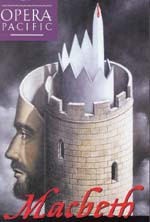
It is with a sense of apprehension that I drove 45 miles to attend the first performance of Verdi's Macbeth in Orange County, Costa Mesa, home of Opera Pacific (I don't know why they would call an opera company "Pacific" named after an ocean. Sounds fishy). Anyway, the last great Macbeth that I attended was at the Metropolitan in New York many moons ago with the memorable Leonard Warren and Company. Unfortunately for us, the great ones "sono tutti morti."
And so we have to contend ourselves to go to the opera and hear and see a facsimile of a carbon copy of a sketch of a great musical masterpiece. The very casual conducting of Mr. DeMain (the conductor and also the Music Director of Opera Pacific), in the preludio sets the tone for the whole opera, and as one tries to see and hear, there is no Verdi to be found anywhere. In the program booklet DeMain writes that he wants to celebrate the centennial of Verdi's death, but you don't have to kill one of Verdi's masterpieces in doing so. You cannot round up some musicians and expect them to play Verdi's music. Nor can you pick up a few singers here, some singers there, and a chorus devoid of any feelings and understandings for Verdi's music, a soprano (Lady Macbeth), who seems to confuse being dramatic with screaming, lays on her back on a queen-size bed, spread-eagle style, while trying to arouse herself erotically (What the hell does a porno show have to do with the Shakespearean-Verdi's Macbeth?), and a baritone (Macbeth) with whom we don't know what he really sounds like without the help of the microphones all over the stage. A critic from the Los Angeles Times stated, in his review of the show, that this particular fellow Macbeth is one of the few Verdian baritones.... MAMMA MIA! I wonder what the rest sound like. Pick up some props on sale and some costumes worthy of a Hollywood Boulevard costume shop, package all together, with all the benefactors' names and pictures on the program pages, and you, Opera Pacific, have managed to transform a masterpiece into a "Minestrone." Like the song says, maybe next time. - Publius Ovidius Nasonem - 
|