 |
|
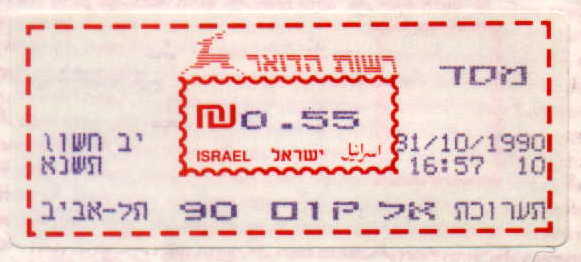
Figure 1: Commercial Mail Meter |
 |
|
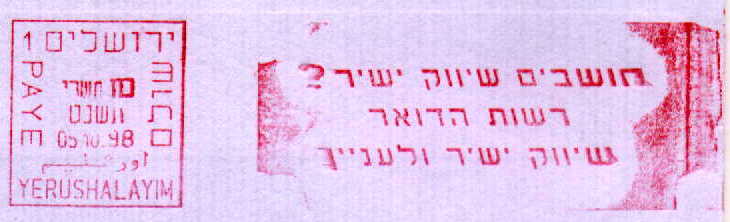
Figure 2: Bulk Mail Meter |
In late 1991, as part of the computerization process of the Postal Offices, counter meter machines were introduced for the first time. This was the advent of a new philatelic item, and a new form for franking letters and packages: the Computer Vended Postage Label. The label, received its popular name from the Hebrew initials of the technology project “Mihshuv Snifey Doar” (in Hebrew: “Computerization of Postal Offices”), or in Hebrew short-form: “Massad”. The following paragraphs will summarize, in a chronological sequence, over a decade of presence in the Israeli Postal landscape, listing the various issues, types, printing phenomena and various uses of the Massad Labels.
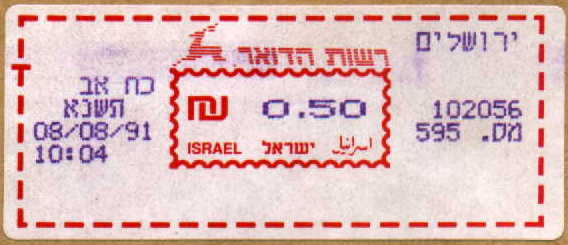
Until 1990 the only forms of metered franking known in Israel were commercial-mail franking (Figure 1) and bulk-mail franking (Figure 2). The metered franking was performed directly on the envelope. However, these forms of franking were restricted in use: the former was available only for commercial uses by companies and establishments using special equipment, and the latter was not available for postings of individual letters.
In the 1980s, the Philatelic World saw the introduction of a new form of metered franking: printing of the “meter postmark” on a self-adhesive label. The pioneers of this form of postal franking were the French. The Israeli Philatelists waited an additional decade, for a similar postal item.
Figure 1: Commercial Mail Meter
Figure 2: Bulk Mail Meter
The "El-Com 90" Demonstration
During the “El Com 90” Telecommunications Exhibition, held in Tel-Aviv in October 1990, the Postal Authority demonstrated, for the first time, new technology for distribution of self-adhesive over-the-counter metered franking labels. Visitors at the exhibition could obtain samples of new label which was imprinted with the date and time, the tariff, the label sequence number, a “Massad” inscription at the top right corner, and an indication in Hebrew of where the label was produced: “El Com 90 Exhibition, Tel-Aviv” (Figure 3). To date only a few of these labels have been recorded in collections. A few were also used for actual postage (see image of serial no. 12 in [1], pg. 346). These items can be considered the proofs of the First Definitive Issue that followed a year later, and are extremely rare.
|
|
|
Figure 3: "El-Com 90" Demonstration Massad Label |
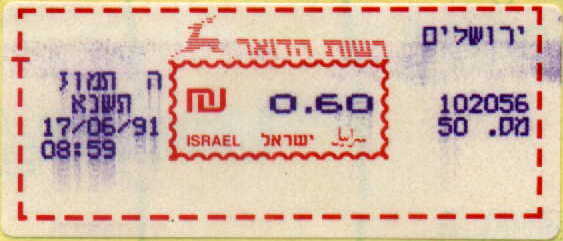
Public notice no. 59/91 dated June 3rd 1991, announced the introduction of a new service, as part of the computerization of the post office branches. According to the announcement “…New software will allow dispensing of postage labels. These labels will be used primarily for franking of postal items (letters, and packages) presented for postage at the counter”. The new software was to begin a trial service at the Beit-Hakerem Postal Office in Jerusalem on June 17th. There was no mention of an official end date for the trial service. Many collectors, as well as official publications, referenced this issue as the “Experimental Issue” (e.g. Bale Catalogue), due to the fact that these labels were available for a limited time trial period, and only at one location. The official catalogue of the Israeli Postal Authority (no. 13) lists this item as the “First Definitive Issue”, with an end of sale date of 22.July.91. According to [2], the labels were withdrawn due to “legal reasons” (latest reported date – 11.July.91). These reasons were non-conformance with UPU regulations (article 196): lack of the words “postage paid” and the fact that the place of origin was not imprinted in Roman letters. However, labels produced after this date, which were mailed in response to a collector’s mail order, are known to exits (Figure 4). Hence the correct last known date is 8.Aug.91.
|
|
|
Figure 4: Last known date - 8 Aug. 91 |
Three machines operated during the trial service. Different from the case of the “El-Com” Demonstration label (which had no machine identification imprint), the “Beit-Hakerem” labels had the machine ID numbers imprinted on the right side of the labels. These were: 102030 (Figure 5), 102048 and 102056. The other predominate change to the printing format was moving the date and time from the left side of the label to the right side.
During the process of studying the dates and times of printing of these labels, an interesting philatelic phenomenon was revealed, related to the actual date and time of printing of the “Day-of-Issue” labels, as described in the following paragraphs.
The first observation is the fact that there are labels that the imprinted time of production is very late at the night of June 17th (21:02-22:55, Figures 6-8).
 |
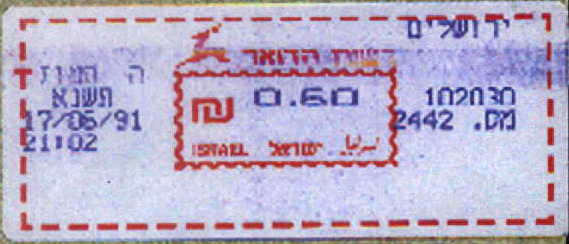 |
| Figure 5: "First Day" Label | Figure 6: June 17th "Late Night" |
 |
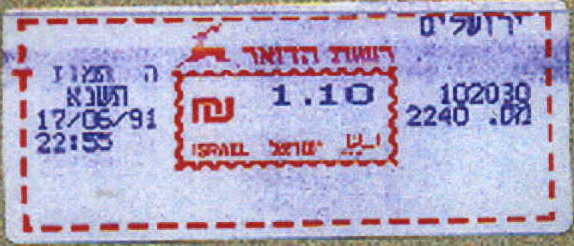 |
| Figure 7: June 17th "Late Night" - Serial number of label is lower than the serial number of one with an earlier time imprint | Figure 8: June 17th "Late Night" - Serial number of label is relatively higher than the previous one (Figure 7) but still lower than the first (Figure 6) |
The second observation is that the serial number of the imprinted stamp doesn’t correlate with the chronological order of the printing. Samples from machine 102030 show that at 21:02 label no. 2443 was printed (Figure 6), at 22:10 the number goes down (!) to 2004 (Figure 7), and at 22:55 back up again to 2241 (Figure 8). This phenomenon was observed on printings from the 102056 machine as well.
The third observation comes from the examination of labels originating from Dr. Joseph Wallach's stock. Labels from the 102048 machine were found that had an imprinted date of 18.Jun.91, i.e. the second day of service, with a time imprint from the afternoon hours (No. 1780 at 16:34). According to Dr. Wallach, he didn’t explicitly request in his mail order, labels from the second day!
Summarizing the above observations it seems that the production of Massad labels at the Beit Hakerem Branch continued till late at night of the first day, followed by some additional production on the afternoon of the following day. But does that make sense? This is very strange, as it seems unlikely that the postal clerks would have stayed extra-hours till late at night, to catch-up on loads of work created by enthusiastic collectors and dealers. The author wishes to present the theory that part of the production of the “Day-of-Issue” labels was conducted on the morning of the second day (Tuesday, June 18th). The “Day-of-Printing”, which probably could be configured manually in the system software, was left initially on the previous date (June 17th) during the morning hours, and changed later during the day (by someone unaware to the philatelic consequence!) to the current date (June 18th). The fact that the serial numbers from “late-night June 17th” don’t match the chronological order , and that the labels observed from June 18th have a very high serial number, indicate that the software control of the production counter was not controlled by the software date parameter and the machine clock. There is high likelihood that someone was playing with the software settings, but we can't rule out, a lower likelihood option, that the system had a software bug! Collectors who have Beit Hakerem labels in their collections and who can assist in verifying or dismissing this theory, are invited to write to the author at the address below.
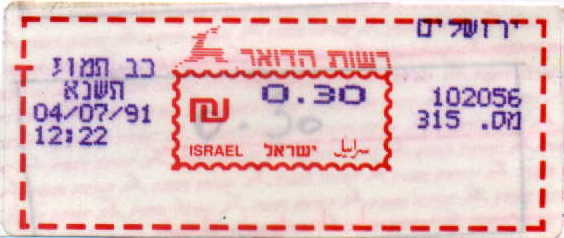
The “Beit-Hakerem” labels have two interesting production varieties. The first is the existence (or lack-of) the “T” on the left-hand edge (Figures 9 & 10). Actually, this is not a “T” but a horizontal bar marked to provide the postal clerk with a reference for placing the label in the machine, such that the imprinted values will appear in the center of the label. The known varieties are summarized below:
 |
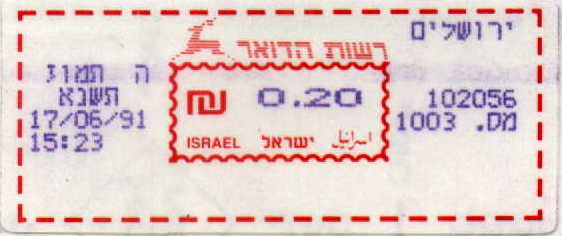 |
| Figure 9: With "T"; Exists from machines 102030, 102048, 102056 | Figure 10: Without "T"; Exists from machines 102048, 102056 |
The second production variety is the color of the paper to which the adhesive labels were attached. The adhesive labels came in sheets, which were manually cut to the format of strips of 10 labels. There are two known colors of the background sheet – yellow and white (Figures 11 & 12). Printings from all three machines exist on both yellow and white background, as depicted in the table below. However, the without “T” variety has been observed, thus far, only on white background.
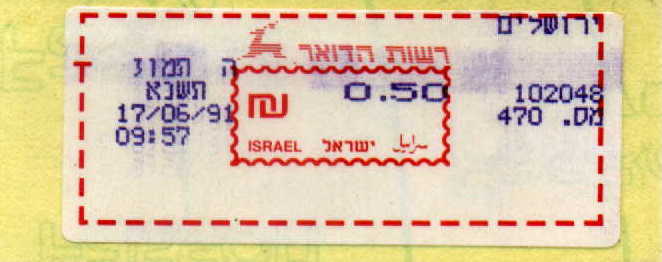 |
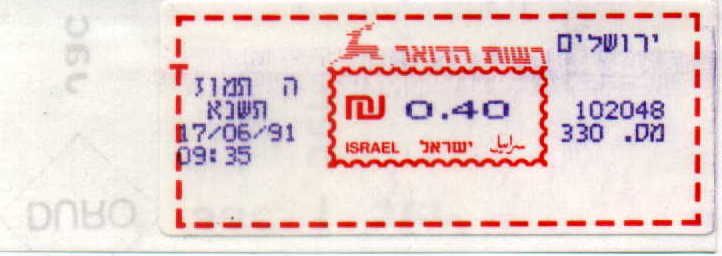 |
|
Figure 11: Yellow Background |
Figure 12: White background |
Following withdrawal of the trial label above, a new label was designed [2]. This label was smaller in size (63mm x 22mm), but had the addition of the words “Postage Fare Paid” (in Hebrew). It represents a format that potentially resolved the incompatibility with UPU regulations (referenced earlier). This label was not put into use, and exists only in proof form (Figure 13). As it bears closer resemblance to the “Beit-Hakerem” label it is included in this report, as a conclusion of the “Beit Hakerem” story.
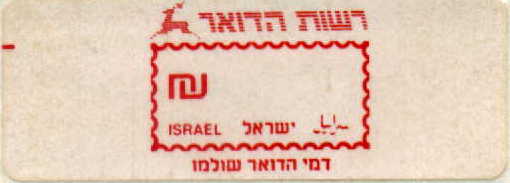 |
| Figure 13: Proof of redesigned Massad Label |
The author invites correspondence at: Evyatar Chelouche, P.O.Box 67, Reut 71908 Israel.
References
[1] Z. Shimoni, HLPH no. 47, pg. 345-347
[2] N. Sharshevsky, HLPH no. 49-50, pg. 496-497