| CANARY ISLANDS |
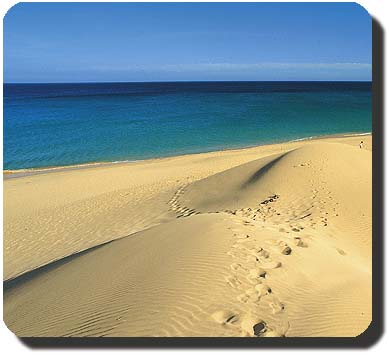
| This paradisiac group of islands, with a preferred subtropical climate and constant temperature through all the year, and splendid beaches of fine sand, consists of 7 larger islands (Gran Canaria, Fuerteventura, Lanzarote, Tenerife, La Palma, Gomera, Hierro) and a few smaller ones (Alegranza, Graciosa, Monta�a Clara, Roque del Este, Roque del Oeste and Lobos). Surprisingly, the landscape of each island is radically different to the others. Already Greeks and Romans reported on this archipelago of volcanic origins, and called it the Happy Islands, Garden of the Hesperides, Atlantida, Some historians suppose that the legendary continent Atlantis was located here. The islands original population, called Guanches, is tall and of white skin. In 1496 the islands became part of the Spanish Kingdom, a short period of time later the three ships of Christopher Columbus stopped here on their travel to discover the New World. |
| The Canary Islands are Spain's tropical paradise and for Spaniards living in mainland Spain they are synonymous with holidays, as they are for the hundreds and thousands of foreign tourists who pack the islands' resorts all year round. Colonized and populated by Spaniards, they lie 1,000 km off the coast of Africa. They are politically and administratively Spanish and yet culturally and geographically they have very much their own personality. The Canaries today consist of seven islands divided, for administrative purposes, into two areas. The province of Las Palmas brings together the major island of Gran Canaria and the lesser ones of Lanzarote and Fuerteventura. The province of Santa Cruz de Tenerife encompasses Tenerife and its satellite islands of la Gomera. La Palma and El Hierro. Within the archipelago there is a variety so extreme that it is easiest to refer to it as a mini-continent. The isles share an eternal spring climate but they differ dramatically amongst each other. Exploring the Canaries you move from sub-tropical vegetation to volcanic semi-deserts, from verdant cliffs and gorges to sand dunes by the sea shore. One wonders to this day when and how the ancients learnt about this little paradise which Herodotus called the Garden of Hesperides, Homer the Elysian Fields and Pliny the Fortunate isles. Modern contact with the Canaries began to develop in the Middle Ages as sailors from peninsular Spain arrived to plunder the isles of their orchids, which were used to make dye, and of their inhabitants, who were enslaved. Conquest in earnest only began with the Norman adventurer Jean de Bethencourt who, in 1402 , claimed Lanzarote on behalf of his feudal lord. Henry III of Castile. In 1483, during the region of the Catholic Monarchs, Pedro de Vera established a base in Gran Canaria and in 1496 Alonso Fen�ndez de Lugo won control of Tenerife. From then on colonization started in earnest. The original inhabitants of the Canaries were a race known as the Guanches, a name derived from guan, meaning man or people, and achinch, meaning white mountain in an obvious reference to Tenerife's snow-capped volcano Mount Teide. The natives lived a Stone Age existence of shepherding and very rudimentary agriculture. They buried their dead and, in the case of chieftains, mummified the, much like the ancient Egyptians. In Tenerife, Bencome, the Mencey or leader of the tribe, fiercely resisted the conquistadors with his flint exes and slings, while in Gran Canaria the ruling Guanarteme. Semidan, welcomed the European strangers and established truces. The isles began to realize their potential for the Crown of Castile as the links developed with the New World. Right at the beginning of that awesome period Christopher Columbus, on his first voyage, rested at La Gomera before venturing into the unknown, westwards in search of the Indies. Before long the Canaies were to become the vital link in transatlantic crossings, a stepping stone between Europe, Africa and the American continent. Last century, as trade and travel increased, the first hotels began to open in Tenerife. Since then commerce and leisure have spread and never ceased developing throughout the archipelago which still retains the paradisiacal qualities that earned it such poetic appellations so many centuries ago. |
 |
 |
 |
| E-mail: [email protected] |
| For further informations please call: tel. +34-922-280525 we provide accomodations in Hotels, Apartments, Aparthotels, Residences, Bungalows, Villas, Rural Homes, House Boats. We provide also Cars for hire ( more than 7.000 vehicles ) |