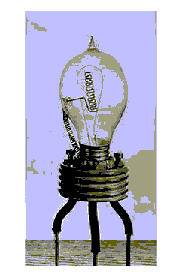
Vacuum tube is basically composed of cathode, anode, one or more grids and the heater or filament. These elements or electrodes are enclosed in a glass envelope with no air inside or with the addition of a special gas to enhance the operation of a particular tube. The elements are connected with metal pins via its plastic/ceramic or phenol base to the outside to act as terminals or connectors. See picture as shown.
A heater heats the cathode element such that at certain temperature electrons from its hot surface is emitted. This is known as Thermionic Emission, the emission of free electron from a hot surface. This is the working/operating principle of all vacuum tubes. The cathode is also called the emitter and is self heated or directly heated
or heated by a separate heater or indirectly heated one (See figure A-1). The cathode must be applied or biased with a negative potential for normal operation.
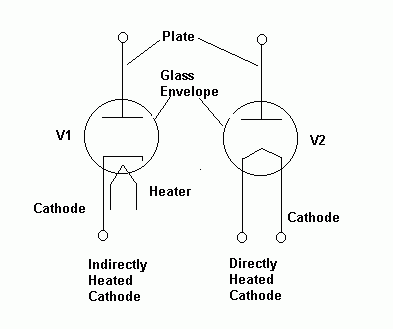
The anode element or the plate attracts or collect the emitted electrons of the cathode, hence, for normal operation the plate is positively biased or applied with a positive potential. Electron flow is established in a vacuum tube through its cathode and anode. In this case the vacuum tube process and passes current to other devices in an electronic system.
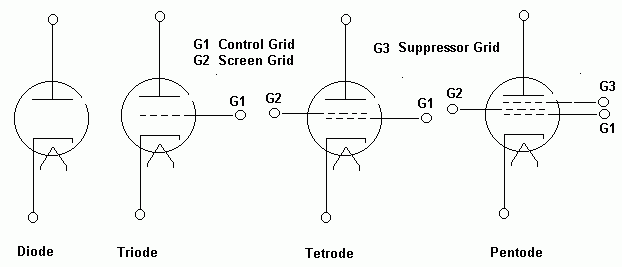
The grids are elements of the vacuum tube that have a number of functions. The control grid is used to control the flow of electrons from cathode to anode, the screen grid is used to minimize the effect of inter-electrode capacitance between the elements of the tube, and the suppressor grid is used to lessen the effect of secondary emission. Secondary emission is the emission of free electrons from the plate due the effect of a positively biased screen grid.
The basic form or generic vacuum tube is the vacuum tube diode, where the major elements are only cathode and anode, then the triode, the tetrode and the pentode. The schematic symbol of each is shown below (See figure A-2). There are cases that two or more generic tube type is integrated in a single enclosure, such tube is known as multi-unit tube. There are also vacuum tubes with special functions, such as the cathode ray tube or CRT, industrial vacuum tubes, and microwave tubes.
Vacuum tubes are voltage-operated devices; require turn on time and bulky. In the advent of miniaturization, discreet or integrated semiconductor devices replaced vacuum tubes. Return