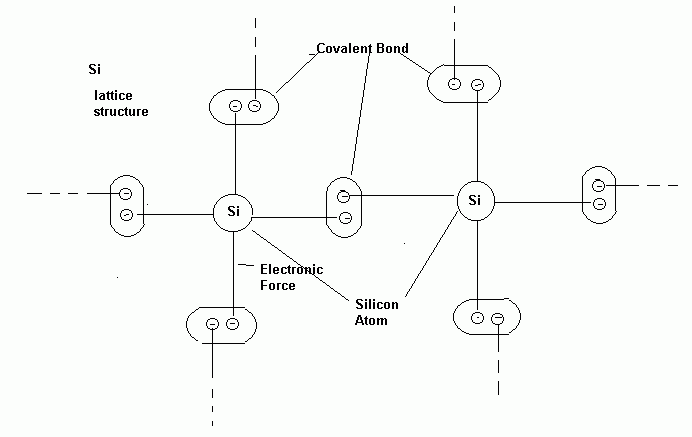
There are different methods producing a pure, or intrinsic, semiconductor. A pure Silicon crystal is formed by covalent bonding. A covalent bond is created by pairing the four valence electrons, or outer electrons of a Silicon atom (See Figure A-3).
At absolute temperature no free electrons exist in the conduction band of the Si atom, hence it is a perfect insulator. Exposing the crystal to higher temperature or light excite the valence electrons out of their bonds to become a free electrons, which are responsible for conduction. Empty spaces are left behind in the bond, which contribute also to the flow of electricity, the empty spaces are called holes and said to possess positive polarities. The bond which hole is created is called a dangling bond. (See figure A-4) There are now two kinds of current carriers in a semiconductor crystal, holes and free electrons. The magnitude of current in a pure/intrinsic semiconductor crystal is not enough for a purposeful application, so there is a need to increase its conductivity.